English
Views: 0 Author: Elsa Long Publish Time: 2026-11-09 Origin: Site


If you run a high-mix EMS line and you only read one paragraph, read this one. On the weights declared below, the top slot goes to the DEK TQ: ±17 µm wet print accuracy at 2 Cpk, a 5-second core cycle on a 400 × 400 mm print area, and enough consumable capacity to run eight hours unattended — the combination that survives a fine-pitch customer audit. The I.C.T-5151 takes second place and is the value answer: a 510 × 510 mm print area, ±0.025 mm print accuracy with ±0.01 mm repeat positioning, a sub-7-second core cycle and 2D inspection in the base configuration, for a fraction of the capital. If your recurring defect is release quality rather than speed, the MPM Momentum II Elite is third.
Everything below is ranked on one declared criterion: value for an EMS operation — changeover speed and flexibility 24%, print accuracy and repeatability 22%, service and spares 16%, inspection and data 15%, total cost of ownership 13%, line compatibility 10%. Weights and their reasoning are in the next section, and we say plainly where our own product sits in that ranking.

This guide was built from five independent research passes plus two separate passes dedicated to negative feedback, then reconciled rather than averaged. Primary sources were manufacturer specification pages and PDFs (ASMPT DEK, ITW EAE MPM, Yamaha, GKG), a Panasonic SPG2 catalogue dated 2022 that is still the current public document, ITW EAE's published product life-cycle policy, and practitioner threads on SMTnet. Where the passes disagreed, the text says so. Where nobody could source a number — market share above all — the number is absent, because every share figure we retrieved contradicted another from the same report family.
A captive factory prints one family of boards for years. Its printer is optimised once and then forgotten, and the purchase decision is essentially a precision decision. An EMS plant prints somebody else's boards every week, and the printer is the machine that decides whether Monday's schedule survives contact with Tuesday's engineering change. That difference rearranges the entire specification sheet: the number that matters most on a captive line (best-case wet print accuracy) is not the number that decides most EMS purchases (how long the machine sits idle between two products).
Three consequences follow, and they drive everything in this ranking.
Changeover is the real throughput metric. A printer that prints in five seconds but needs twenty minutes of stencil swap, support-pin rebuild, recipe recall and first-article check is slower across a week than a machine with an eight-second cycle and a nine-minute changeover. Field-reported full changeover on a mid-range automatic machine runs 10–18 minutes including first-article confirmation; vendors quote 3–5 minutes for the same event when the stencil is pre-staged and the first-article check is excluded. Both numbers are true, and neither is the number your production manager experiences.
Stencil logistics, not machine speed, constrains the schedule. New stencils typically arrive in 3–5 working days. On a line running eight to twelve product changeovers a week, that lead time is a planning constraint that no printer can fix, which is why the machines that win EMS work are the ones that tolerate late stencil arrivals and awkward panels rather than the ones with the fastest core cycle.
Downtime costs more than the machine. Published estimates put SMT line downtime at roughly USD 1,000–5,000 per hour for small and mid-sized EMS plants, higher for consumer-electronics volume lines; sources vary widely on this and the figure should be read as an order of magnitude. One week waiting for a part can consume the price gap between two machines, which is why service coverage carries more weight here than it does in a captive-factory comparison.
The ranking is an editorial judgement applied to a declared weighting, not a laboratory result, and it should be read that way. We scored each candidate on six dimensions, weighted them as stated in the opening, and then checked whether the resulting order survived a sanity test: would an experienced process engineer, told only the weights, arrive at roughly the same order? In two places the raw scores and the final order diverge, and both are noted in the relevant module.
Four rules governed inclusion:
In-line automatic stencil printers only. Semi-automatic, manual and benchtop machines are excluded by definition; they have no closed-loop vision alignment and no SMEMA handshake. If you are still deciding whether automation pays at all, the break-even is around four changeovers per shift, which is the subject of our automatic vs semi-automatic comparison.
Stencil printing only. Jet printers such as the Mycronic MY series form deposits without a stencil or squeegee. They are a legitimate technology and a different process; several market reports fold them into “stencil printer” share figures, which makes those figures unusable.
New machines, currently supported. Used and refurbished units are a real option for an EMS plant — a five-year-old platform can cost 50% of new — but mixing them into a new-machine ranking distorts both price and support comparisons.
A named service channel. White-label machines sold under several brands from the same trading account, with no parts channel and no process support, fail the downtime test in point three above regardless of their specification sheet.
One disclosure before the table: position 2 is our own machine. I.C.T manufactures it, this site sells it, and it did not appear in any of the five independent research passes, because a Dongguan-built printer does not surface in English-language buyer research the way a DEK or an MPM does. We did not put it first. The machine that wins on fine-pitch documentation is not ours, and claiming otherwise would cost you more than it costs us. It sits second on the declared weights, we tell you exactly which of its numbers are manufacturer-published rather than independently benchmarked, and positions 1 and 3 through 7 stand entirely on their own.
Machine | Standout spec | Best for | Watch out for |
|---|---|---|---|
TOP 1 ASMPT DEK TQ | ±17 µm wet print at 2 Cpk, 5 s core cycle, 8 hours unattended | Plants whose customers demand fine-pitch capability and an auditable Cpk history | 400 × 400 mm print area on TQ; larger boards need TQ L or TQ XL |
TOP 2 I.C.T-5151 | 510 × 510 mm print area, ±0.025 mm print, ±0.01 mm repeat, <7 s core cycle, 2D standard | High-mix EMS lines that need one machine to cover small boards and large panels | Brand recognition still being built in Western markets; specs are manufacturer-published |
TOP 3 ITW EAE MPM Momentum II Elite | ±11 µm alignment at 6σ, ±17 µm wet print, enclosed print head | Shops where release quality, not speed, is the recurring defect | Software upgrade stops 7 years after end of production |
TOP 4 Yamaha YRP10 / YSP20 | 5–10 s cycle, ±0.008–0.01 mm repeat, dual stencil front-to-back | Lines already built around Yamaha mounters and one data backbone | Heavy footprint and floor loading; the dual-stencil design raises stencil spend |
TOP 5 ASYS EKRA SERIO GenS | 5 s core cycle plus print time, ±12.5 µm, multi-board alignment up to 50 sub-boards per carrier | Sub-assembly, SiP and panelised work with many small boards per carrier | Carrier tooling becomes a hidden recurring cost; patchy local presence outside Central Europe |
TOP 6 Panasonic SPG | 6.5 s board exchange, ±5 µm repeat at 6σ, paperless cleaning option | Plants running NPM lines that want printer-to-SPI closed loop inside one software stack | Single lane; the vendor's own service contract is expensive and scheduled |
TOP 7 GKG G-Tera | 510 × 510 mm, ±8 µm machine alignment, 2-minute changeover | Cost-sensitive plants that still need panel-size flexibility | Historical software and cleaning-circuit complaints on older platforms; no published MTBF |
Machine | Print area (mm) | Wet print / alignment | Core cycle | Board thickness | Inspection in base machine |
|---|---|---|---|---|---|
DEK TQ / TQ L | 400 × 400 / 600 × 510 | ±17 µm at 2 Cpk / ±12.5 µm at >2.0 Cmk | 5 s / 6.5 s | Per configuration | HawkEye in-machine verification |
I.C.T-5151 | 510 × 510 | ±0.025 mm print / ±0.01 mm repeat (manufacturer) | <7 s | 0.4–6 mm (10–15 mm option) | 2D standard |
MPM Momentum II Elite | Up to 610 × 508 (100) | ±17 µm print / ±11 µm at 6σ | 6 s | Per configuration | 2D with SPI closed loop |
Yamaha YSP20 / YRP10 | 510 × 460 | ±0.01 mm / ±0.008 mm repeat at 6σ | 5 s / 10 s | Per configuration | Vendor SPI integration |
EKRA SERIO GenS / X5 | 508 × 508 | ±12.5 µm | 5 s + print / 10 s | Per configuration | 2D, SPI integration |
Panasonic SPG | 510 × 460 | Repeat ±5.0 µm at 6σ; no published wet print figure | 6.5 s board exchange | Per configuration | APC link to 3D SPI |
GKG G-Tera | 510 × 510 | ±8 µm alignment at Cpk≥2.0 / ±12.5 µm process | <8.5 s core, 12.5 s actual | Per configuration | SPI closed loop option |
Read this table with one rule: never compare a wet print figure with an alignment figure. The left-hand number in each accuracy cell describes the printed deposit after separation; the right-hand number describes stage position. They differ by design and by measurement method, and vendors quote the sigma and sample size that suit them. Cells marked “per configuration” are places where the manufacturer publishes board thickness only inside a configuration guide rather than on the product page — ask for it in writing if your assembly is carrier-loaded.

ASMPT's TQ is the machine the rest of this list is measured against, and it earns that position on two numbers that are genuinely hard to copy: ±17 µm wet print accuracy at 2 Cpk, and a 5-second core cycle on a 400 × 400 mm print area. A Cpk-qualified wet print figure is a different animal from a machine-alignment figure — it describes the printed deposit, after paste behaviour, squeegee dynamics and separation, not the stage position. Comparing a Cpk print number with a Cmk alignment number is the single most common error in printer comparisons, and it is why two machines can both claim “±12.5 µm” and behave nothing alike.
The TQ's most useful feature for an EMS plant is not the cycle time. It is the consumable budget behind it: a 22 m stencil wipe roll and 7 litres of cleaning solvent, sized so the machine can run an eight-hour shift without an operator refilling anything, with automatic support-pin placement from a 30- or 60-pin magazine. On a three-shift schedule that removes twelve interventions a week, and each intervention is a chance to introduce the alignment error you were trying to prevent. Off-belt printing, where the board is printed clear of the conveyor belt rather than on it, addresses the same class of defect from the other direction: less belt-induced coplanarity error at the board edge.
The trade is print area. TQ covers 400 × 400 mm. If your mix includes 500 mm panels you need TQ L at 600 × 510 mm and a 6.5-second cycle, or the NeoHorizon iX platform, where 03iX prints 510 × 508.5 mm at ±25 µm wet print and 01iX at ±20 µm — both looser than TQ's ±17 µm, which is worth knowing before someone quotes you a NeoHorizon as an upgrade. A TQ XL was announced at productronica 2025 for 850 × 610 mm boards; as of this writing ASMPT has not published a full specification sheet for it, so treat any accuracy figure you see for the XL as unconfirmed.
Three cases. First, single-machine shops with no redundancy: the TQ is a premium platform with premium spares, and a plant that cannot absorb a two-day parts wait is buying risk along with capability. Second, plants whose boards are all under 300 mm and whose customers never ask about Cpk — you are paying for accuracy headroom nobody invoices you for. Third, plants whose stencil supply chain cannot hold tolerances: a ±17 µm printer on a stencil with a 15 µm aperture positional error prints the stencil, not the specification, and the first person blamed will be the machine.
Ask who will answer the phone at 2 a.m. and what tier you are in. A long-serving SMT maintenance engineer put the industry's open secret on SMTnet without decoration: DEK printers are capable, but “the service is terrible if you're not a big one.” It is one person's experience and not current-dated, but the pattern is real across premium brands: response scales with account size. If you are a 30-person EMS plant buying your first premium printer, get the response commitment written into the order with a named escalation contact. Also check platform age: 2014-era Horizon machines have moved out of official support, which changes the parts calculus on the used market entirely.

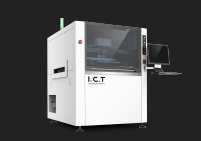
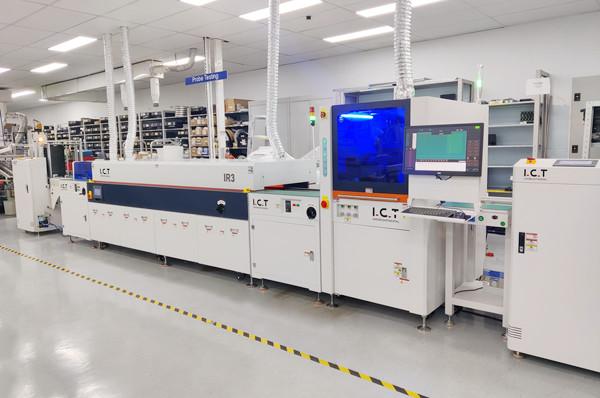
The 5151 is the largest square-format machine in I.C.T's standard automatic range, and its argument is deliberately unglamorous: one machine that covers a 51 mm board and a 510 mm panel without a change of platform. That sounds like a specification detail until you price the alternative. An EMS plant that buys a 400 mm-class printer and later takes a customer with 480 mm backlight panels ends up either refusing the job or buying a second machine whose only purpose is the oversize corner of the schedule.
On a 510 mm machine the same platform runs LED backlights, 400 × 300 mm control boards and 50 × 50 mm modules, with stencil frames from 470 × 370 mm up to 737 × 737 mm — the common frame family in Asia and Europe, which matters more than it sounds because a machine that only accepts one frame size forces you to own two stencil libraries. Board thickness runs 0.4–6 mm as standard, with 10–15 mm available for carrier-loaded assemblies, and warpage tolerance is quoted at under 1%, the figure that decides whether a 0.4 mm backlight panel prints flat or bridges at the edge. Transport is bidirectional in all four combinations and SMEMA-compatible, so the machine can be dropped into an existing line without re-planning conveyor flow.
Two things come up consistently from the installed base: the machine is forgiving with awkward panels, and the cleaning cycle does not stop the line. The dry/wet/vacuum cleaning system runs with the camera carriage separated from the cleaning head, so residue does not contaminate the optics — a small design decision that shows up as fewer false alignment failures after a long shift. 2D inspection is standard rather than an option, which matters at quotation time: a printer that ships without inspection pushes the paste-volume check onto a separate SPI purchase or onto an operator with a lamp.
What we cannot prove is equally specific. Our accuracy figures are manufacturer-published: ±0.025 mm print accuracy and ±0.01 mm repeat positioning, measured under our own conditions, with no third-party Cpk study and no independent benchmark we can point you to. If your customer's PPAP pack requires a Cpk study on the printer itself, the study will be run at your site with your stencil and your paste, and the number that matters will be that one, not ours. Treat our figure as a capability claim from the builder, in the same category as every other vendor's headline number in this article.
Before choosing this machine, check three things: the largest panel you will run in the next three years (not today), the frame sizes your stencil suppliers actually stock, and whether your quality system needs 3D volume data or whether 2D area and height are enough. If the answer to the third is 3D, budget the SPI alongside the printer rather than after it — the S400 3D solder paste inspection machine is the pairing we usually quote, and closed-loop correction is where the yield money actually sits. The automatic printer range lists the 4034, 5134, 6534 and 6561 if your board mix points somewhere else, and the I.C.T-5151 product page carries the full configuration list.

Every printer on this list moves paste with a squeegee. MPM's difference is that the paste never sees open air. The EnclosedFlow head keeps solder paste in a sealed chamber and pushes it through the aperture under pressure, which is why ITW can claim more than 50% paste savings against a conventional blade setup — that figure is vendor material, not an independent study, and the real saving depends on how much paste you currently leave rolling on the stencil. The engineering consequence is more interesting than the saving: a sealed head has no paste roll to dry out, so the first board after a 40-minute stoppage prints like the last board before it, and paste viscosity drift stops being a morning problem.
The Momentum II Elite's numbers are ±11 µm alignment at 6σ with Cpk≥2, a 6-second core cycle, and ±17 µm wet print — parity with the DEK TQ on print capability, at a longer cycle but with a print head that behaves differently on release. Long-time users on SMTnet make the point bluntly: for release quality, MPM is the machine they reach for. That is anecdote, not measurement, and it clusters around older platforms; treat it as a hypothesis to test with your own fine-pitch board rather than a conclusion.
The most useful document ITW publishes is not a brochure, it is the product life-cycle policy. Seven years after a model leaves production it enters the archive phase: no software upgrades, parts subject to availability, limited field service. Fourteen years after, support ends. That is unusually honest and unusually restrictive at the same time. If you plan to run a printer for twelve years — normal in an EMS plant that depreciates on a ten-year schedule — you are buying a machine whose software will stop moving in year seven. Ask for the model's production status in writing before you sign, not after, because the answer changes whether a five-year-old bargain is a bargain.
Before choosing this machine, price two things first: the enclosed-head consumable set (chamber seals and blades are a different cost line from stainless squeegees) and the paste you will standardise on, because a sealed head rewards a consistent paste and punishes a shop that buys whatever is on offer. Then run a first-article check on your hardest board with your own stencil. The Elite's reputation is built on exactly that test, so it is the one test that can confirm or kill the case in an afternoon.

Yamaha's printers are usually sold as the first module of a Yamaha line, and the machine only makes sense read that way. YSP20 prints at a 5-second cycle with ±0.01 mm repeat positioning at 6σ; the newer YRP10 runs a 10-second cycle at ±0.008 mm with dual-lane independent operation and optional automatic stencil and support-pin change; YSP10 sits between them at 10 seconds with automatic stencil change; YCP10 is the compact 13.5-second machine for shops that need the ecosystem but not the footprint.
The front-to-back stencil arrangement on YSP20 is the feature most worth understanding, because it is easy to dismiss as a gimmick and easy to over-buy. Two stencils in one frame mean a machine can print two different pastes, or two different print definitions of the same board — step stencils, cavity work, double-sided print in one pass — without a changeover between them. For a plant that runs a repeat product with a two-paste requirement, that removes a changeover from every cycle. For a plant whose products change daily, the second stencil position mostly sits empty, and you have paid for a 2.9-tonne machine, a 1,779 × 2,410 mm footprint and a heavier floor load than a single-stencil design would need. Check your floor and your schedule, in that order.
What owners on Yamaha lines credit is less the printer than what sits behind it: recipe, support program and board data live in one place, so the printer inherits the setter's discipline from the mounters instead of duplicating it. That is a vendor-ecosystem claim rather than an independent finding, and it is the reason Yamaha quotes rarely lose on price to a same-spec machine from a brand the line does not already run.
Yamaha's parts-cost ceiling — a published cap of roughly 1.5% of machine value per year on wear parts — is a genuinely useful commitment and rare in this category. Read the qualifier: it applies to new machines bought through the authorised channel, and it does not travel with a used unit or an older platform. If you buy a Yamaha second-hand to get the ecosystem at half price, you get the ecosystem's data integration and none of the spares protection. Given that a printer's five-year cost is dominated by consumables and parts rather than purchase price, that is the line item to model before choosing the used route.
Before choosing a Yamaha printer, ask two questions in this order: is the mounter line already Yamaha, and will you buy new. One yes and one no — used Yamaha into a mixed line — is the combination where the ecosystem's value and the spares protection both evaporate at once.

EKRA's machines occupy a niche that the rest of this list treats as an afterthought: printing many small boards at once. Optilign alignment handles up to 50 sub-boards on a single carrier jig, and MultiCarrier fixtures allow up to six panels to print in one cycle — ASYS's own material claims capacity approaching three times a single-board machine with fewer wipe cycles. The current SERIO GenS quotes a 5-second core cycle plus print time at ±12.5 µm; the X5 Professional offers the same accuracy at a 10-second standard cycle, or 5 seconds in high-speed mode plus print time.
If you print module carriers, sensor arrays, SiP substrates or LED strips where the board is 20 × 30 mm and the carrier holds forty of them, standard printers waste most of their cycle on transport and alignment per board. EKRA's economics invert: alignment happens once per carrier, print happens once, and the per-board cost collapses. That is also why EKRA shows up disproportionately in European automotive-electronics and packaging-adjacent plants, where the board is small, the tolerance is tight and the volume justifies tooling. Print area tops out at 508 × 508 mm on X5, so this is not a machine for a 600 mm panel — it is a machine for forty small ones.
The praise here is structural rather than anecdotal, and you can test it on your own numbers: alignment cost is amortised across every board on the carrier, so the per-board figure falls as the carrier fills. Plants that print carriers say the machine stops being the constraint in the takt calculation — the operator loading the jig becomes the constraint instead. That is a good problem, and it is specific to this design.
Check the service map before the specification. A buyer in Australia, mid-evaluation, put the problem in one line: EKRA looks good, but there is no local presence here at all. That is a single data point and it may have changed, but it illustrates the regional asymmetry in this segment — EKRA's strength is Germany, Switzerland, Austria and their near neighbours, and the further you get from Bönnigheim the thinner the field service gets. For a plant in Southeast Asia or Latin America, ask for the named service partner, the parts warehouse location, and the response commitment in hours, before you ask about alignment accuracy.

Panasonic's SPG quotes repeat positioning of ±5.0 µm at 6σ and 2 Cpk — the tightest repeatability figure on this list, and a number that deserves scepticism and respect in equal measure. Scepticism because it is a machine-position figure measured under Panasonic's own conditions, and because Panasonic does not publish a corresponding wet print accuracy number at all, so you cannot compare it with the ±17 µm Cpk figures quoted by DEK and MPM. Respect because the mechanism behind it is real: board exchange in 6.5 seconds on a 350 × 300 mm board, a frame range from 600 × 550 to 736 × 736 mm, and a print area up to 510 × 460 mm, all in a 1,580 × 1,800 mm footprint at 1.7 kVA — modest power and floor demand for the accuracy class.
What keeps SPG on bid lists is not the µm figure. It is that paste-volume correction happens inside the same software stack that runs the line: APC position compensation talks to a 3D SPI, the SPI talks to the printer, and nobody writes an integration project to make that happen. For a plant already on NPM mounters and PanaCIM, that is a real operating advantage; for a plant on mixed equipment, it is a capability you will pay for and may never switch on.
The paperless cleaning option is the quiet cost story here. A conventional cleaner consumes wipe roll and solvent on every cycle; a paperless system consumes neither, which on a three-shift schedule removes a recurring purchase and a recurring operator task. Panasonic has offered this for years and it remains one of the few genuinely differentiated consumable designs in the category. If your plant runs high cycle counts on a narrow product mix, model the five-year consumable difference; on a low-volume high-mix line, the saving is real but small against labour.
Panasonic's global service model is expensive and scheduled. Third-party maintenance providers in Asia market themselves explicitly against it: 40–60% of the OEM rate, with the pitch that you do not queue for an OEM slot. Those providers are selling, and their claims are unverified, but the existence of that market tells you something about response time. Industry estimates put annual maintenance on NPM-class equipment at 3–5% of machine value. Panasonic's own answer to the cost problem has been localisation — a China-developed CSP-L printer shipped from Suzhou in early 2026, positioned on local cost and speed — which is a strong signal that the global SPG is not the value play in every region. Get the service quote in writing with the machine quote, and compare the two together, not separately.
Before choosing the SPG, check three things: whether your SPI is already in the same software stack, the service contract price against a third-party option, and the lane count you actually need. If the answer to the first is no, the machine loses most of its advantage over a cheaper platform with the same print accuracy.

GKG is the largest stencil-printer brand most Western buyers have never quoted, and the G-Tera is the machine that makes the conversation worth having: 510 × 510 mm, ±8 µm machine alignment at Cpk≥2.0, ±12.5 µm process accuracy, a 2-minute product changeover and a reported 12.5-second actual cycle including print and clean. Those are current-platform claims from GKG, and the most convincing evidence for them is not the datasheet: it is that JUKI sells this platform in the Americas under its own brand, with G-Titan specifications matching GKG's line for line. An OEM with a field-service organisation to protect does not rebadge a printer it has not qualified.
Changeover is where GKG's value argument is strongest. Two minutes for a product change, on a machine that costs a fraction of the European platforms, is the number that changes a high-mix schedule. The counterweight is the cycle: GKG's own figures separate a sub-8.5-second core cycle from a roughly 19.5-second actual cycle on the previous G-Titan, because print plus cleaning dominates. The G-Tera's 12.5-second actual figure is a genuine improvement if it holds in your application, and it is the number to verify in a demo with your stencil rather than a brochure with theirs. Ask for the actual cycle, including cleaning, on your board — not the core cycle.
GKG's installed base is large and its reputation is mixed in a very specific way. Practitioner threads describe the G5-era cleaning circuit — the stencil wipe and alcohol spray plumbing — degrading after a few years until the wipe function effectively stops, and describe mark-recognition misreads on hot-air-levelled boards where the fiducial surface is uneven. Those complaints cluster on 2020–2022 machines, and there is no published evidence that the G-Tera has redesigned its way out of either. The fair reading is neither “GKG is unreliable” nor “GKG is fixed”: it is that maintenance access to the cleaning circuit and fiducial robustness are the two things to inspect on a demo unit, and that a plant buying its first GKG should hold a spare-parts kit from day one rather than day ninety.
If your buying committee has never heard of GKG, the JUKI Americas distribution agreement is the argument that usually settles the room, and it is a legitimate one: the same platform, sold through a Western OEM channel with local stock in North Carolina and California. It also protects you from a specific failure mode — the white-label printer with no parts channel — because the platform has at least two independent supply routes. What it does not give you is European depth: GKG's European distribution only became formal in 2026, when Etek Europe took on G-Tera and GL-Star. Ask which of the two channels will hold your spares, and get it in the contract.

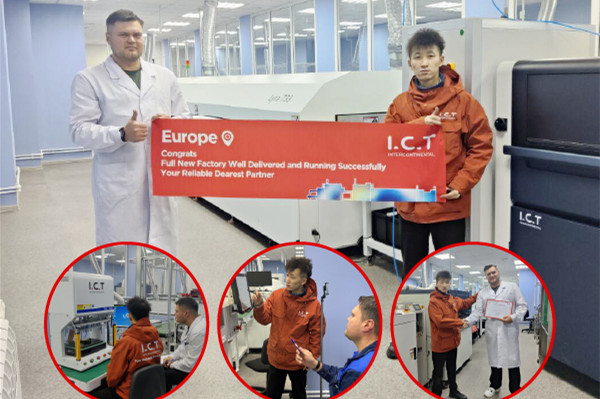
The most useful thing we can show you is not another specification table. It is what happens in the two weeks after the truck leaves, because that is where most printer purchases are quietly lost: the machine arrives, the stencil does not, the board support is built for a different panel, and the first article fails for a reason nobody can attribute. The project below is one we delivered: read it as a project account, not an independent case study — the figures come from our project team, not an audit.
Field | Detail |
|---|---|
Customer industry | Aviation electronics, 25 years in service; in-seat entertainment control panels and USB charging modules for commercial aircraft |
Configuration | Automatic stencil printer, high-speed pick-and-place, Lyra-series reflow oven, turn conveyor; plus a conformal coating line with selective coater, UV curing oven and inspection conveyor |
Product and pain points | Seat-back USB power control boards: mixed board sizes, low volume per variant, conformal coating over fine-pitch joints, and an airline customer base that audits process records |
Production challenge | New line, new operators, a delivery window tied to an airline retrofit programme, and no tolerance for a slow first-article loop |
Solution | Line layout fixed before shipment; printer configured for the panel range; on-site install and levelling; process tuning on the customer's own boards; six days of operator training covering setup, maintenance, troubleshooting and coating path programming |
Verified results | Line installed and running in under one week against a two-week expectation; customer team operating independently at handover; customer statement: “we expected a two-week setup, but it was completed in just a few days” (project record, not an independent audit) |
What this case adds beyond a spec sheet is a sequence. The printer was not the bottleneck; the printer's configuration against a board range was the thing that had to be right before the machine was built, because the panel mix included both a small module and a large control board, and a machine sized for one would have failed on the other in week two. That is the same decision an EMS plant makes when it chooses between a 400 mm and a 510 mm platform, and it is made once, with no cheap correction afterwards.
Work through the five questions below in order. They are sequenced deliberately: the first two eliminate most of the market, the third and fourth set the budget, and only the fifth is a technical comparison. Answering them out of order is how plants end up comparing µm figures between machines that were never in the same buying category — the most expensive mistake in this purchase, because it ends with a machine that is technically superior and operationally wrong for the schedule it has to run.
What is the largest board or panel you will run in three years? Not today's biggest. A single customer win can move this from 350 to 500 mm, and print area is the one specification you cannot add later. If the honest answer is “I don't know”, buy the larger platform and accept the price premium.
How many changeovers per shift? Below four, semi-automatic economics often still win; above four, automation pays and changeover time becomes the deciding metric. Most EMS plants have already crossed this line without noticing.
What does your quality system have to export? ISO 9001 needs records; IATF 16949 and ISO 13485 customers expect recipe locking, parameter history and traceability, and a printer that cannot export them costs you a week of manual work per audit. 2D inspection in the base machine saves a separate purchase; 3D volume data means an SPI.
Who fixes it at 3 a.m., and how far away are they? Get the answer as an hours commitment, not a brand reputation. Ask for the parts warehouse location for your region and the name of the service partner.
Which two parameters actually bind your process? For most EMS work it is wet print accuracy at your finest pitch, and repeatability across a shift. Choose the machine whose weakest of those two clears your requirement with margin, not the one with the better headline.
Your situation | Try first | Check before ordering |
|---|---|---|
High-mix, 8–12 changeovers a week, boards from 50 mm to 500 mm | I.C.T-5151, GKG G-Tera | Frame sizes your stencil supplier stocks; cleaning-circuit spares kit on day one |
Customers demand 01005 and a Cpk pack | DEK TQ, MPM Momentum II Elite | Whether the Cpk study will run on your stencil at your site; service tier commitment |
Release quality is your recurring defect | MPM Momentum II Elite | Paste standardisation; enclosed-head seal and blade cost line |
Many small boards per carrier (modules, sensors, SiP) | EKRA SERIO GenS, X5 | Fixture cost per product; local service partner and response hours |
Already running NPM mounters and want one data stack | Panasonic SPG | Service contract price against a third-party option; single-lane constraint |
Budget-bound, but need panel flexibility and fast changeover | I.C.T-5151, GKG G-Tera, used DEK NeoHorizon | Support status of the used platform; who holds spares in your region |
Budget band (industry estimates, new machines) | Realistic shortlist | What you give up |
|---|---|---|
Entry: under USD 50k | I.C.T-5151, GKG G-Tera, entry Sun East models | The European brand's Cpk documentation and depth of local field service |
Mid: USD 50–150k | Yamaha YSP10/YSP20, Panasonic SPG, EKRA SERIO GenS | Dual-lane capacity and the largest panel sizes; some automation options |
Premium: above USD 150k | DEK TQ/TQ L, MPM Momentum II Elite, TQ XL | Capital efficiency — you pay for accuracy headroom and service depth that only some customers invoice for |
Two caveats on those bands. They are industry estimates assembled from reseller and used-equipment listings, not quotations, and a configured price can move 30% on options alone. And the used route is a fourth band that crosses all three: a five-year-old premium platform typically trades at about half of new, with the support clock already running — check the model's archive date in the OEM's life-cycle policy before you commit. For the line items behind consumables and payback, see our cost and ROI breakdown and the buying checklist.
Rarely, and the gap is informative. A quoted 5- or 7-second figure is the core print cycle: stencil in place, board in place, print, separate. It excludes transport into and out of the machine, alignment, and cleaning. Add those and a well-configured machine typically lands between 12 and 20 seconds per board, which is why GKG quotes both a sub-8.5-second core cycle and a 19.5-second actual cycle for the same platform. When you compare machines, ask each vendor for the actual cycle including cleaning on a board of your size. Our own method for estimating this is set out in estimating printer cycle time and throughput.
It depends on what your customer's quality system asks for. 2D inspection measures area and, on some machines, height, and catches the failures that matter most in a high-mix shop: missing print, smearing, gross misalignment. It cannot give you volume, and volume is what correlates with mid-plate opens and insipient shorts on fine-pitch work. If your customers are automotive tier-two, medical or aerospace, they will ask for volume data with a Cpk attached, and that means 3D SPI. If you print LEDs and industrial control boards, 2D plus a disciplined first-article check is often sufficient. The pairing logic is covered in matching printer and SPI.
Ten to eighteen minutes on a mid-range automatic machine, when you count stencil swap, support-pin rebuild, recipe recall, paste check and the first-article confirmation that a customer audit expects. Vendors quote three to five minutes for the mechanical portion with the stencil pre-staged and the first article excluded. Both numbers describe the same event from different scopes. The part you can actually improve is preparation: pre-staged stencils, pre-built support programs and a recipe library cut the field-reported time by roughly half without touching the machine.
Only if you buy the print area up front. A 510 × 510 mm machine such as the I.C.T-5151 or GKG G-Tera covers a 50 mm module and a 500 mm backlight panel on one platform, with the same 470 × 370 to 737 × 737 mm frame family. Below that, you are either refusing work or buying a second machine for the oversize corner of the schedule. The trade is floor space and a slightly longer transport stroke, not print quality.
On mechanics, usually yes; on paperwork and service depth, often not yet. The Chinese platforms in this list copy the same architecture as the European machines — independent print heads, vision alignment, dry/wet/vacuum cleaning — and at least one is sold under a Japanese OEM badge, which is a stronger qualification than any brochure. What they generally do not have is a third-party Cpk study you can attach to a PPAP pack, or a parts warehouse within a day's courier of your plant. So the honest test is not country of origin but three documents: a Cpk study run on your board, a named service partner with stocked spares, and a FAT protocol with acceptance numbers written in. Without those, no origin is good enough; with them, origin stops mattering. Note that we build one of these machines, so weight this answer accordingly.
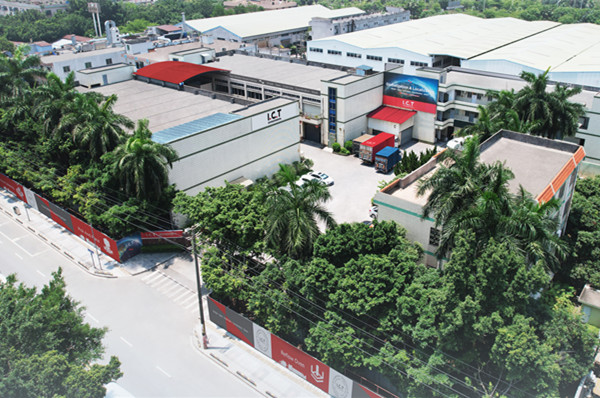
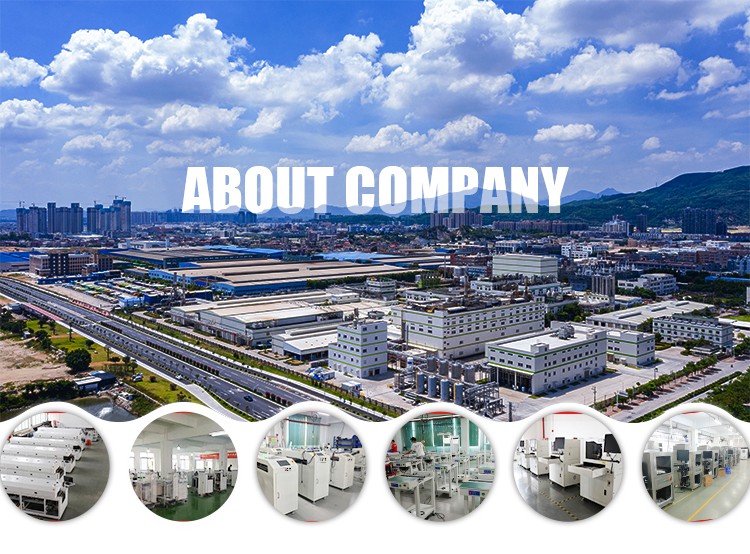
I.C.T has built SMT equipment in Dongguan since 2012: 89 staff including 20 engineers across a 12,000 m² plant, 1,600-plus customers in 72 countries, eight overseas branches, and CE, RoHS and ISO 9001 certification. The printers, ovens, mounters and handling equipment are assembled and tested in-house, with a pre-shipment ageing run before dispatch and on-site commissioning by the same engineering team that builds the line. That combination — a Chinese-built machine with an owned field-service organisation — is why the 5151 sits second in a ranking weighted towards changeover, service and total cost — first among the machines we build, second behind a platform whose Cpk documentation we cannot match, and why its position should be read as a declared editorial judgement rather than a market fact.
Tell us the panel and the pitch. We will tell you the machine.
Send the largest PCB or panel you expect in the next two years, the finest pitch on your hardest board, and your changeover count per shift. You will get a configuration and a cost breakdown, not a brochure.
Request a printer configuration Compare the full automatic range

%IMG10%