English
 Views: 0 Author: Elsa Long Publish Time: 2026-10-13 Origin: Site


Short answer: there is no single better printer class in the automatic vs semi automatic SMT stencil printer decision — there is the class that fits your production model. A plant that runs one product across three shifts and a plant that runs forty prototypes a month can both be right while buying different machines. The specifications are the same; the answer is not.
This guide works through three real factory profiles of an automatic vs semi automatic SMT stencil printer choice — the high-volume multi-shift plant, the high-mix NPI cell, and the mid-volume factory in transition — plus the five numbers that actually decide the call, the true cost premium the invoice hides, and a twelve-month migration path if you start on the semi-automatic side.
Table of Contents
The automatic vs semi automatic SMT stencil printer question behind the question
Decision rules you can take into the meeting on an automatic vs semi automatic SMT stencil printer
When a procurement team sits down to choose between an automatic and a semi-automatic SMT stencil printer, the question on the agenda is almost never the question that actually decides the outcome. The agenda says "which machine is better". The real question is "which factory am I". Those are different questions, and they have different answers — which is why two plants running identical products, in the same country, with the same budget, can both be right when they buy different printer classes.
The reason is that the printer class is not a specification decision, it is a production-model decision. It determines whether a person or the machine owns the print quality, and whether the cost of that decision scales with volume or with headcount. A cut-and-dried comparison table — throughput on one side, price on the other — hides that distinction because it averages over exactly the variable that matters. Two factories can print the same number of boards per day and still need different machines, because one is buying throughput and the other is buying flexibility.
There is a second reason the naive comparison fails. The stencil printer is the first process step on the line and therefore the first place where a defect can be created, but it is not the step that sets the line's output on most mature lines — the mounters do that. What the printer sets is the quality gate that everything downstream inherits. A printer that holds deposit volume and position consistently makes every subsequent station easier to run; a printer that does not forces inspection, rework and rework loops all the way down the line. That is why the printer decision is usually argued on the wrong axis: it is discussed as a throughput purchase when it behaves as a yield purchase.
This article takes a different route. Instead of marching through specifications, it describes three real factory profiles — the high-volume multi-shift plant, the high-mix NPI cell, and the growing mid-volume factory in transition — and works out, for each one, which printer class is the defensible choice and why. Along the way it covers the six dimensions that drive the call in practice: production volume, labor and operator skill, changeover and product mix, process repeatability and Cpk, capital and total cost of ownership, and the type of product being built. If you want the general framework first, the solder paste printer product hub collects both printer classes and the supporting documentation; this article assumes you already know the basics and need a decision you can defend.

Before any comparison, fix the labels. A semi-automatic SMT stencil printer mechanises the print stroke — squeegee motion, stencil-to-board separation — but still needs an operator to load the board onto the table and remove it after printing. A fully automatic SMT stencil printer takes the board from the conveyor, clamps it, runs fiducial vision alignment, prints, separates, and hands it downstream with no operator in the loop. The operator's job shrinks to paste replenishment, stencil changes and clearing the occasional jam.
Everything else follows from that one difference. Because the operator is or is not inside the print cycle, the two classes sit at different points on three curves at once: the throughput curve, the labour curve and the quality-variance curve. A semi-automatic machine's throughput is capped by how fast a person can place and remove a board, so it scales poorly no matter how good the mechanics are. Its labour cost scales linearly with shifts. Its yield is a function of who is standing there. A fully automatic machine breaks all three links: throughput becomes machine-limited, labour becomes a fraction of one person across a cell, and yield stops tracking the operator. The rest of this section — and this article — is about working out which of those three effects actually binds in your plant.
The three personas below are drawn from the buying patterns I.C.T sees across LED panel plants, EMS providers and OEM in-house lines. They are composites, but the numbers attached to each are representative rather than invented, and they are separated by what constrains them, not by their size. Two plants of similar volume can land in different personas, which is exactly the point.
Several hundred thousand boards a month, and in the larger examples well over a million. One product dominant, maybe two. Two or three shifts, 250 to 350 production days a year. The line runs long and unbroken: boards enter at the printer and leave at the AOI without the line stopping for a setup change between shifts. The printer is a bottleneck that must not be a bottleneck.
What defines this plant is not the volume number by itself but the relationship between volume and mix. Persona A runs the same board, the same stencil and the same support-pin layout for weeks. Changeover is a monthly event, not a daily one, and stencil changes are driven by stencil wear rather than by product change. That means the usual objection to automation — "our mix is too varied for recipes" — simply does not apply here. The plant can afford to invest setup effort once and amortise it over a very large number of boards, which is the precondition for automated alignment to pay.
The operational pressure in Persona A is night shift and variance, not speed. Because the line runs 24/7, any yield difference between shifts compounds over hundreds of thousands of boards before anyone notices it in the shift report. A three-shift semi-automatic line needs three operators per printer per day, the third of whom is the hardest to hire and the most likely to be running at reduced yield in the first months. That combination — high volume, multiple shifts, low mix — is what makes Persona A the clearest fully automatic case in this article. The purchase is usually triggered by a new product ramp, a second line, or a customer audit that demands traceable process data, and in all three cases the answer is the same machine class.
Thirty to a hundred distinct products a month, in batches of 50 to 500 boards. Frequent engineering changes, awkward geometries, hand-populated sections, NPI runs that exist for one week and never repeat. The printer must be flexible, not fast.
The defining characteristic here is that the unit of work is not the board, it is the product introduction. A board might run today and never again, or run again in six months with a changed outline and a new support-pin requirement. Half the fixtures are improvised on the day. The engineer who sets the printer is often the engineer who designed the board, and their time is the scarcest resource in the building — far scarcer than machine time, which is frequently under-utilised by design because it has to absorb unpredictable work.
This is the persona that is most often argued badly in both directions. A sales team pushes the fully automatic machine because it is the flagship product; a procurement team pushes the semi-automatic machine because it is cheaper. Neither argument engages the real economics, which are about engineering overhead per product introduction rather than cost per board. In Persona B the printer must accept a new product with almost no preparation, tolerate a support scheme that was designed an hour ago, and let the engineer move on to the next design. Throughput per hour is largely irrelevant to the decision because the line is never throughput-limited; setup-to-print ratio and the ability to absorb a design change without rebuilding a recipe are the whole case.
Medium volume today, rising steeply. Running a semi-automatic line that is starting to miss. No appetite for a full line rebuild, but increasing pressure on yield, traceability and headcount. This is the persona where the printer decision is genuinely hard.
The reason it is hard is that Persona C is being pulled by two forces that point in opposite directions at the same time. Volume and customer requirements are pushing it toward the fully automatic class: first-pass yield is slipping, a second shift is being added, or a customer has started asking for process data the current line cannot produce. Capital discipline is pulling the other way: the plant has a working semi-automatic line, no greenfield budget, and an approval process that requires payback inside a single budget cycle. Doing nothing is not neutral either, because the gap between what the line delivers and what the customer expects widens every quarter.
Persona C is also the persona where the accuracy trigger usually arrives before the volume trigger does. A customer moving to a 0.4 mm pitch QFN can force a printer decision on a plant whose volume alone would not yet justify it, because the semi-automatic class cannot hold deposit position at that pitch on a production basis. That is why the decision so often feels premature to the people holding the budget: it is not being driven by the throughput model that the budget was built around.
A single throughput number cannot distinguish these three. Persona A and Persona C may print the same number of boards per day; the difference is whether the saved operator-hour is the binding constraint. Persona B may have the highest aspirational volume of all three and still be a semi-automatic case forever, because its economics are driven by flexibility and changeover, not by steady-state speed. Reading a comparison table without knowing which constraint binds is how plants end up buying a machine that is correct on paper and wrong on the floor.
The profiles also explain why the same vendor conversation produces different recommendations. When a supplier asks "how many boards per hour", both Persona A and Persona C give a large number, and a supplier who stops there will recommend the same machine to both. The follow-up questions — how many distinct products per month, how many shifts, is the customer driving a fine-pitch requirement, is the printed board high value — are what separate the two. Bring those four answers into the conversation and the recommendation usually becomes unambiguous.
If your product mix or process is unusual enough that none of the three fits, the broader how to choose a solder paste printing machine for your SMT line walk-through covers the general selection logic and the product families in more detail.
The table below compresses the three personas into the variables that actually drive the printer decision. It is deliberately short: if a plant matches a row on the middle columns, the answer in the last column is the one to defend.
Profile | Volume & mix | Shifts | Binding constraint | Correct class |
|---|---|---|---|---|
A — high-volume plant | Several hundred thousand boards a month, one or two products | 2 to 3 | Operator-hours per shift and night-shift consistency | Fully automatic |
B — NPI and prototype cell | 30 to 100 products a month, 50 to 500 boards per batch | 1, occasionally 2 | Engineering hours per product introduction | Semi-automatic |
C — mid-volume in transition | Rising volume, moderate mix, tightening yield | 1 rising to 2 | Accuracy, traceability and budget timing | Fully automatic, staged |
Notice that the last column is a conclusion about the plant, not about the machine. That is the whole argument of this article, and sections 3 to 5 work through each row of it in detail.
For Persona A the answer is not close. The fully automatic printer wins on every dimension that Persona A cares about, and the case does not depend on a fragile assumption. That is rare in equipment decisions, and it is worth understanding exactly why the case is so robust before looking at the two ways a high-volume plant can still get it wrong.
The reason is arithmetic rather than preference. Persona A runs the same product for weeks, across two or three shifts, with high-value boards and an auditable process requirement. Every one of those four conditions independently favours the same machine class, and where four independent arguments point the same way, the conclusion survives even if one of them is overstated. That is the opposite of the Persona C situation, where the arguments genuinely conflict.
Two or three shifts, a long run, one dominant product. Boards arrive from the upstream conveyor and leave to the mounter on the next conveyor. The operator is not standing at the printer at all — one person covers three to six printers across the line. The printer exists to disappear into the line, and any manual intervention is an exception, not the norm.
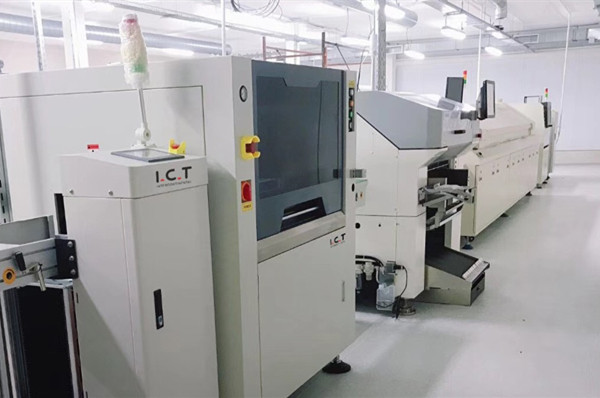
The line is usually laid out as printer, inline SPI, two or three mounters, reflow, AOI. The printer is the first station, so its output rhythm sets the cadence everything else has to absorb, and its defect rate sets the inspection load at every downstream station. In a properly integrated line the printer runs unattended for hours at a time, interrupted only by paste replenishment on a fixed interval and stencil changes on a wear cycle. There is no operator assigned to it in the job sheet; the cell operator owns three to six machines and treats the printer as one of them.
That layout is the reason the fully automatic class is not really optional in this profile. Once the printer is inside a conveyor-linked line, an operator stationed at it is an anomaly in the line design — a manual step in the middle of an automated flow. The cost of that anomaly is not just the operator's wage, it is the fact that the line can no longer run unattended, which changes how the whole plant is staffed.
A fully automatic printer runs a 5 to 9 second cycle, machine-limited and repeatable. A semi-automatic printer runs roughly the same mechanical stroke but adds 3 to 7 seconds of operator placement and removal. At first glance that looks like a modest gap: the print stroke itself is similar, and the added time is only a few seconds. Measured per labour-hour it is not modest at all.
A fully automatic printer sustains 700 to 900 boards per operator-hour once paste replenishment and stencil changes are factored in. A semi-automatic printer sustains 200 to 350. The fully automatic machine is not only faster, it is faster per person — and at Persona A's volume, person-hours are the scarce resource, not machine hours. The plant is not short of floor space, it is short of people willing to work a night shift in a cleanroom, and that is the constraint the machine class has to relieve.
Put the same comparison in shifts and the gap widens further. To match the output of one fully automatic printer running unattended, a semi-automatic line needs two to four printers and an equal number of operators per shift, plus fixture duplication and additional floor space. At that point the capex comparison is no longer "one machine versus another machine"; it is "one machine and a fraction of a person versus four machines and four people per shift". The price gap that looked decisive on the datasheet disappears once the comparison is made at equal output, which is the only comparison that matters at this volume.
Persona A's defining feature is that the line runs more than one shift, and this is where the semi-automatic case collapses. A semi-automatic line needs one operator per printer per shift. Three shifts means three operators a day for the same machine, and the night-shift operator is the hardest to hire, the most likely to be new, and the most likely to be running the line at lower yield. The variance that follows is invisible in a monthly average and very visible in a customer audit.
A fully automatic printer removes that dependency entirely: the night-shift print quality equals the day-shift print quality because no human eye is in the loop. This is not a marketing claim, it is a mechanical consequence of where the alignment decision is made. Fiducial vision alignment and closed-loop pressure control do not get tired at 3 a.m. and do not need six months to reach full competence. The plant's yield curve becomes a function of its process, not of its recruiting pipeline.
For a plant running three shifts, the labour arithmetic alone — three operators replaced by a fraction of one — puts the fully automatic payback inside 24 months in almost any high-labour-cost region. That is why fully automatic penetration in North American and Western European high-volume lines is above 90 percent. The remaining semi-automatic lines in those regions are usually there because the product mix is genuinely high-mix, which means they are Persona B plants running a high-volume floor plan rather than Persona A plants.
The only way a high-volume plant gets this wrong is by buying the technology without the process around it. A fully automatic printer feeding a line with no inline SPI gives up most of the yield it is capable of. The printer's value is realised only when the inspection loop that closes around it exists: deposit volume measured on every board, fed back to the printer, used to adjust squeegee speed, pressure and cleaning interval before the drift becomes a defect. Buy the printer without the loop and the plant gets the cycle time and none of the Cpk. Persona A should budget for SPI at the same time as the printer, not a year later.
A secondary risk is over-specification. A high-volume plant running only 400 x 400 mm boards does not need a 1.5-metre long-board platform; it needs a reliable standard-platform machine. Long-board platforms carry their own mechanical compromises in rail rigidity and stencil handling, and paying for them to run small boards is a net negative. Matching platform size to the actual board is worth more than buying headroom that will never be used, and the money is better spent on the inspection loop and on a second stencil set for changeover.
The third and least obvious risk is treating the printer as a purchase that ends at installation. A high-volume line lives with its printer for eight to twelve years, and the difference between a machine that is well supported and one that is not shows up in uptime, in spare-part latency and in whether the vendor can help when a new product ramp exposes a process limit. At Persona A's volume, a single day of unplanned downtime costs more than the price difference between two comparable machines, so service depth belongs in the decision alongside the specification.
Persona B is the mirror image of Persona A, and it is the case most often argued badly in both directions. Sales teams push fully automatic; procurement pushes semi-automatic for price. Neither argument engages the real economics, which are about the cost of a product introduction rather than the cost of a board.
It helps to be explicit about that unit. In Persona A the cost of interest is cost per board. In Persona B it is cost per product introduction — the engineering and setup effort spent to get a new design from a bare board to a passing print, divided by however many boards that design will ever run. For a product that runs 40 boards and never returns, a two-hour recipe build is a five-minute-per-board overhead. That single calculation explains almost every correct answer in this section.
An NPI and prototyping cell, or a contract manufacturer in a specialist niche. Thirty to a hundred products a month, batched at 50 to 500 boards. A board might run today and never again. Half the fixtures are improvised. The engineer who sets the printer is often the engineer who designed the board.
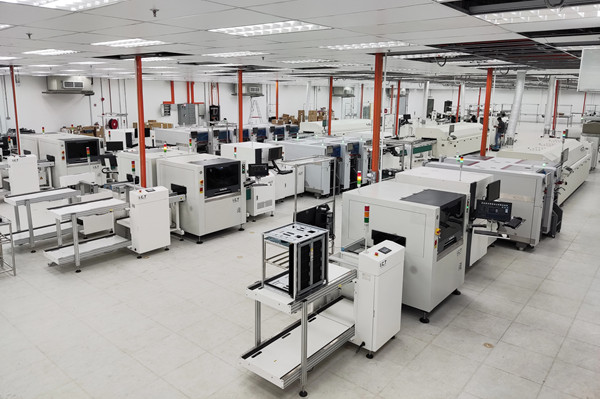
The physical setup is usually one or two printers on stands with manual infeed, adjacent to a small reflow oven and often a benchtop AOI or a microscope station. There is no conveyor architecture to speak of, because the whole point of the cell is to be reconfigured in an afternoon. Floor space is cheap relative to engineering time, machines are shared between product families, and the schedule is driven by customer engineering-change requests rather than by a production plan.
In this environment the printer is a tool, not a line station. It is expected to accept whatever comes through the door: a 0.3 mm-thick panel, a board with an unusual outline, a design with a hand-populated section that cannot be reflowed, a board whose support-pin layout has to be invented on the spot. The performance question is not how many boards per hour, it is how many minutes of engineering attention the machine demands before the first good print.
A fully automatic printer with recipe management and automatic stencil recognition changes over in 60 to 120 seconds — but only for a product that already has a recipe. A genuinely new product, or a board whose support-pin layout has changed, or a panel with a hand-populated section, is exactly the case where the automatic machine's stiffness becomes friction: somebody must build the recipe, validate it, and often rebuild it when the prototype board changes next week.
A semi-automatic printer has no such overhead. The operator places the board against pins, nudges the stage, and prints. For a 40-board prototype run, the time spent printing is trivial compared to the time spent preparing an automatic recipe — and the preparation is repeated every time the design changes. Where a production machine's value comes from never having to touch it, a prototyping machine's value comes from being touchable in seconds.
There is a second, quieter cost to the automatic route in this profile: validation. An automatic recipe has to be proven before it can be trusted, which means printing test boards, measuring deposits, adjusting parameters and recording the result. That work is worthwhile when it will be amortised over hundreds of thousands of boards. On a 40-board prototype it is pure overhead, and worse, it competes for the same engineering calendar as the next customer's design review.
Persona B's bottleneck is not boards per hour. It is engineering iterations per week. Every hour spent building and validating a printer recipe for a product that runs 40 boards is an hour not spent on the next design. The semi-automatic printer converts setup time into printing time, and in an NPI cell that trade is almost always correct.
This is also why the "fully automatic is more accurate" argument does not automatically apply here. Accuracy matters when a product is in stable production; in NPI, the dominant risk is that the product changes before the process stabilises, and the flexibility to absorb that change counts for more than a marginally tighter alignment number. A ±12.5 µm machine that needs a two-hour recipe for a design that will be revised on Thursday is less useful than a ±25 µm machine that prints the revision in ninety seconds.
There is an exception worth naming, because it is where Persona B plants get their decisions wrong in the other direction. If a prototyping cell is regularly producing fine-pitch designs for an automotive or medical customer who will later audit the production process, then the prototype itself has to be built under a process that resembles production. In that specific case a semi-automatic printer can create a validation gap — the prototype passes, the production line behaves differently — and the right answer is either a fully automatic machine or a disciplined process-transfer step. That is a compliance argument, not a throughput argument, and it should be made explicitly rather than smuggled in as a capability claim.
The genuinely interesting case is a factory that is high-mix and rising in volume — the boundary between Persona B and Persona C. The modern answer there is not one class or the other but a fully automatic printer configured for high-mix work: quick-release or frameless stencil clamping, recipe-driven support-pin reconfiguration, and an offline stencil cleaning station so the printer is not occupied during cleaning. That configuration keeps most of the changeover speed of a fully automatic machine while keeping most of the flexibility of a semi-automatic one.
The payback on that configuration comes from a different place than in Persona A. It is not the labour saving, which is small when only one shift runs. It is the elimination of changeover-induced stoppages on a line that now changes over several times a day, plus the yield consistency that lets the plant quote tighter delivery windows to customers. A high-mix house that can change over in two minutes while holding a stable process can compete for work that a plant with 15-minute manual changeovers has to decline.
When evaluating a vendor for this segment, the question to ask is not the headline changeover time on the easiest product in the mix. It is the changeover time on the most awkward product in the mix, measured with the actual tooling and the actual operator, on the shop floor before the purchase order is signed. A machine that changes over in 90 seconds on a clean 400 x 400 mm board and 25 minutes on the board that actually troubles your plant has not solved your problem, it has only moved it.
Persona C is where the printer decision stops being obvious, and it is the persona most readers of this article will recognise in themselves. It is not a compromise between A and B; it is a distinct situation with its own logic, in which the technically correct answer and the financially defensible answer can arrive on different schedules.
The defining feature of Persona C is that it is being squeezed from both ends at once. Requirements are rising — more volume, a second shift, tighter pitch, a customer asking for traceable process data — while the capital envelope stays where it always was. The plant is not choosing between two machines on merit; it is choosing how much machine it can buy this year while still answering a customer question that has already been asked. That is why the answer for this persona is usually a staged one, and why sections 8 and 10 carry most of the weight for it.
Medium volume today and climbing. Running a semi-automatic line that is starting to miss its targets: first-pass yield slipping, a second shift being added, customers asking for traceability that the current process cannot provide. The plant does not want a greenfield rebuild and cannot justify a full automation budget in one year — but doing nothing means the gap widens every quarter.
The symptoms usually arrive together, which is what makes the plant realise the problem is systemic rather than a bad week. First-pass yield drifts down by a point or two and stays there. Rework rises in the same proportion. The best operator's shift outperforms the newest operator's shift by a margin that is now big enough to show up in the weekly report. A customer sends a process-audit questionnaire that the plant cannot complete from records, because the records are a paper traveller and a set of operator notes rather than machine data.
The plant's instinct — and it is a reasonable one — is to look for a cheaper intervention first: better training, a new squeegee, a tighter stencil spec, more inspection. Some of those help temporarily. None of them addresses the structural issue, which is that print quality is being owned by a person in a process that the customer now expects to be owned by the machine. Persona C is the moment that becomes clear.
A representative semi-automatic printer from a Tier-1 vendor lands at 40,000 to 80,000 USD depending on options. A comparable fully automatic printer lands at 80,000 to 180,000 USD. The gap is two to three times, and it is often the largest single equipment line item outside the pick-and-place machines. For a plant that has to demonstrate payback inside a single budget cycle, the sticker price matters.
It matters for a second reason that is easy to overlook: the working capital and floor-space consequences arrive in the same year as the purchase. A fully automatic machine needs conveyor interface, an inline inspection partner, and a support-tooling set; it changes the line layout; it may require a different utilities and compressed-air arrangement. None of those items is optional once the machine is installed, and all of them land in the capex request. A plant preparing that request honestly will find the true first-year outlay is meaningfully higher than the machine price.
But the sticker price is the wrong number to anchor on, and section 7 shows why: the true cost premium is larger than the sticker gap, and the true benefit is larger than the labour saving. Persona C is exactly the profile that gets hurt by comparing sticker prices, because the plant's own approval process tends to reward the smaller number and defer the analysis that would justify the larger one.
Persona C usually faces a specific technical trigger rather than a general aspiration. A customer moves to a 0.4 mm pitch QFN, and the semi-automatic line can no longer hold the deposit position reliably. The headline specification to compare is not camera resolution — both classes use similar vision systems. It is alignment repeatability at 4 sigma, measured on a real fine-pitch board, not on a fiducial.
A well-engineered semi-automatic machine holds about ±25 µm at 4 sigma under that test; a well-engineered fully automatic machine holds about ±12.5 µm. The distance between those two numbers is the distance between printing 0.4 mm pitch packages reliably and not printing them at all, and it is the reason a mid-volume plant can be forced into a fully automatic machine long before its volume alone would justify it. The industry baseline for stencil aperture design and the accuracy those numbers are tested against is set out in IPC-7525A, Stencil Design Guidelines.
Two things make this trigger sharper than it first appears. The first is that the failure mode is not a clean rejection; it is an intermittent one. A semi-automatic line at the edge of its capability does not stop producing good boards, it produces most boards good and a few boards bad, and the ones that are bad are found at AOI or at end-of-line test rather than at print. That pattern is expensive — the value added before discovery is wasted — and it is very hard to attack with operator training, because the operator has no reliable signal to act on.
The second is that the requirement tends to ratchet. A plant that qualifies a 0.5 mm pitch process for a customer is usually asked about 0.4 mm within a year, and 0.35 mm after that. Buying to just clear the current pitch leaves the plant repeating the same approval cycle annually. The honest way to frame the printer decision in Persona C is not "can this machine print our current board" but "can this machine still print our board in three years without another capital request".
The most expensive mistake Persona C makes is a half-step: buying a mid-range machine that is neither a clean semi-automatic nor a true fully automatic, and stitching together process control with manual inspection to compensate. The result is the cost of automation without the benefit: the plant pays for vision alignment but still needs an operator in the loop, still has no closed-loop feedback, and still has an operator-dependent night shift.
The trap is seductive because the machine in question does have vision, does have a motorised stage, and does have a recipe system. What it does not have is the combination that produces a closed loop: automatic board transfer, measurable deposit feedback and a mechanism to act on that feedback without human intervention. Vision without the closed loop improves the print; it does not make the process self-correcting, which is the property the customer requirement actually depends on.
If the accuracy trigger is real, the honest move is to a proper fully automatic printer with inline inspection, even if it means doing one line at a time over two budget cycles. The migration path in section 10 is built for exactly that constraint. If the trigger is not yet real and the plant is buying on aspiration, the honest move is to wait and spend the year improving the process on the existing machine — because a partial step now makes the eventual correct purchase harder to justify, not easier.
Strip away the personas and five numbers carry almost all the decision weight. Each is measured on your own line, with your own product, not taken from a datasheet. They are presented here in the order in which they usually become decisive, but the right way to use them is as a set: a plant that is strong on one and weak on the others should not let the strong one carry the decision.
Two ground rules apply to all five. First, measure them on the worst product in the mix, not the easiest, because the decision has to survive the awkward cases. Second, measure them across several shifts and several days, because a single shift's numbers will flatter or penalise the current machine depending on who was standing at it. The whole point of these figures is to remove the operator from the measurement.
The single most decision-relevant throughput figure is boards per operator-hour. It folds cycle time and labour content into one number and makes the comparison honest across the two classes. Fully automatic lands at 700 to 900; semi-automatic at 200 to 350.
Boards per hour, by contrast, is almost useless for this decision because it hides the difference in staffing. A semi-automatic printer quoted at 250 boards per hour sounds competitive until you note that it needs one operator to achieve it, at which point the comparison is 250 boards per person-hour against 800. The metric should be computed over a full shift, including paste replenishment, stencil changes, breaks and the downtime attributable to the printer, so that the number reflects what the line actually delivered rather than what it achieved during a good hour.
There is one refinement worth making for high-value products: convert boards per operator-hour into value added per operator-hour. A 200 USD board produced at 250 boards per person-hour contributes far more per labour-hour than a 5 USD board at the same rate, which is why the same labour arithmetic supports a fully automatic machine in one plant and not in another. The labour saving is the same in both cases; what changes is what the plant does with the hours it frees.
Compare solder paste volume Cpk on the same product on both classes. A fully automatic printer on a 0.5 mm pitch QFN typically holds Cpk 1.6 to 2.0 on paste volume and 1.3 to 1.6 on deposit position. A semi-automatic machine on the same product lands at Cpk 1.0 to 1.4. Cpk below 1.0 means the process cannot hold the specification; 1.33 is the usual floor for high-reliability work. The workmanship criteria that turn this Cpk conversation into a customer-facing promise are defined in IPC-A-610, Acceptability of Electronic Assemblies, where Class 2 versus Class 3 is the line the semi-automatic class typically cannot cross.
Cpk is the right metric rather than a simple average because print defects are driven by the tails of the distribution, not the mean. Two machines can produce the same average deposit volume while producing very different numbers of out-of-specification deposits, and it is the out-of-specification deposits that become solder bridges and opens. This is why replacing a semi-automatic machine with a fully automatic one often improves yield by several percentage points even when the average deposit volume barely moves: the automatic machine's tighter distribution removes the tail.
When you measure this, use the same stencil, the same paste and the same board for both machines, and take at least 30 boards of data per machine. Then look at the position Cpk separately from the volume Cpk. Volume is mostly a function of printing parameters and can often be improved on either class; position is mostly a function of alignment, and that is where the two classes genuinely diverge. If volume Cpk is your problem, a printer change may not be the cheapest fix. If position Cpk is your problem, it usually is.
Multiply the changeover time difference (roughly 90 seconds versus 5 to 15 minutes) by the number of changeovers per week. For Persona A, that product is near zero. For Persona B, it is the dominant term. The number is only meaningful when it carries your actual mix, which is why headline changeover times mislead.
The calculation should also include the recovery time after a changeover, which is often larger than the changeover itself. A semi-automatic line typically prints two to five boards before the process is back inside specification after a setup, and at high value that ramp is real money. An automatic machine with a validated recipe can start inside specification on the first board, or on the second after a minor adjustment, because the recipe carries the parameters rather than relying on the operator to re-establish them.
Finally, count the changeovers that are not in the plan. Engineering changes, rework re-runs, customer sample builds and weekend interruptions all consume setup time, and they hit a manual process harder than an automated one because each one restarts the human learning curve. If your plant's changeover count for the quarter is materially higher than the production plan implies, the weighted changeover penalty is larger than the plan suggests, and that argues for the automated side even in a mid-mix plant.
A fully automatic printer integrates into a conveyor line; a semi-automatic machine often lives on a stand with manual infeed. Greenfield, the conveyor cost is the same either way. Retrofitting a semi-automatic cell into a conveyor line can cost more than the printer. This number is where the two classes are closest and is frequently the tie-breaker.
The calculation is best made per 10,000 boards a day because that normalises the fixed integration cost against output. At that rate a semi-automatic approach needs several printers and several operators, so the footprint and the integration cost multiply, while the automatic approach stays at one machine per line. In a plant where floor space is genuinely constrained — a cleanroom with fixed air-handling capacity, or a leased building with a hard column grid — that second-order effect can decide the purchase on its own.
Do not forget the support infrastructure that travels with each class. Vacuum or magnetic clamping, support-pin kits, stencil storage and an offline cleaning station all occupy floor area, and the semi-automatic approach needs them duplicated across every printer it uses to reach the same output. Add the aisle space that manual infeed requires and the practical footprint difference is larger than the machine dimensions alone suggest.
Paste consumption per board, and the spread of that consumption, differ between the classes because of stencil cleaning frequency, print pressure control and the number of aborted prints. The variance matters more than the mean: high variance drives both paste cost and rework. Automatic cleaning and closed-loop pressure control reduce the spread by a measurable margin over a shift.
Paste is also the component most exposed to handling discipline, which is why a semi-automatic line's consumption is sensitive to how long the paste sits on the stencil between prints and how often the operator scrapes and re-mixes. Overnight and over a weekend, those habits change, and so does the consumption figure. An automatic machine with a scheduled cleaning cycle and controlled pressure removes most of that human variable, which makes both the paste cost and the paste-related defect rate more predictable.
The practical measurement is simple: weigh paste issued and paste returned over a two-week period on the same product, and divide by boards printed. Do it separately for each shift. If the shift-to-shift spread is more than about a tenth of the average, the process has a handling-variance problem that a machine class change will partly, but not entirely, fix. The residue of that variance is a training and procedures issue and should be solved regardless of which printer you buy.
The table compresses the five figures into the form in which they are usually argued. The last column is the more useful one: it names which persona each number actually decides, which is a reminder that adding all five together is the wrong way to use them.
Number | Semi-automatic | Fully automatic | Which persona it decides |
|---|---|---|---|
Boards per operator-hour | 200 to 350 | 700 to 900 | Persona A |
Paste volume Cpk (0.5 mm QFN) | 1.0 to 1.4 | 1.6 to 2.0 | Persona C |
Changeover time (per event) | 5 to 15 min | 60 to 120 s | Persona B |
Line integration cost | High if retrofitted | Native | Persona C |
Paste wastage variance | Higher spread | Lower spread | All three |
The capital gap is the visible part of the difference between the two classes. It is also the part that hides the real number, because it is the only part that arrives as a single line on a quotation and therefore the only part anybody builds a business case around.
A procurement case for the cheaper machine is easy to write when the comparison stops at the invoice: the semi-automatic option is two to three times cheaper and the plant already knows how to run it. That case is not wrong, it is incomplete, and it is incomplete in both directions at once — it omits the costs that come with the automatic machine and the costs that come with staying where you are. The rest of this section supplies both halves.
A plant comparing a 60,000 USD semi-automatic machine with a 110,000 USD fully automatic machine sees a 50,000 USD premium and stops there. That is the wrong stopping point. The difference in total cost of ownership over the deployment — one-time tooling, consumables, service, and the yield cost of the transition — is what the procurement case should carry, and it is larger than the sticker gap.
The premium is larger because the automatic machine changes what the plant has to own. It needs stencils in a specific frame format, support tooling that matches its clamping system, an operator population trained differently, and a service relationship that covers more moving parts. Each of those is modest in isolation and substantial in aggregate, and none of them appears on the machine quotation. A plant that budgets the sticker price and discovers the rest after installation has effectively made the decision twice, and the second time with less leverage.
The premium is also asymmetric in a way that matters to a business case. Most of the additional cost is one-time and identifiable: stencil re-framing, fixtures, interface work, training. The additional benefit, by contrast, is recurring and compounding: yield, uptime, labour and consistency, every shift, every month, for a decade. A finance function that discounts both at the same rate will systematically under-value the automatic option, because it is comparing a lump sum today against an annuity tomorrow.

Seven items account for almost all of the gap between the invoice and the true cost. They are listed here in the order in which they usually appear in a project plan, which is also roughly the order in which they surprise people.
Machine price premium. The visible gap, typically 30,000 to 60,000 USD between comparable Tier-1 machines, and the only item that the quotation makes explicit.
Stencil frame inventory. Fully automatic machines with magnetic or frameless clamping need stencils in the printer's format. Existing stencils may need re-framing — a one-time cost that scales with the number of active products, and one that is easy to under-count because it scales with the long tail of the product list rather than with the current production plan.
Support tooling and fixtures. Vacuum plates, magnetic clamps, support-pin kits and product-specific fixtures. Commonly five to fifteen thousand dollars of one-time tooling per machine, and frequently more in a high-mix plant where the fixture count is high.
Conveyor and line interface. If the line is being built greenfield, this is a wash. If the printer is being retrofitted into an existing line, the interface cost can dwarf the printer price difference, and it also consumes engineering time that is usually already committed elsewhere.
Operator training. A fully automatic machine needs a different operator profile — recipe management, SPI feedback interpretation, basic troubleshooting — and that training is recurring, not one-off, because operators rotate and the recipes themselves evolve.
Transition yield loss. The first month on a new fully automatic machine typically runs 5 to 10 percent below steady-state yield while recipes settle. Plan for it explicitly, in the budget and in the customer conversation, rather than discovering it in the weekly report.
Service over ten years. More moving parts mean more failure modes. Ten-year field service typically runs 8 to 12 percent of capital for a fully automatic machine against 4 to 6 percent for a semi-automatic one, so the service line item scales with the machine's own price.
The case is symmetric, and this half is usually ignored. Staying on a semi-automatic line carries hidden costs too: the labour content of every shift, the yield variance that tracks operator skill, the rework and scrap from manual alignment, and the compliance and traceability cost of a process with no closed-loop record. For any product where the customer audits the process — automotive, medical, aerospace — that last item alone can disqualify the semi-automatic option regardless of price.
The labour component is the easiest to see and the easiest to underestimate, because it is spread across many cost centres rather than presented as a single number. It appears as headcount in the plant budget, as overtime in the month's accounts, as the recruitment cost of replacing a night-shift operator, and as the training cost of bringing a new hire to the yield level the line needs. None of those lines says "stencil printer"; together they are the recurring price of the semi-automatic choice.
The yield component is harder to see because it is a distribution rather than a number. A semi-automatic line's first-pass yield is not a constant, it is a range that depends on who is on shift, how long they have been on the line and how tired they are. That range is what makes quoting a delivery date difficult and what makes a customer's process audit uncomfortable. The automatic alternative's value is often described as a yield improvement; in practice it is more accurate to describe it as a variance reduction, with the average improvement being a consequence of removing the bad tail rather than of raising the good performance. Traceability then falls out of the same change, because a machine that makes the alignment decision can also record it.
None of this argues against fully automatic printers. It argues against comparing sticker prices. The true cost premium is larger than the invoice gap, and the true benefit is larger than the labour saving — which is the subject of the next section. A procurement case that includes both is defensible; one that includes neither is a coin toss dressed up as analysis.
The practical way to present it is as two lists on one page. On the left, every incremental cost of the automatic route, with a number and an owner, including the transition yield dip and the tooling. On the right, every recurring saving and every avoided cost, converted to an annual figure and then to a payback period. If the payback is inside the plant's normal capital threshold, buy it and stop arguing. If it is outside, say so explicitly and name the trigger that would change the answer — a pitch change, a volume threshold, a customer requirement — so the decision is revisited on evidence rather than on sentiment.
The reason the true cost premium is usually worth paying is that the benefit side is also larger than it first appears — and the largest single benefit is not labour. Getting this wrong in either direction produces the same failure: a business case that understates the automatic machine badly enough to lose an argument the numbers should have won.
The confusion arises because labour is the only benefit that is easy to quantify before a purchase. Yield improvement is real but requires an assumption about how much of your current loss is print-related; uptime improvement requires an assumption about current unplanned stops; traceability has no obvious price. So most cases are built on labour alone, and labour alone is the weakest of the four arguments in a low-labour-cost region. The sections below rebuild the case in the right order.
Start with the simple version. Let CA be the capital premium of the fully automatic machine, L the fully-loaded hourly labour cost, and assume the machine saves about one operator per shift at sustained volume. Break-even in shifts is CA ÷ (L × 1 operator). At a premium of 45,000 USD and a labour cost of 12 USD/hour, that is roughly 3,750 shifts — six to eleven years at two shifts a day. Taken alone, that number kills the case in low-labour-cost regions, which is why the simple formula is not the whole story.
The formula is also pessimistic in three separate ways, and it is worth naming them because each one is easy to correct on your own data. It ignores the fact that one operator per shift is an under-statement in a multi-printer cell, where the automatic route can absorb work that would otherwise need a second or third machine. It ignores the yield differential entirely. And it treats the saved operator-hour as worth only the wage, when the real value is the marginal cost of covering that hour on a night shift — which is higher, and sometimes much higher, once recruitment and turnover are included.
The honest way to use the formula is as a floor. If the labour-only payback already clears the plant's threshold, the decision is straightforward and the rest of this section is confirmation. If it does not, the question becomes whether the yield and uptime terms are large enough to carry it — and that is a question about your product value, not about your labour rate.
The labour formula ignores the yield difference, and the yield difference is where the payback actually lives. Moving from a semi-automatic to a fully automatic printer with inline SPI typically lifts first-pass yield by 3 to 8 percentage points on a high-value product. On a board with 200 USD of loaded material and labour, every percentage point of yield is worth roughly 2 USD per board. Eight points on 5,000 boards a shift is 80,000 USD a shift, which repays the entire capital premium in a matter of months — not the years the labour formula predicted.
The mechanism is worth stating plainly, because it is routinely misunderstood. A yield gain from better printing is not usually a gain in the fraction of boards that print well; it is a reduction in the number of boards that fail somewhere downstream because of a marginal deposit. Those boards consume the full cost of the line before the defect is discovered at AOI or end-of-line test, which means the value destroyed per escape is the entire loaded value of the board, not the cost of the printing step. That is why a small print improvement produces a disproportionate financial result on expensive assemblies and a barely visible one on cheap ones.
This is why the payback answer is so sensitive to product value. The same machine upgrade that pays back in under a year on a high-value board can take five years on a low-value one. The board, not the printer, sets the clock — and that is also why two plants with identical volume and identical labour costs can reach opposite conclusions from the same quotation.

The same printer produces very different paybacks depending on labour cost and product value. The table below uses a representative 45,000 USD capital premium, one operator per shift saved, and a mid-value product.
Read the table across the rows, not down the columns. The labour-only column is the argument a plant usually makes; the second column is what actually happens once a realistic yield improvement is included. The distance between the two columns is the cost of building a business case on the wrong term, and in every row it is larger than the difference between regions.
Context | Loaded labour cost / hour | Break-even (labour only) | Break-even (labour + mid-value yield) |
|---|---|---|---|
North America, high volume | 35 to 50 USD | 1.8 to 2.6 years | under 12 months |
Western Europe, high volume | 30 to 45 USD | 2.0 to 3.0 years | 12 to 18 months |
Southeast Asia (Tier-1) | 8 to 15 USD | 6.0 to 11 years | 2 to 4 years |
Greater China (Tier-2 city) | 6 to 12 USD | 7.5 to 15 years | 3 to 5 years |
Two caveats belong with the numbers. The second column assumes the plant has a measurable print-related yield loss to recover; a plant already running Cpk above 1.6 on the semi-automatic class has less to gain and should not use this column. And the figures assume the SPI loop is in place at the same time as the printer — without it, the automatic machine delivers the cycle time and only a fraction of the yield effect, and the second column collapses back toward the first.
Persona A does not need the yield engine to justify the decision — the multi-shift labour arithmetic clears the bar on its own, which is why that plant should not spend much time on business-case construction at all. Persona C usually needs the yield engine, which is why its speed to a decision is set by product value and by the accuracy trigger, not by headcount. Persona B rarely reaches a payback at all on this kind of upgrade, which is the strongest evidence that Persona B belongs on a semi-automatic platform.
There is a fourth case that sits outside the three personas and is worth naming, because it is common: the plant whose payback is fine but whose cash flow is not. A high-value board, a strong labour rate and a clear accuracy trigger can make the automatic machine obviously correct on paper while the plant still cannot fund it in one year. That is not a business-case problem, it is a financing problem, and the correct response is the staged migration in section 10 rather than a weaker version of the same machine. Compromising on capability to fit a budget produces the partial-automation trap described earlier; staging the deployment does not.
The most under-rated variable in this decision is not on any datasheet. It is who is standing at the machine at three in the morning. It is under-rated because it is a human-resources variable being argued in a procurement meeting, and because its cost never appears as a line item in the printer's quotation.
It is nevertheless the variable most likely to decide whether the machine you buy performs as promised in the second year. Specification compliance is a property of the machine; sustained yield is a property of the process, and the process includes the people running it across all the shifts the line operates. A machine that only delivers its specification when the best operator is present has not delivered its specification at all.
On a semi-automatic line the operator is a real-time quality control loop: they notice a smear, re-seat a warped board, re-align the stencil. That is genuinely valuable when the operator is experienced. It is a liability when they are not. The same semi-automatic line can run at 90 percent first-pass yield with a veteran and 70 percent with a new hire, and the difference is invisible in the specification sheet.
The uncomfortable implication is that a semi-automatic line's verified capability is really the capability of its best operator, and the plant's actual capability is the capability of the average operator on the worst shift. Any quotation that compares a semi-automatic machine's best-case performance against an automatic machine's typical performance is comparing the wrong two numbers, and it is a comparison plants make against themselves constantly when they benchmark against their own best week.
This also explains why semi-automatic lines are so difficult to scale. Doubling output means duplicating operators, and the supply of operators who can hold 90 percent first-pass yield on fine-pitch work is limited and expensive. The automatic route scales by adding machine capacity, which is a procurement problem rather than a hiring problem, and procurement problems are reliably easier to solve than hiring problems.
Skilled operators are expensive and scarce, and they are scarcest on night shifts. A semi-automatic line running at capacity often finds that the night shift is the real constraint: lower yield at night, the day shift catching up, and the line running at 80 percent of its theoretical capacity without anything obviously broken. Fully automatic printing removes that dependency because print quality no longer tracks who is on shift.
The cost of the dependency is wider than the yield difference. It appears as overtime to cover absence, as a slower ramp on new-product introductions because they have to be scheduled around the best operator's availability, and as an inability to commit to delivery dates with any confidence. It also shows up in recruitment: a plant that needs three shift-qualified operators per printer has a permanent hiring burden, and one unexpected resignation can put a line below target for a month.
For a single-shift plant, the picture is different and the argument is correspondingly weaker. One shift means one operator, the same person every day, accumulating competence. That is exactly why Persona B can stay semi-automatic indefinitely: the operator-dependency that is a serious liability across three shifts is a manageable, even desirable, arrangement across one. The shift count is therefore not a detail of the plant description, it is one of the load-bearing inputs to the decision.
Fully automatic printing does not eliminate the operator — it changes the job. The operator now needs to replenish paste, run the changeover recipe, and interpret SPI feedback when it flags a drift. That is closer to a process technician than a line worker, and it requires structured training rather than on-the-job osmosis. The I.C.T internal shared training handbook for SMT stencil printing is one example of the kind of material a plant should have in place before the machine arrives, because the first month's yield depends on it.
The shift in skill is worth planning deliberately, because it changes who you hire and how you assess them. The attributes that make a good semi-automatic operator — dexterity, patience, visual judgement — are not the same as the attributes that make a good automatic-line operator, which are pattern recognition on data, willingness to follow a documented changeover, and the confidence to stop the line when the SPI trend says something is drifting. Promoting the best semi-automatic operator into the automatic role without training is a common and avoidable mistake.
The table below is the version of that transition most plants end up with. It is worth filling in with your own numbers, because the training line is almost always longer than expected and the difference between a good and a poor transition is whether the training happened before installation or after.
Operator task | Semi-automatic | Fully automatic |
|---|---|---|
Board load and unload | Every board, by hand | Conveyor, unattended |
Alignment | Manual stage adjustment | Fiducial vision, automatic |
Changeover | Re-teach squeegee and pins | Recall a validated recipe |
Quality check | Visual, intermittent | Inline SPI, every board |
Corrective action | Operator judgement | Closed-loop parameter adjustment |
Core skill | Dexterity and judgement | Data interpretation and discipline |
The reason the fully automatic night shift matches the day shift is the closed loop: an inline SPI sits downstream of the printer, measures deposit volume and position on every board, and returns that data to the printer, which adjusts squeegee speed, pressure and cleaning interval automatically when the SPI flags a drift. The board is corrected at the station where the defect was created, and the correction does not depend on the operator noticing anything. The full argument for this architecture — SPC, Pareto, corrective action — is in the dedicated how matching your SMT printer and SPI improves first-pass yield article, and the statistical baseline it relies on is IPC-9191, Statistical Process Control. A semi-automatic line cannot reproduce this loop, because the operator interrupt between printing and inspection breaks the feedback path.
It is worth being precise about why the interrupt breaks the loop rather than merely slowing it. A closed loop requires that the corrective action be applied to the same process state that produced the deviation, before that state changes. On a semi-automatic line, the board is removed by hand, the next board is placed by hand, and the printer's condition between the two prints has changed in ways the inspection data cannot describe — paste has aged, the stencil has been wiped or not, the stage has been nudged. The measurement still exists, but the causal link between measurement and adjustment is broken, so the correction becomes a manual experiment rather than a control action.
The practical consequence for a buyer is that the printer and the inspection machine should be evaluated as a pair, not as two purchases. A specification-conformant printer with no inline inspection, or an inspection machine feeding a printer that cannot act on its data, delivers a fraction of the closed-loop value. For any plant with an audit or high-reliability requirement, the pair is the unit of decision, which is also why the reference configurations in section 11 are described with the inspection interface included.
Persona C almost never has a single-year budget for a clean cut-over, which is why the right answer is usually a migration rather than a purchase. The path below is the one I.C.T sees work in practice — it moves a mid-volume plant from semi-automatic to fully automatic printing over twelve months, one line at a time, without a production interruption.
The path is deliberately gated. Each stage ends with a measurable exit criterion, and a plant that fails a gate returns to the previous stage rather than proceeding on optimism. That discipline is what makes the migration cheaper than a single large purchase: the second and third machines are justified by a measured result on the first, so the capital request is supported by evidence the plant generated itself rather than by a vendor's reference installation.

A migration spreads the capital across two budget cycles and validates the decision on a pilot line before the second machine is ordered. It also produces a trained operator, a working recipe library and a measured yield lift — the three things that make the second and third machines cheap to deploy. The cost is time, and the discipline of not skipping the gates.
There is a second, less obvious benefit. A migration generates its own internal reference data, which changes the character of the debate inside the plant. Instead of arguing about whether an automatic machine will help, the engineering team is arguing about numbers it measured on its own product with its own operators. That is a much shorter argument, and it is also the argument that survives a later review when someone asks why the money was spent.
The approach also derisks the part of the change that is genuinely uncertain, which is not the machine but the process transfer. Whether a recipe validated on a pilot product will hold on a different board, with a different stencil and a different support scheme, is an empirical question. A migration answers it once on a small scale, before the plant has committed to a plant-wide standard.
Each milestone below has a purpose, an activity and an exit gate. The gates matter more than the dates: a plant that reaches month 4 without a clean baseline audit should extend the audit rather than start the pilot, because the pilot's result will not be interpretable against a baseline that was never measured.
Months 0-1 — Baseline audit. Measure current first-pass yield, boards per operator-hour, changeover time and paste wastage on the worst product in the mix. This is the number the migration will be judged against, and it must be measured before anything changes. Exit gate: a signed-off baseline with at least two weeks of data across all shifts.
Months 2-3 — Pilot line. One fully automatic printer, one line, one representative product. Establish a first recipe and a first yield number. Keep the semi-automatic machine running next to it and treat the pilot as an experiment, not a replacement. Exit gate: the pilot holds Cpk above 1.33 on the chosen product for a full week.
Months 4-6 — Parallel run. Run the pilot and the existing line in parallel on real orders. Compare yield, throughput and paste consumption against the baseline audit. This is the stage where most migrations uncover a fixture or a conveyor issue that would have been expensive to find after the switch. Exit gate: a documented comparison against the baseline, including the problems found.
Months 7-8 — Cut-over. Move the pilot product fully onto the automatic line and retire the equivalent semi-automatic capacity. Budget for the 5 to 10 percent yield dip in the first weeks and have the SPI loop in place before, not after. Exit gate: the pilot product reaches the parallel-run yield within eight weeks of cut-over.
Months 9-10 — Parameter lock-in. Turn the pilot's recipes into standard recipes, document the changeover procedure, and train the night-shift operators who will inherit the line. This is the stage that converts a working pilot into a repeatable process, and it is the stage most often skipped under schedule pressure. Exit gate: a signed recipe library and at least two trained operators per shift.
Months 11-12 — Multi-line rollout. Deploy the validated configuration to the remaining lines, reusing the recipe library, the training material and the measured yield model. The business case for the second and third machines is validated by the first, which makes it far easier to approve. Exit gate: a costed business case for the next machine using measured, not assumed, performance.
A migration is not free. The parallel run doubles some operating cost for three months, the baseline audit consumes engineering time, and the first cut-over carries a yield dip. Those costs are real and should be in the plan. They are almost always smaller than the cost of a full-line mistake — which is the entire point of migrating rather than buying.
The hidden cost that catches plants most often is the engineering time, because it is not new headcount and therefore does not appear in the budget. The baseline audit, the pilot recipe, the parallel-run comparison and the recipe documentation together consume a substantial fraction of one process engineer's year. If the plant does not have that capacity, the migration will run late and the lateness will be attributed to the machine, which is both unfair and unhelpful.
The second hidden cost is organisational rather than financial: a migration keeps two processes alive at once, which means two sets of documentation, two training paths and two sets of operator expectations for several months. That period is manageable with discipline and corrosive without it. Appointing one owner for the migration, with authority to close the semi-automatic path at a stated date, is the single cheapest control available.
If the baseline audit shows that the binding constraint is not the printer — if the line is losing time to the mounter, the reflow profile, or the absence of a conveyor — then no printer upgrade will pay. Fix the real constraint first. A fully automatic printer behind a mounter that cannot keep up is an expensive way to move the queue one station upstream.
The same logic applies to a plant whose print-related yield loss is already small. If the audit shows that the printer contributes only a fraction of a point of the plant's total loss, then even a perfect print process leaves the business case short, and the money is better spent on the stations that are actually losing it. That conclusion is worth stating plainly and revisiting annually, because the constraint moves as volume grows and the printer may well become the binding one two years later.
There is also a third case worth naming: a plant that is about to change product family or customer base so substantially that its own history is not a guide. In that situation the most valuable step is not a purchase or a migration but a definition — writing down what the next product will require in pitch, board size, volume and traceability, and then choosing against that specification rather than against the current line's limits.
The current I.C.T range splits cleanly along the same line the three personas do. The configurations below are the ones to compare against when the question is automatic vs semi-automatic SMT stencil printer and the answer has to fit a specific factory profile.
Two notes before the list. First, the working area is the constraint that should be settled before the automation class, because board size determines the platform and the platform determines the price band. Second, the class names below describe how the machine handles the board, not how sophisticated it is; a semi-automatic machine for fine-pitch NPI work can be a more precise instrument than a basic automatic one, and is chosen for exactly that reason.
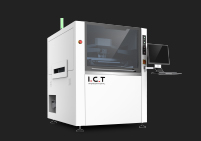
The standard-platform workhorse is the ICT-4034 fully automatic SMT stencil printer, which targets the 400 x 400 mm working area and is the default for medium-to-high volume, mixed-product lines. It is the configuration to match against Persona A's requirements: conveyor-linked, recipe-driven, and specified for continuous multi-shift operation with paste replenishment and stencil changes as the only planned interventions.
The long-board segment is served by the I.C.T 1200 1.2 meter SMD stencil solder printer machine for boards and panels approaching 1,200 mm, and the LED-specific long-panel class by the I.C.T 5151 solder paste PCB SMT machine screen printer fully automatic for LED. Both belong to the same argument as the 4034 — single dominant product, long runs, multi-shift — with the platform sized to the panel rather than to a generic board. In an LED plant the panels are long and the volume is high, which is the combination that makes the automatic class almost unavoidable.
The dual-squeegee segment for NPI fine-pitch work is the I.C.T P3 semi-auto dual squeegee PCB printer with high precision. The dual-squeegee stroke matters in this segment because it allows print parameters to be tuned more finely for the awkward geometries that NPI work produces, without the setup overhead that an automatic recipe would demand.
The standard SMD workhorse of the semi-automatic class is the I.C.T P6 semi-auto SMD solder paste printing machine SMT printer — the machine to reach for when the requirement is a flexible, low-overhead platform that a design engineer can set up in minutes. The high-precision option for QFN and BGA NPI is the I.C.T P12 high-precision semi-automatic SMT screen stencil printer in SMD assembly line, which exists for the case where precision matters but the volume does not yet justify automation. Between them, these three cover the range of NPI requirements from general-purpose to fine-pitch without pushing the plant into a machine class its mix cannot support.
The table below maps the range onto the three personas. Where a persona appears twice, the deciding difference is the working area or the pitch requirement rather than the production model.
Persona | Class | Reference model | Working area | Why this one |
|---|---|---|---|---|
A — high volume | Fully automatic | ICT-4034 | 400 x 400 mm | Multi-shift stability, standard platform |
A / C — long boards | Fully automatic | I.C.T 1200 | 1,200 mm | Long LED panels and oversized boards |
A / C — LED panels | Fully automatic | I.C.T 5151 | 1,500 mm | High-volume long-panel production |
B — fine pitch NPI | Semi-automatic | P3 dual squeegee | 400 x 400 mm | Dual-squeegee stroke for fine pitch |
B — standard NPI | Semi-automatic | P6 | 400 x 400 mm | Flexible, low-overhead workhorse |
B / C — QFN, BGA | Semi-automatic | P12 high-precision | 400 x 400 mm | Precision without automation cost |
Read down the class column and the logic of this article is visible in the product range: the automatic models are matched to the persona whose constraint is operator-hours, and the semi-automatic models to the persona whose constraint is engineering-hours. The overlap rows — the long-board and fine-pitch entries — are where the platform or the pitch requirement overrides the production model, and they are the rows most likely to apply to a Persona C plant working through the migration path.
The personas and numbers above collapse into a short set of rules. They are phrased as conditions, not questions, so they can be applied directly to a procurement agenda. Work down the list and stop at the first rule that fires: each one is written to be decisive on its own, and the order reflects how frequently each condition occurs in practice.
If the line runs more than one shift at sustained volume, default to fully automatic. The night-shift consistency argument is decisive on its own, before any yield calculation, and it does not depend on assumptions about product value.
If the product mix is above roughly five distinct products changing daily, and volume is low, default to semi-automatic. The changeover overhead of an automatic recipe dominates the print time in that regime, and the engineering hours saved are worth more than the machine hours lost.
If a customer is moving you to 0.4 mm pitch QFN or finer, the accuracy trigger overrides volume. Alignment repeatability at 4 sigma decides this, and the semi-automatic class typically cannot hold it on a production basis.
If you need traceability or process audit for the customer, closed-loop SPI is effectively mandatory, which means a fully automatic printer, regardless of headcount economics. This rule fires even in a single-shift plant, which is the case that most often surprises people.
If boards exceed 600 mm, the working area constrains the choice before automation class does. Pick the platform first, then the automation level, because the long-board platform options are narrower than the standard ones.
If the payback case rests on labour alone and labour is cheap, do not force the upgrade. Wait for the yield trigger or the volume trigger; a weak case bought early is a weak case carried for a decade.
If the plant cannot fund the correct machine this year, stage it — do not downsize it. A migration over two budget cycles preserves the capability; a mid-range compromise preserves the budget and loses the capability.
Apply the rules in order and the persona usually falls out of them. For the broader selection framework — working area, panel handling, alignment strategy, inspection interface and the rest — the detailed how to choose an SMT stencil printer for your production needs guide is the companion piece to this one. Read that one for the specification logic; read this one for the decision.
Three next steps follow from the argument above, and they can be taken in any order. Measure the five numbers on the worst product in your mix, across all shifts, before talking to any vendor — the measurement is what makes the rest of the conversation short. Decide which of the three personas your plant actually is, using the table in section 2, and be willing to conclude that it is not the persona the plant assumed. And if the answer is Persona C, treat the migration path in section 10 as the plan rather than as a fallback, because the staged approach is the one that survives a budget review.
Whichever class you end up buying, evaluate the printer and its inspection loop as a single system. The specifications in this article describe what a machine can do; the yield numbers describe what a process delivers, and the difference between the two is almost always the inspection loop that closes around the printer. That is the argument worth carrying into the meeting alongside the price.
Not sure which persona your plant is?
Send the I.C.T engineering team your boards per shift, number of shifts, labour cost and the longest board on your line. We will tell you which of the three profiles you fit, recommend the matching printer class and configuration from the P-series or 4000-series range, and arrange a sample print on your actual board.
Boards per operator-hour, not boards per hour. It folds cycle time and labour content into one figure and makes the comparison honest across the two classes. A fully automatic printer sustains 700 to 900 boards per operator-hour; a semi-automatic printer sustains 200 to 350. If your scarce resource is machine time you are probably a Persona A plant; if it is engineering time you are probably Persona B. Measure it over a full shift on the worst product in the mix rather than during a good hour on the easiest one, because the decision has to survive the awkward cases and the tired shifts.
Probably not on volume alone. At 2,000 boards per shift the labour saving of a fully automatic machine rarely repays the capital premium before year five to seven, unless the labour rate is high. But volume is not the only trigger: if a customer moves you to 0.4 mm pitch QFN, or if you need process traceability, the accuracy and inspection requirements can override the volume arithmetic and pull the decision forward. That is the Persona C situation, and it is usually solved with a staged migration rather than a single purchase, which spreads the capital across two budget cycles and proves the case on one line before the rest of the plant commits.
Yes, and that flexibility is the strongest argument for the class in an NPI cell. The same machine handles 40-board engineering samples and 5,000-board small-batch runs. The variable is operator skill, not machine capability, and once that is managed the semi-automatic printer is the most versatile platform for prototyping and low-volume production. Its weakness is not flexibility; it is throughput per person and repeatability at fine pitch. If your mix regularly includes fine-pitch work for an audited customer, the versatility argument weakens, because the prototype then has to be built under a process that resembles production.
60 to 120 seconds on a modern fully automatic machine with recipe management and automatic stencil recognition, against 5 to 15 minutes on a semi-automatic machine that needs manual support-pin adjustment and squeegee re-teaching. But that fast changeover only applies to a product that already has a validated recipe. For a genuinely new prototype, the time to build and validate the recipe can exceed the time the product will ever spend on the machine, which is why high-mix NPI work often stays semi-automatic. Add the two to five boards most manual lines need before the process returns inside specification, and the practical gap on new work is wider still.
On a high-volume line in a high-labour-cost region, under 12 months once yield is included; 12 to 18 months in Western Europe; two to five years in lower-labour-cost regions on a mid-value product. The labour-only calculation is much slower, which is why the yield engine matters: a 3 to 8 percentage point first-pass yield improvement on a high-value board often repays the capital premium within a year. On a low-value board, the same upgrade can take five years. Note that the yield column assumes the inline SPI loop is installed at the same time as the printer; without it, the automatic machine delivers the cycle time and only a fraction of the yield effect.
Technically it can be paired with inline SPI, but the workflow does not close the loop, because the operator interrupt between printing and inspection breaks the feedback path. A closed loop requires the corrective action to be applied to the same process state that produced the deviation, and on a manual line the board is removed and the next one placed by hand, so the printer's condition has changed in ways the inspection data cannot describe. In practice most semi-automatic lines rely on operator visual inspection and downstream AOI. If inline SPI with automatic recipe adjustment is a requirement — which it usually is for any audited or high-reliability product — a fully automatic printer is effectively mandatory.
For a mid-volume plant with a tight budget, staged migration is usually the better answer. A twelve-month path — baseline audit, pilot line, parallel run, cut-over, parameter lock-in, multi-line rollout — spreads the capital across two budget cycles and validates the choice on one line before the rest of the plant commits. It also produces the trained operators and recipe library that make the second and third machines far cheaper to deploy, and it generates the plant's own measured data to support the next capital request. The only situation that argues for a single cut-over is a greenfield line where there is no existing process to protect, or a plant whose current line is already failing so consistently that the loss outweighs the cost of a controlled interruption.