English
Views: 0 Author: Site Editor Publish Time: 2026-02-03 Origin: Site
In today’s electronics manufacturing world, one question quietly shapes countless investment decisions:
Should I build a fully automatic SMT line, or start with a semi-automatic one?
On the surface, this looks like a simple equipment comparison. In reality, it is a strategic choice that directly impacts your factory’s cost structure, production stability, delivery reliability, workforce requirements, and long-term growth path.
Many factories make this decision based on budget pressure or supplier recommendations. But the most successful manufacturers approach it from a different angle. They ask not which line is more advanced, but which one fits their current production reality and future expansion roadmap.
Many factories only realize they chose the wrong automation level after overtime becomes routine and delivery dates start slipping. By then, the cost is no longer just financial — it becomes operational stress, workforce fatigue, and lost customer trust.
This article will walk you through a practical, factory-level decision framework to help you confidently choose between fully automatic and semi-automatic SMT production lines — without overspending, underbuilding, or locking yourself into an inflexible setup.

When factory owners and production managers debate automation levels, the real concern is rarely about machines. Instead, it centers on four fundamental business risks:
Over-investment risk: Buying advanced equipment that stays idle.
Under-capacity risk: Building a line that quickly becomes a bottleneck.
Quality instability risk: Relying too heavily on manual operations.
Growth restriction risk: Designing a line that cannot scale.
Choosing the wrong automation level can freeze capital, slow production, strain labor management, and force expensive upgrades later. Choosing correctly creates a production system that grows smoothly with your orders.
The right SMT line is not the most automated one — it is the one that matches your factory’s stage, product mix, and growth ambition.

A semi-automatic SMT line combines automated core machines with manual or semi-manual supporting operations. Typical configurations include:
Manual or semi-automatic PCB loading
Manual unloading
Manual inspection and rework stations
In practice, semi-automatic lines rely more on human involvement for material handling, board transfer, inspection, and quality judgment.
On the factory floor, this often means operators constantly moving boards, checking screens, adjusting feeders, and responding to small variations that automation would otherwise absorb. This flexibility is powerful — but it also introduces variability.
Lower initial investment: Entry cost is significantly lower than a fully automatic line.
High flexibility: Manual handling allows quick adaptation to different PCB sizes, shapes, and product types.
Simple operation: Training requirements are lower, making it suitable for new teams.
High labor dependency: Output consistency and yield heavily depend on operator skills and discipline.
Limited scalability: As production volume grows, labor cost and error rate increase sharply.
Semi-automatic SMT lines are often the first step for startups, small factories, and R&D production centers.

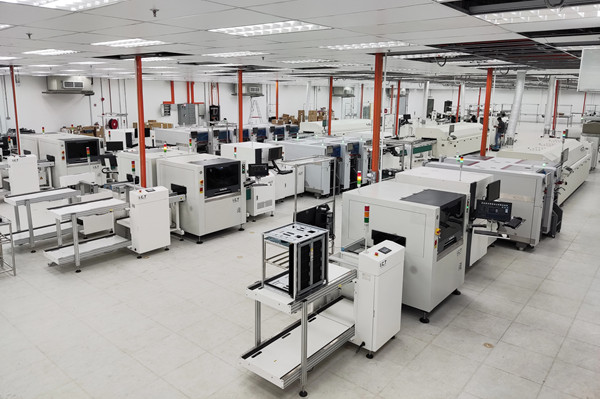
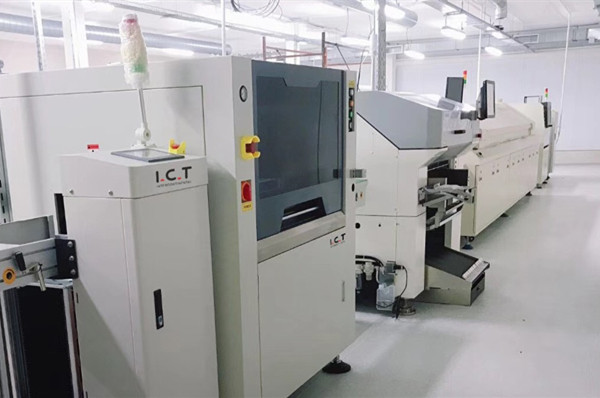
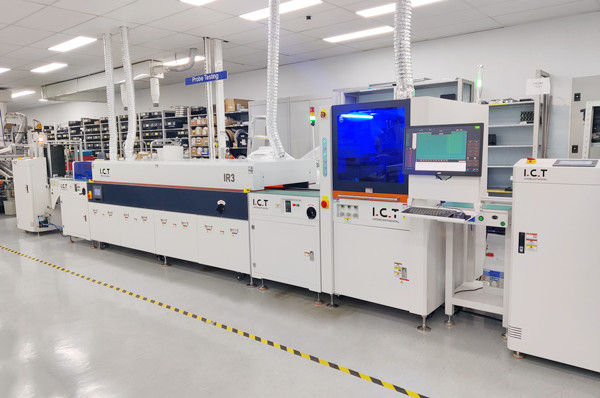
A fully automatic SMT line integrates all major production steps into a closed-loop system with minimal manual intervention. A standard setup typically includes:
Automatic unloader
Intelligent conveyors and buffer systems
This configuration creates a continuous, synchronized production flow where every process step is controlled, monitored, and optimized.
High production stability: Automated transport and inspection significantly reduce process variation.
High throughput: Optimized line balance enables consistent high-speed output.
Lower labor dependency: Fewer operators are needed per shift.
Better traceability: Data collection supports quality analysis and process control.
Higher initial investment: Equipment cost is higher, but long-term operational efficiency is improved.
Fully automatic SMT lines are designed for mass production, stable order flow, and long-term manufacturing efficiency.
| Factor | Semi-Automatic SMT Line | Fully Automatic SMT Line |
|---|---|---|
| Initial investment | Low | High |
| Labor dependence | High | Low |
| Production stability | Medium | High |
| Throughput | Low to medium | Medium to high |
| Quality consistency | Operator-dependent | System-controlled |
| Scalability | Limited | Strong |
| Best use scenario | Startup, R&D, high-mix low-volume | Mass production, stable orders |
Interpretation: In reality, most production problems appear not at the machine level, but at the interfaces between people, process, and equipment. Automation reduces these interfaces, which is why higher automation usually leads to higher stability.

For companies entering electronics manufacturing, capital preservation and flexibility are critical. Semi-automatic lines allow startups to:
Test market demand
Validate product design
Develop process experience
Control financial risk
Investing heavily before stable orders are secured increases financial pressure and reduces operational agility.
EMS factories serving multiple customers often face:
Frequent product changeovers
Wide PCB variations
Short production runs
In such environments, manual handling and flexible setups allow faster line reconfiguration. Semi-automatic systems can outperform rigid automation when adaptability is the top priority.
Research centers and engineering departments need rapid setup, frequent process adjustments, and hands-on control. Semi-automatic lines support:
Fast prototyping
Process experimentation
Low-volume trial production
Automation complexity can slow innovation cycles in these scenarios.
In areas where labor cost remains low and workforce availability is high, the economic return of full automation becomes less attractive. Semi-automatic lines provide sufficient productivity while maintaining cost efficiency.
Industries such as automotive electronics, LED lighting, power electronics, and consumer devices demand:
High daily output
Consistent quality
Tight delivery schedules
Fully automatic lines ensure predictable production capacity and minimize human-induced defects.
In many regions, skilled SMT operators are increasingly scarce. Automation reduces workforce dependency and stabilizes output regardless of staffing fluctuations.
Automotive, medical, industrial, and aerospace applications require:
Traceability
Statistical process control
Stable defect rates
Only fully automated inspection and data integration can reliably meet these demands.
Factories planning aggressive growth benefit from early automation planning. Fully automatic lines scale more efficiently as production increases, avoiding frequent redesign and reinvestment.
Many factories evaluate SMT line investment purely based on purchase price. A more accurate decision requires analyzing total cost of ownership (TCO).
Semi-automatic line: Lower upfront equipment cost
Fully automatic line: Higher initial investment
Labor cost
Yield loss
Rework cost
Downtime
Maintenance
Over time, fully automatic lines often deliver:
Lower labor expenses
Higher yield n- Reduced rework
More predictable maintenance
In long production cycles, OPEX savings can surpass the initial investment difference.
Automation is not just about speed. It directly determines product reliability.
Operator-dependent solder paste quality
Manual inspection variability
Higher risk of handling damage
SPI ensures paste volume accuracy
AOI detects soldering and placement defects
Closed-loop feedback improves process stability
For products where field failure leads to severe consequences, automation becomes a strategic necessity.
In semi-automatic lines, bottlenecks often occur at:
Manual loading/unloading
Inspection
Rework stations
Fully automatic lines distribute cycle times evenly, enabling smooth takt flow and predictable output.
Line balance optimization allows factories to:
Shorten delivery lead time
Improve scheduling accuracy
Increase machine utilization
Larger workforce
Higher training demand
Operator variability
Smaller teams
Focused technical training
Stable operational discipline
In regions with high turnover, automation greatly reduces management complexity.
The smartest factories do not view this as a binary decision. Instead, they design a scalable automation roadmap.
Build process foundation
Develop workforce skills
Validate product demand
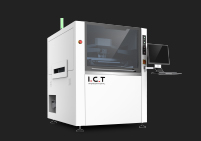
Add automatic printer
Integrate SPI and AOI
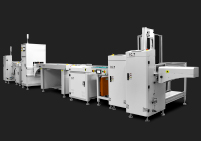
Introduce inline conveyors
Complete inline material flow
Centralized data monitoring
High-throughput production
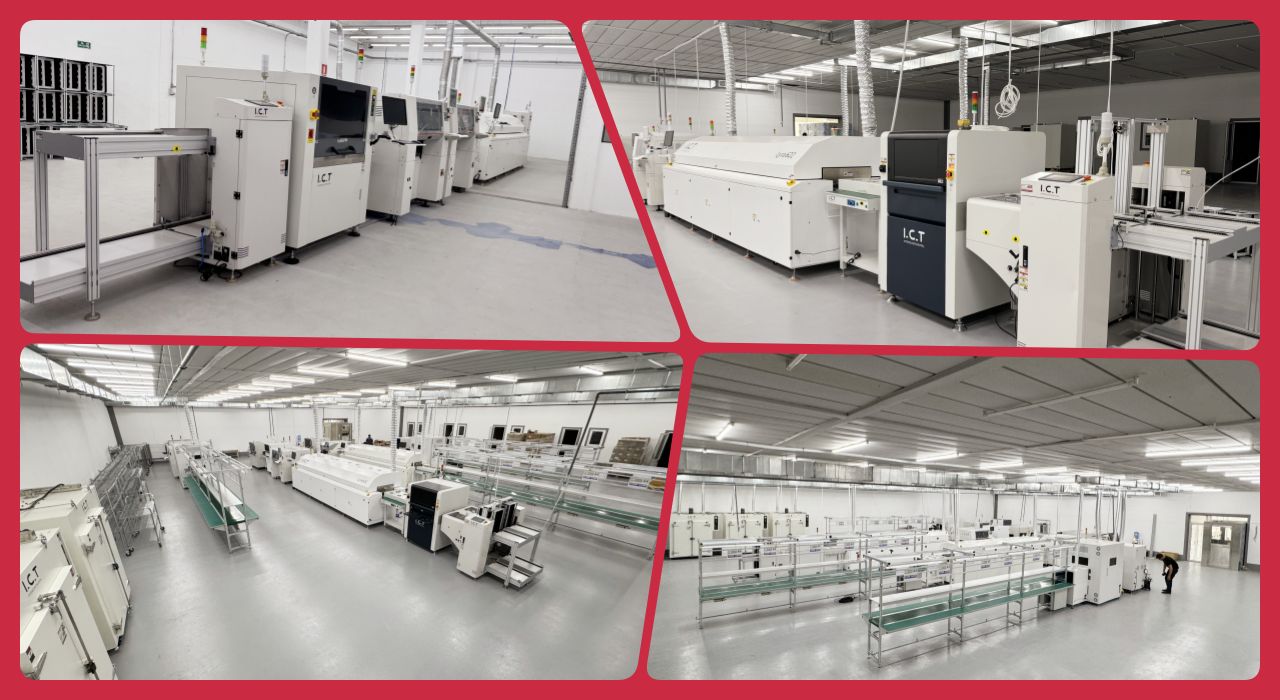
At I.C.T, many SMT lines are designed with this staged automation logic, allowing factories to upgrade inline equipment without rebuilding the entire line. This approach protects early investment while ensuring smooth long-term expansion.
Before finalizing your SMT line strategy, evaluate the following:
Monthly production target
Product stability
Order fluctuation
Labor availability
Quality requirements
Capital budget
Growth forecast (2–3 years)
If most answers point toward uncertainty, flexibility, and low volume, semi-automatic lines may be optimal. If stability, scale, and long-term expansion dominate, full automation is likely the smarter investment.
Buying maximum automation without stable orders
Underestimating labor management complexity
Ignoring future capacity requirements
Designing rigid lines with no expansion room
Strategic planning prevents expensive redesigns.
Choosing between fully automatic and semi-automatic SMT lines is not about equipment level. It is about aligning production capability with business reality.
The best SMT line is not the most advanced one — it is the one that delivers stable quality, healthy cash flow, and sustainable growth.
Understanding your current production reality is the first step. Designing an SMT line that can grow with your factory is what truly protects your investment.