English
 Views: 0 Author: Mark Publish Time: 2026-01-20 Origin: Site


Many SMT lines begin to struggle not because of poor equipment quality, but because the layout decision was fundamentally wrong from day one. Problems often appear gradually: adding a single AOI or X-ray forces days of downtime, buffers end up undersized or poorly positioned, and overall throughput declines over time—even though each machine continues to perform within specification. These issues are rarely random. They are structural consequences of how the line was originally configured.
Choosing between an inline and a modular SMT line layout is therefore not a question of floor space efficiency. It is a long-term manufacturing strategy that directly affects material flow stability, changeover flexibility, system resilience, and the true cost of future expansion.

What makes layout decisions especially dangerous is that their limitations are often invisible at the beginning. During initial ramp-up, both inline and modular lines may appear to run smoothly. The real differences only surface later—when production volumes increase, product mix changes, or additional inspection steps become necessary. By the time these constraints are obvious, correcting them usually requires significant rework, downtime, or capital reinvestment.
To understand why so many SMT lines become constrained early in their lifecycle, it is essential to first examine how layout choices can lock structural limitations into a production line from the very first day.
Many factories only realize too late that their SMT line was constrained from the very beginning. Even when equipped with fast, reliable placement platforms such as JUKI or Hanwha, overall line performance can still degrade month after month. Throughput slowly drops, small adjustments become major disruptions, and every improvement seems harder than expected.
These problems are rarely caused by machine capability. They are the result of layout decisions made early in the project—decisions that quietly lock structural limitations into the line and become increasingly expensive to correct over time.
In the early stage, everything appears to run smoothly. Cycle times are met, buffers stay mostly empty, and the line looks balanced. Over time, however, reality changes. Product variety increases, volumes fluctuate, and changeovers become more frequent.
Waiting time begins to accumulate between processes. Some machines start blocking while others sit idle. The original line balance gradually breaks down, not because individual machines lose performance, but because the layout cannot absorb variation. As a result, overall output declines even though each machine is still operating within specification.

As quality requirements rise, additional inspection such as AOI inspection machine becomes unavoidable. In many inline layouts, adding a single inspection step requires cutting conveyors, shifting multiple machines, and rebalancing the entire flow.
What seems like a minor upgrade can turn into days—or even weeks—of production downtime. By contrast, modular layouts are designed to isolate sections of the line. Inspection units can often be inserted or relocated with minimal impact, reducing disruption to hours rather than days.
This difference becomes critical once the line has already entered stable production. When your assemblies move toward higher-density packages or hidden-joint components, X-ray often becomes a practical requirement rather than a “nice-to-have.” If you want to understand when and why X-ray inspection in PCBA is typically introduced—and what that means for line integration—this can guide how you plan space and modular connection points early.
Buffers are meant to absorb short stops and prevent disruptions from propagating through the entire line. In practice, many SMT lines suffer because buffers were undersized or placed without a clear strategy.
When a single machine stops, material quickly backs up, blocking upstream processes and starving downstream stations. Small, frequent interruptions accumulate into significant output loss. Effective layout planning defines buffer length and placement early, based on process behavior rather than available floor space, to prevent these recurring micro-stoppages.
SMT line layout is often treated as a space-planning exercise—how to fit machines into the available area. In reality, layout decisions define how the entire production system behaves over its lifetime. They determine how smoothly materials flow, how quickly products can be changed, and how costly future modifications become. A poor layout rarely fails immediately; instead, it creates structural bottlenecks that quietly reduce efficiency year after year.
Layout decisions only make sense when you are clear on the full scope of the system you are designing—from printing and placement to reflow, inspection, handling, and traceability. If you want a quick refresher on what an SMT line includes and how each process step affects downstream stability, it can help you evaluate inline vs modular choices with a more complete system view.
Once a line is installed and running, these constraints are difficult to remove without major disruption. That is why layout choice should be evaluated as a long-term manufacturing strategy rather than a short-term installation task.

In a well-designed layout, PCBs move through the line at a steady pace with minimal waiting. Each process hands off smoothly to the next, and small variations are absorbed without stopping the flow. This stability is what allows throughput to remain predictable over time.
In a poorly designed layout, material flow becomes uneven. Queues start forming in front of printers, reflow ovens, or inspection stations. These waiting periods are often overlooked because machines appear busy, but they directly reduce effective output. Over time, small delays compound into significant losses, even though individual machines continue to operate at rated performance.
As product mix increases, layout flexibility becomes a decisive factor. Efficient product changeovers depend on easy feeder access, clear material paths, and the ability to isolate setup activities from running processes.
Inline layouts tightly link all machines into a single flow. While this can be efficient for stable production, it also means that many changes require stopping the entire line. In contrast, modular layouts are designed to decouple sections. Teams can prepare feeders, adjust programs, or validate processes in one module while other sections continue operating, significantly reducing downtime.
This difference becomes increasingly important as product variety and change frequency grow.
Layout decisions also determine how expensive future changes will be. In an inline configuration, relocating a printer, reflow oven, or inspection system often involves dismantling conveyors, shifting multiple machines, and rebalancing the entire line. The true cost is not just labor—it is weeks of lost production and delayed deliveries.
Modular layouts are built with change in mind. Equipment can be added, repositioned, or upgraded with limited impact on adjacent sections. Over the lifetime of a factory, this flexibility translates directly into lower operational cost and less disruption when business requirements evolve.
An inline SMT layout connects all machines into a single, continuous production path. Its core strength lies in speed and rhythm. When production conditions are stable and predictable, inline configurations can deliver very high throughput with minimal material handling and clean process flow.
This is why inline layouts remain widely used in environments where product variety is limited and production runs are long. Under the right conditions, they are efficient, easy to understand, and capable of impressive output.

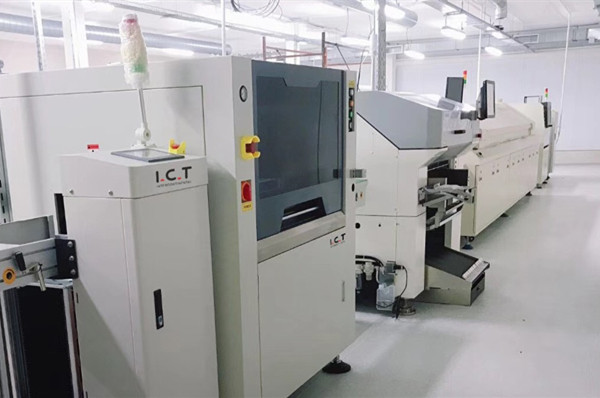
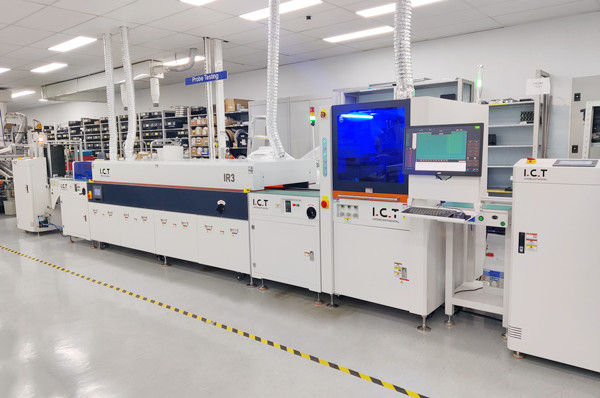
In an inline layout, PCBs move directly from solder paste printing to placement, reflow, and inspection without intentional breaks in the flow. Conveyors are tightly linked, and each process hands off immediately to the next.
This uninterrupted movement minimizes manual handling and can reduce cycle time when the line is well balanced. As long as every process operates within a narrow performance range, the line behaves like a single machine, advancing boards at a steady pace with little variation.
The effectiveness of this model depends entirely on balance and consistency.
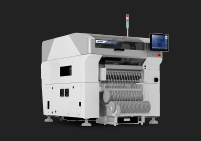
Inline layouts align naturally with the strengths of high-speed placement platforms. Machines from manufacturers such as JUKI and Hanwha are designed to run continuously at high throughput, feeding components at full speed with minimal interruption.
When product types remain unchanged for extended runs, the steady material flow of an inline line allows these platforms to operate close to their optimal performance envelope. Changeover frequency is low, feeder configurations remain stable, and placement speed becomes a true advantage rather than a theoretical specification.
In this scenario, inline layouts can deliver maximum output with relatively simple line control.
The same tight coupling that enables high speed also introduces a fundamental risk. Because all machines are linked directly, a stop at any single process point propagates immediately through the entire line.
A feeder error, routine maintenance, or a minor adjustment on one machine can bring the whole line to a halt. Buffers offer limited protection in this configuration, as there is little physical or logical separation between processes. As production complexity increases, even small and frequent interruptions can significantly impact overall efficiency.
This structural vulnerability becomes more pronounced in factories with high product mix, frequent changeovers, or limited tolerance for downtime—conditions that many operations only encounter after the line has been running for some time.
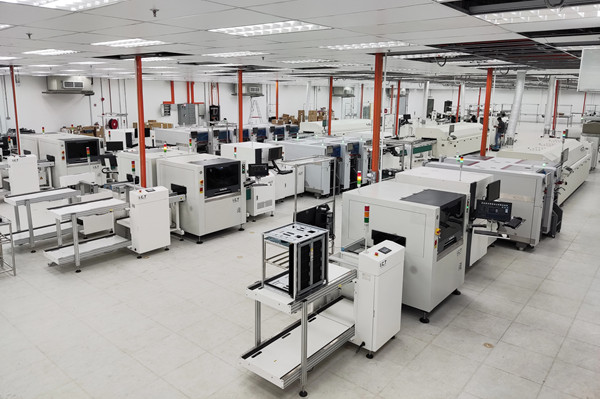
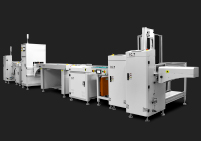
A modular SMT line layout divides the production line into multiple functional sections, connected by short conveyors or buffer units. Unlike inline layouts that behave as a single continuous system, modular configurations are designed to tolerate variation. Each section operates with a degree of independence, allowing the line to absorb disturbances without immediately forcing a full stop.
This design philosophy prioritizes resilience over absolute speed. As production conditions evolve, modular layouts provide a more forgiving structure that can adapt without constant rebalancing.

In a modular layout, solder paste printing, placement, reflow, and inspection are treated as distinct process modules. These modules are linked, but not tightly bound. When an issue occurs in one section—such as a feeder adjustment or inspection tuning—the impact on the rest of the line is limited.
Buffers between modules temporarily hold PCBs while the issue is resolved, allowing upstream processes to continue running. This separation prevents small disruptions from cascading through the entire line and turning minor events into full production stops.
Over time, this semi-independent structure significantly improves operational stability, especially in environments with frequent adjustments.
Buffers in a modular layout do more than store boards. They act as shock absorbers for the production system. Short downstream interruptions no longer force immediate upstream shutdowns, and recovery after a stop is faster and more predictable.
Short conveyors between modules also play a critical role. They simplify physical separation between processes and make it easier to insert, remove, or reposition equipment without reworking the entire line. Instead of redesigning material flow, changes can be localized to a single module.
This combination of buffers and short connections is what allows modular lines to maintain throughput even when conditions are less than ideal.
Inspection requirements tend to grow over time. Additional SPI, AOI, or selective X-ray steps are often introduced as quality standards tighten or product complexity increases. Modular layouts are inherently well suited to this evolution.
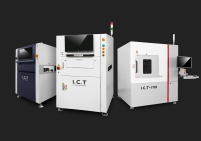
Because modules connect through flexible interfaces, inspection platforms can be added or repositioned with minimal disruption. Modern systems—such as those provided by I.C.T—are designed to integrate smoothly into modular lines, allowing inspection steps to be inserted where they provide the most value without forcing a full line rebuild.
As a result, inspection upgrades in modular configurations typically require far less downtime and engineering effort than in tightly coupled inline layouts. AOI is one of the most frequently added or repositioned inspection steps as product requirements evolve, especially when you introduce more variants, tighter workmanship rules, or customer-specific quality gates. A clearer understanding of how AOI works in PCB assembly makes it easier to decide where modular connection points and buffer capacity should be reserved from the beginning.
There is no universally “correct” SMT line layout. The right choice depends on how your factory actually operates today—and how it is likely to change over the next few years. Looking at real production scenarios makes the differences between inline and modular layouts much clearer than abstract comparisons.
High-mix, low-volume environments place constant pressure on line flexibility. Frequent product changes, different board sizes, and varied component sets make changeover efficiency critical.
In these conditions, modular layouts usually perform better. Teams can prepare feeders, adjust programs, or fine-tune inspection settings in one module while other sections continue running. Downtime is localized rather than global. Inline layouts, by contrast, often require full-line stops for changeovers, turning short setup tasks into extended production losses.
As product variety increases, this difference becomes increasingly visible in daily output.

When production is focused on one or two products with long, uninterrupted runs, inline layouts show their strength. Continuous flow minimizes handling, and the line can be finely balanced for maximum throughput.
In this scenario, high-speed placement platforms such as Hanwha operate close to their optimal conditions. Changeovers are rare, feeder configurations remain stable, and the cost per assembled board is typically lower than in more segmented layouts.
Inline works best when variability is intentionally kept out of the system. Many consumer electronics programs reward stable high-volume execution, where uptime, takt consistency, and cost per board dominate the decision model. If this resembles your production reality, reviewing how SMT lines for consumer electronics are typically specified can help you confirm whether an inline layout will stay efficient as volumes scale.
In regions with high labor costs, downtime quickly becomes expensive. When a line stops, operators, technicians, and supervisors often wait idle while issues are resolved.
Modular layouts help reduce this hidden cost by limiting the scope of stoppages. Maintenance, adjustments, or minor issues in one module do not necessarily bring the entire line to a standstill. Inline layouts, on the other hand, demand near-perfect balance and reliability to avoid costly idle time across the whole workforce.
For many European factories, this resilience can outweigh pure speed considerations. In Europe, layout decisions are often driven not only by labor cost, but also by reliability and audit expectations—especially for automotive and industrial programs.
If you are building toward higher-reliability production, SMT line planning for automotive electronics provides useful context on why inspection expansion, traceability, and process stability tend to shape layout strategy early.
Inspection requirements rarely stay static. In many factories, the first inspection step that gets added or upgraded is solder paste inspection, because it prevents downstream defects and reduces rework loops. Understanding how SPI machines in SMT lines are typically placed and used will help you predict whether your layout will accept new inspection steps cleanly—or force disruptive rework later. As quality standards tighten and products become more complex, additional SPI, AOI, or X-ray steps are often introduced.
Modular layouts are inherently better suited to this evolution. Existing buffer space and flexible interconnections allow inspection equipment to be added or repositioned with limited disruption. Inline layouts may require significant conveyor rework and line rebalancing to accommodate new machines, turning quality improvements into major engineering projects.
If inspection expansion is part of your medium-term plan, layout flexibility becomes a decisive factor.
When teams compare SMT line layouts, the focus is often on initial investment and installation speed. What is frequently underestimated is how much future change will cost—in time, labor, and lost output. Layout decisions determine whether expansion and modification are routine adjustments or disruptive projects that consume weeks of production capacity.
As you plan expansion, it helps to think beyond physical equipment moves. Many factories are also preparing for higher automation maturity, where data, traceability, and adaptive control become part of the production strategy. If you are exploring what lights-out manufacturing looks like in practice—and what it demands from your line architecture—this is worth reviewing as part of your long-term layout decision.
Over the lifetime of a factory, these hidden costs often exceed the original price difference between layout options.

Adding a single machine is a common requirement, whether for extra inspection, buffering, or capacity relief. In inline layouts, this typically involves cutting conveyors, shifting multiple machines, and rebalancing the entire flow. Even a well-planned change can result in days—or sometimes weeks—of downtime.
In modular layouts, new machines are added as additional sections. Existing modules remain largely untouched, and integration is localized. In many cases, installation and commissioning can be completed within hours, allowing production to resume quickly with minimal throughput loss.
The difference is not theoretical—it shows up directly in delivery schedules and customer commitments.
Large equipment such as printers and reflow ovens are among the most difficult elements to relocate. In inline configurations, moving one of these machines often requires disconnecting multiple upstream and downstream processes, realigning conveyors, and restoring line balance from scratch.
Modular designs reduce this impact by isolating major equipment within defined sections. A printer or oven can be repositioned or replaced without forcing a complete line teardown. Labor requirements are lower, restart is faster, and the risk of introducing new instability is significantly reduced.
As factories evolve, this flexibility becomes increasingly valuable. Reflow ovens are not only physically difficult to relocate—they also become core data nodes when you move toward traceability and smart factory integration.
If your roadmap includes recipe control, profiling discipline, and connectivity, understanding Industry 4.0 reflow integration helps you evaluate whether your layout supports clean upgrades without forcing major line restructuring.
Placement technology does not stand still. When higher-speed or higher-accuracy platforms become available, many factories want to upgrade incrementally rather than rebuild the entire line.
In tightly coupled inline layouts, upgrading to faster placement platforms—such as newer models from JUKI or Hanwha—often forces a full re-evaluation of line balance. Downstream processes may need to be upgraded simultaneously to avoid new bottlenecks, increasing cost and disruption.
Modular layouts allow a phased approach. One placement module can be upgraded first while other sections continue operating at their existing pace. Investment is spread over time, and performance improvements are introduced without destabilizing the entire line.
Before committing to an SMT line layout, step back and evaluate your situation honestly. This checklist is designed to help you compare your real operational needs against the strengths and risks of each layout option. There are no right or wrong answers—only safer and riskier choices based on your context.
Start with your product mix. If you assemble many different boards in small batches and change products frequently, modular layouts generally provide a safer operating margin. Changeovers can be isolated, and setup work does not always require stopping the entire line.
If your production focuses on a small number of products with long, uninterrupted runs, inline layouts can perform very well. The key is consistency. The more variation you introduce, the more stress you place on a tightly coupled line.
Next, consider how stable your production volume is likely to be over the coming years. Inline layouts are most effective when volume remains predictable and balanced over time. They reward stability with high efficiency.
If demand is uncertain, growing, or expected to shift toward a higher product mix, modular layouts handle these changes more gracefully. They allow capacity and process adjustments without forcing a complete line redesign.

Layout decisions also reflect how much flexibility you want to preserve financially. If you have limited tolerance for future downtime, relocation costs, or repeated engineering work, modular layouts help minimize these expenses over the life of the factory.
If you are willing to invest more upfront and expect little need for future modification, inline layouts may deliver a lower cost per board in stable conditions. The trade-off is reduced flexibility later.
Inspection requirements rarely decrease over time. If your roadmap includes multiple AOI, SPI, or X-ray steps—either now or in the near future—modular layouts simplify integration and reduce disruption.
If inspection needs are minimal and unlikely to expand, inline layouts remain straightforward and efficient. The more inspection you add, the more valuable layout flexibility becomes.
Finally, evaluate your team’s experience. Inline layouts demand disciplined operation, fast troubleshooting, and efficient changeover execution. Teams with strong process control and clear routines can succeed in these environments.
If your team has less experience managing frequent stops or complex changeovers, modular layouts provide a more forgiving structure. They reduce the impact of human error and make recovery faster when issues occur.
Inline layout excels in stable, high-volume runs with continuous flow and high-speed placement like JUKI and Hanwha. Modular layout offers better resilience for changes, high-mix low-volume, and future expansions with easier integration of I.C.T inspection and buffers. The right choice depends on product mix, volume stability, inspection plans, and tolerance for future change costs—not just initial space or price. Use the 5-point checklist to match your real situation and avoid expensive rework later.
Contact our team at market@smt11.com for a free layout review or help choosing the right configuration for your next SMT line.

Yes, but it is expensive and slow. Inline lines have tight connections, so switching to modular means cutting conveyors, adding buffers, and rebalancing everything. Many factories spend months and lose production during the change. It is better to choose modular from the start if you think flexibility will matter later. Inline-to-modular conversions often cost more than building modular first because you pay twice for some work.
Not always. Modular needs more conveyors and buffers at start, so initial cost can be 10–30% higher depending on line length. But inline saves money only if you never change much. When you add machines or products later, modular usually pays back fast because changes cost less time and labor. In high-mix or growing factories, modular total cost over 3–5 years is often lower.
Both work in either layout because JUKI and Hanwha are high-quality. Inline suits them best for stable high-volume because their speed matches continuous flow. Modular is better if you change setups often—different feeder setups or speeds can run more independently. Many factories mix both brands in modular lines successfully by using buffers to balance slight speed differences.
Small space pushes toward inline because it uses a straight path and less conveyor. But modular can fit small spaces too with shorter buffers and compact sections. If space is very tight and you expect few changes, inline is practical. If you foresee adding inspection or products, modular still offers more value even in small areas by avoiding big disruptions later.
Buffer length depends on your longest expected stop. For most lines, 1–2 meters per critical station (like placement or inspection) is enough to absorb feeder reloads or minor jams (5–15 minutes). Add more if you have frequent long stops or high-value boards that cannot wait. Test with real runs: too little buffer causes backups; too much wastes space. Start with 1.5 meters average and adjust after first months.