English
 Views: 0 Author: Site Editor Publish Time: 2026-05-16 Origin: Site


You can see the roi of investing in smt automation because it gives clear benefits. These benefits include higher productivity and lower costs. When you upgrade your manufacturing line with good machine parts, you make it more reliable. This also helps your machines work the same way every time. The table below shows how this choice affects your investment lifecycle:
Aspect | Initial Investment | Long-term Savings |
|---|---|---|
Equipment Cost | Higher | You save a lot because machines use less energy and last longer. |
Maintenance | Higher | You pay less because the parts are reliable. |
Downtime | Higher | You have less downtime because machines work better and break less. |
Genuine parts help you reach Class 3 quality. They help you meet industry standards. They keep your line running well for millions of cycles.
Putting money into SMT automation helps you work faster and spend less money, so you make more profit.
Finding and fixing slow spots in your SMT line can help things run smoother and stop machines from being off for too long.
Machines that work by themselves need fewer workers and make fewer mistakes, so you can make things quicker and better.
Using good SMT machine parts makes your machines last longer and break less, which means you do not have to pay a lot to fix them.
Automation helps companies give customers what they want by making sure things are made on time and always good quality.
You must find bottlenecks to make your smt assembly better. Bottlenecks slow things down and make costs go up. Some common bottlenecks in old SMT lines are:
Feeder reconfiguration takes a lot of time. Workers have to change feeders by hand. This can use up about 30% of work hours.
Placement accuracy can get worse when machines run for a long time. Heat can build up and make accuracy drift over 50 micrometers.
You can check for these bottlenecks by looking at how long changeovers take. If changeovers are faster, your line works better. Many companies use simulation tools to try out different setups and schedules. Some use digital twins and cyber-physical systems to find and fix problems quickly. These tools help your smt assembly line run well.
Tip: Check your production data often. This helps you see patterns and fix problems before they get big.
You can pick manual, semi-automated, or fully automated SMT lines. Each one changes your costs, defect rates, and how many boards you make. The table below shows how they compare:
Type of Printing | Initial Cost | Labor Cost | Defect Rate | Throughput |
|---|---|---|---|---|
Manual Stencil Printing | $2,000 - $5,000 | High ($20/hour, $160/day) | Higher (5-10% rework) | Low (up to 150 boards/day) |
$8,000 - $14,000 | Moderate ($80/day) | Lower (2-5% rework) | Medium (up to 500 boards/day) | |
$30,000 or more | Low ($40/day) | Very low (under 1% rework) | High (over 500 boards/day, often thousands) |
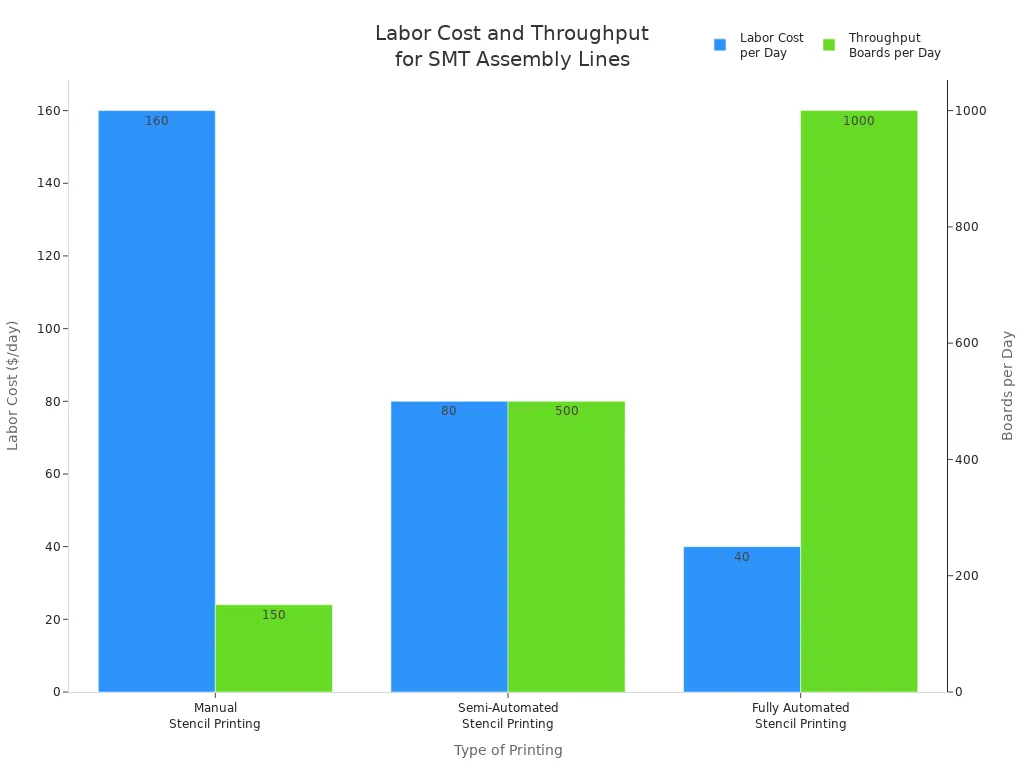
Automation helps lower labor costs and defect rates. It also lets you make more boards each day. This means fewer mistakes and more products. Upgrading to automation helps you keep up with others and meet what customers want.
You want to know if SMT automation is worth it. The best way to check is by finding ROI. ROI means return on investment. The formula is easy:
ROI = (Net Gain from Investment / Cost of Investment) x 100%
First, you look at what you spend on new machines. Then, you compare this to the money you save and earn later. Many companies see good results after switching to automated SMT lines. The table below shows how fast you can get your money back:
Investment Level | Typical ROI Timeline |
|---|---|
Entry-level lines | Under 18 months |
Mid-range lines | 24–30 months |
High-volume lines | 18–24 months |
Most times, ROI comes in less than two years. This means you start making more money quickly. You also get better manufacturing ROI because you make more products with fewer mistakes.
Upgrading your SMT line makes your work faster and smoother. Automated systems help you avoid big errors and waste. You get steady quality, so fewer boards need fixing. This gives you better manufacturing ROI and helps you stay ahead.
Tip: Keep track of your production numbers before and after upgrades. This shows how much your ROI and quality improve.
You might worry about spending a lot at first. But you should think about how much you save later. The table below shows an example:
Description | Amount |
|---|---|
Initial Capital Investment for Automated SMT Assembly Line | $220,000 |
Projected Additional FTEs by 2030 | 90 |
Importance of Calculating Payback Period | Critical for assessing savings against hiring costs |
You pay more at the start, but you save much more over time. The ROI comes from paying less for workers, less waste, and fewer mistakes. You also do not need to hire many new people as you grow.
Here are some big ways you save after automation:
Savings Area | Description |
|---|---|
Labor Savings | Cutting extra jobs and making work easier saves money. |
Material Savings | Better inventory and less waste save on materials. |
Rework Savings | Fewer mistakes and better quality mean less fixing. |
Waiting Time Reduction | Matching materials and schedules cuts waiting time. |
Defect Prevention | Inspection systems catch mistakes early and improve results. |
You see ROI in every part of your process. You spend less on workers and materials. You get better quality and fewer delays. This helps your manufacturing ROI and lets you reach your goals faster.
Note: Always check your current costs against what you could save. This helps you make smart choices and get the best ROI.
When you focus on quality and working better, you get more from your investment. You also boost your manufacturing ROI and set your business up for success.
You want your shop to work well every day. SMT automation helps you make more boards fast. Many companies have checked these improvements. The table below shows how much better production can get with SMT upgrades:
Industry | Measurable Increase in Throughput | Additional Benefits |
|---|---|---|
Automotive | 40% less production time | 25% fewer component failures |
Consumer Electronics | 30% faster production speed | 15% lower manufacturing costs |
General SMT Implementation | 30-50% less total production time | Easier workflows and more output |
SMT lines help you finish jobs much faster. This means you make more products in less time. Machines also run longer without stopping, so you have less downtime.
A fully automated SMT line can cut board cycle time by half compared to semi-manual setups.
IoT sensors in new SMT machines can lower surprise downtime by 90%.
AI maintenance planning helps you reach 94.7% uptime, but old ways only get 86.2%.
Less downtime means your business does not slow down. You keep making products and your customers stay happy.
SMT automation does more than make things faster. It also makes it cheaper to keep machines working. You spend less money fixing machines and see fewer broken boards. Here are some results from places that use automated SMT equipment:
Maintenance costs per hour dropped by 28%, from $18.60 to $13.40.
Unplanned downtime went down by 40%, from 1,240 hours to 744 hours each year.
You save money because machines break less often. You also throw away fewer boards, so there is less waste. This helps you work better and keeps costs low. When you use SMT automation, you make more and waste less.

You want your production line to work well every day. High-quality smt machine parts help you do this. These parts make sure your line does not stop often. When you use the best parts, you get fewer mistakes and less fixing. This means your products meet quality rules more times. You also do not spend as much time fixing machines.
Here are some ways high-quality smt machine parts help your line:
They stop surprise breaks, so you keep making things.
They help you make better products with fewer errors.
Strong parts mean you do not fix or change them a lot.
Advanced parts let you work faster and stay accurate.
Using real parts stops problems and keeps your line working well.
Tip: Pick high-quality smt machine parts to save on fixing costs and make your line better.
You want your machines to last a long time. High-quality smt machine parts help you do this. When you buy good parts, your machines can work hard for many hours. This makes your machines more reliable and last longer.
Premium machines, like YAMAHA mounters, use strong parts that do not wear out fast. You see fewer stops and spend less money fixing things. Your machines work more, so you make more products. But even the best machines need care. If you use them too much without checking for changes, you might still get bad solder joints.
Premium machines use high-quality smt machine parts for better results.
You get fewer breaks and spend less on repairs.
Your line works well for more years.
When you care about quality and use the right parts, your smt machines work better and last longer. This helps you get more from your money.
Your SMT line must work with many products. Customers always want new designs and features. Automated SMT systems help you change boards fast. Modular machines let you switch setups quickly. This saves time. You can add machines if you get bigger orders. Real-time monitoring shows live updates about your machines and jobs. You can make quick choices if something changes.
Feature | Description |
|---|---|
Flexibility | Modular equipment lets you switch between products fast. This cuts downtime. |
Scalability | You can make more boards by adding machines when needed. |
Real-time monitoring | Live updates help you fix problems and change schedules fast. |
You may have some problems. New equipment costs a lot. You must check if buying it keeps your production flexible. You also need to teach your team how to use new machines. Products change quickly, so you must keep up with speed and accuracy. Good planning helps you stay ahead.
Tip: Use event-driven rescheduling to save money when you change jobs or fix machine issues.
You want every board to be high quality. Automated SMT lines use tools to make products better. Automated Optical Inspection (AOI) checks for missing parts or mistakes right after assembly. AOI finds up to 99% of defects. Manual checks only find about 85% to 90%. X-ray inspection finds hidden problems you cannot see. These tools help you keep product quality steady.
To keep your quality high, you should:
Choose the right parts and manage them well.
Make sure solder paste printing is correct.
Put each part in the right place.
Control the reflow soldering process.
Clean boards and use coatings to protect them.
Use AOI and X-ray checks.
Test boards to make sure they work.
Track your results and fix problems over time.
You can use AI and Industry 4.0 tools to make production even better. Training your team and using new materials will help you improve product quality every year.

You must keep your SMT line safe from problems. Using low-quality parts can cause trouble. Fast machines might make bad boards before you notice. Fixing these boards is hard because they are small and crowded. Solder joints connect parts together. If they break, your products might not work. Sometimes, tiny parts have unclear markings. This can cause mix-ups and waste. Hot soldering can hurt parts inside, called “popcorning.” Cleanliness matters because close parts can get dirty.
Risk Type | Description |
|---|---|
Quality Control Challenges | Bad boards make more waste. |
Difficulty in Repair or Replacement | Small, crowded boards cost more to fix. |
Reliance on Solder Joints | Broken joints make products less reliable. |
Part Identification Difficulties | Mix-ups mean you must check or throw away parts. |
Increased Thermal and Moisture Susceptibility | Heat and moisture can damage parts inside. |
Stringent Cleanliness Needs | Dirt can mess up how boards work. |
You can lower these risks by picking good parts. Calibrate your pick and place machines often. This keeps placement very accurate. Automated optical inspection checks boards for mistakes. Well-trained workers help stop errors. These steps make your line safer and your products better.
You want your SMT line to grow as your business grows. Automated lines help you scale up. Dual-lane systems can make much more boards each day. You can run different products at the same time. If one lane stops, the other keeps going. This means less downtime and steady work.
Advantage | Description |
|---|---|
Higher Output Capacity | Dual-lane systems make more boards every day. |
Flexibility for Product Change | One lane can run a new product, so you wait less. |
Built-in Redundancy | If one lane breaks, the other keeps working. |
AI-driven optimization helps you prepare for the future. You can connect machines and watch data live. AI finds patterns and helps you fix problems early. You move from checking for mistakes after making boards to stopping them during production.
The factory of the future uses today’s technology. You can see how product data moves between machines, materials, and quality systems. By connecting equipment and using live data, you find links between conditions and defects. This lets you go from reacting to mistakes to stopping them before they happen.
AI also helps manage supply chains and maintenance. You cut downtime and waste while making more boards. These tools help you stay ahead and keep your SMT line ready for new challenges.
You want your customers to trust your products. SMT automation helps you give them fast delivery and good quality. Automated systems work with customer tools and order software. This helps you send quotes and shipping updates quickly. You can answer questions faster and keep your info correct. Customers want you to deliver on time and keep your word. With SMT automation, you can handle order changes right away. Your production stays steady and your customers stay happy.
Automation makes customers happier in many ways:
Automation makes your process faster and more reliable.
Using the right amount of materials every time keeps things the same and cuts waste.
Fewer mistakes and more good boards mean less fixing and more happy customers.
Fewer problems in the field mean your products work well for customers.
Automation helps you build trust and loyalty. Customers know they can count on you for good products and quick service.
You want your business to be noticed in the market. SMT automation helps you do better than others. You use AI to find and fix mistakes and make your process better. Predictive maintenance keeps machines running longer and saves money. Automation changes how you handle your supply chain. You can see everything and guess what you will need. This helps you react to market changes faster.
The table below shows how SMT automation helps you compete:
Evidence Description | Impact on Market Position |
|---|---|
AI reduces defect rates through advanced inspection and process optimization. | Lower costs and improved yield enhance competitiveness. |
AI-enabled predictive maintenance minimizes downtime and enhances equipment lifespan. | Reduces operational costs, allowing for more competitive pricing. |
Adoption of automation reshapes supply chain management. | Enables end-to-end visibility and predictive logistics, improving responsiveness to market demands. |
Competitive positioning shifts toward integrated, data-driven manufacturing ecosystems. | Companies can leverage data for better decision-making, enhancing their market agility and responsiveness. |
Comprehensive product portfolio and technological leadership as competitive advantages. | Differentiates the company in the market, allowing for a stronger position against competitors. |
Using technology and data gives you a stronger spot in the market. You can offer more products and show you are a leader. SMT automation helps you stay ahead and grow your business. You get a good name for quality and reliability. This brings in more customers and keeps you strong against others.
You can get more ROI with SMT automation. It helps you save money and work faster. You also get better quality. High-quality SMT machine parts keep your line working well. They help you make better products. Look at the table below to help plan upgrades:
Factor | Description |
|---|---|
Long-Term ROI | Mid-range machines with 7-year service contracts cost 22% less over time. |
Predictive Maintenance | Built-in sensors cut surprise downtime by 31%. |
Energy Efficiency | New designs use 19% less energy and need less space. |
Check how you work now. Set clear goals for your business. Make plans to grow for many years.
SMT automation uses machines to place and solder parts on circuit boards. You get faster production, fewer mistakes, and better quality. You can make more boards in less time.
Automation lowers labor costs and reduces waste. You spend less on repairs and get more products out. Your investment pays off faster because you work smarter and save money.
Yes. High-quality parts help your machines run longer and break less. You get fewer errors and spend less on maintenance. Your line stays reliable.
You can upgrade one machine at a time.
Start with the biggest bottleneck.
Add more automation as you grow.
This helps you control costs and see results quickly.
Sign | What You Notice |
|---|---|
Frequent Downtime | Machines stop often |
High Scrap Rates | Many boards get wasted |
Slow Production | Orders take too long |
If you see these, you should consider an upgrade.