English
Views: 0 Author: Site Editor Publish Time: 2026-04-17 Origin: Site
Choosing the right reflow oven isn’t just a technical decision—it can make or break your SMT production line. Many manufacturers struggle with unpredictable solder joints, fluctuating first-pass yield, and hidden rework costs when their oven doesn’t match production volume or product mix. Inline reflow ovens offer high-speed, continuous processing for large-scale operations, while batch reflow ovens provide precise, uniform heating and flexibility for small-batch or prototype runs. By understanding the pros and cons of inline versus batch reflow ovens, electronics manufacturers can optimize PCB yield, reduce operating costs, and ensure consistent, lead-free soldering quality—turning a critical piece of equipment into a strategic advantage.
But choosing the right reflow oven isn’t just about picking a machine—it’s about matching technology to production realities. Different PCB designs, batch sizes, and product mixes bring unique challenges, from thermal profile instability to excessive rework. To make an informed decision, manufacturers need to understand not only the basic differences between inline and batch reflow ovens, but also how these differences directly impact throughput, yield, and long-term operational costs. The next section breaks down the most common pain points in reflow soldering and shows why oven selection plays a critical role in solving them.
Reflow soldering is the final, critical step in SMT assembly, where solder paste melts to create permanent connections between components and the PCB. Many manufacturers face costly defects—tombstoning, solder bridging, insufficient wetting, or excessive voids—especially with lead-free alloys that require peak temperatures of 235–250°C. These issues often result from mismatched oven capabilities, leading to production delays, higher scrap rates, and even customer returns. While placement errors already contribute to assembly problems, poor reflow control compounds them, driving down first-pass yield and inflating rework costs.
Choosing the right reflow oven—inline or batch—directly affects throughput, thermal profile stability, and overall line efficiency. An oven that doesn’t match production needs can create bottlenecks, increase energy consumption, and require frequent manual interventions that drive up labor costs. On the other hand, aligning oven capabilities with actual production volumes and product mix improves consistency, reduces rework, and accelerates time-to-market. Experienced providers like I.C.T help manufacturers evaluate their lines and select reflow ovens that maximize PCB yield while controlling costs, turning a critical piece of equipment into a strategic advantage.
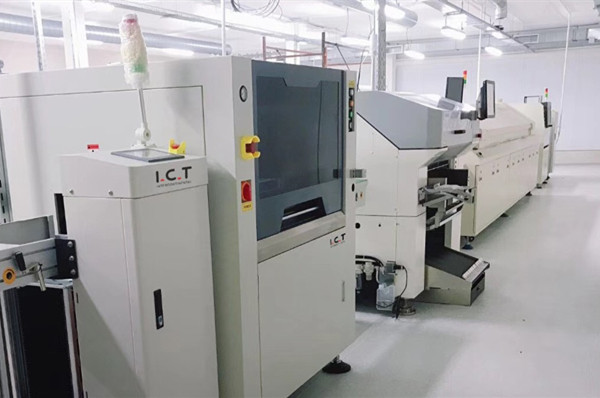
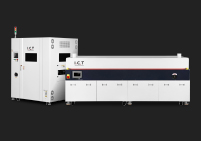
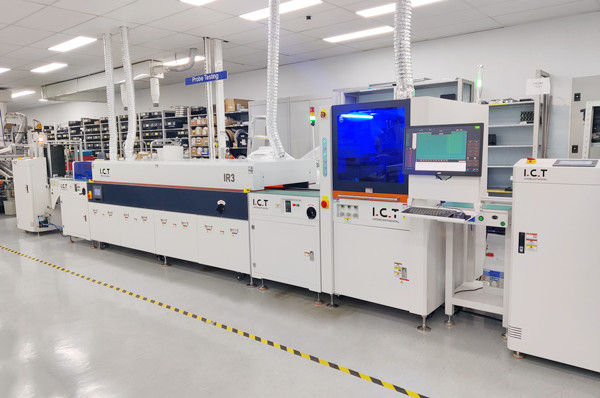
Inline reflow ovens, also known as conveyorized ovens, integrate directly into the SMT production line. PCBs move continuously on a conveyor through multiple independently controlled heating zones followed by cooling sections. Most systems feature 8–12 zones, precise PID temperature control, and optional nitrogen atmosphere.
Why it matters to your production:
Delivers stable thermal profiles even at high throughput.
Seamless integration with pick-and-place machines, SPI, and AOI systems.
Supports speeds exceeding 30 inches per minute and handles high-density, complex boards efficiently.
Inline ovens are ideal for high-volume, continuous production, where consistency and efficiency are critical.
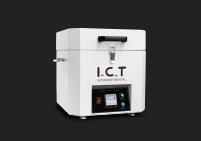
Batch reflow ovens process one tray or chamber load at a time. Operators load PCBs into a sealed chamber, run a programmed cycle, and unload before starting the next batch. While these ovens typically have fewer zones, the entire load experiences uniform heating without conveyor movement.
Why it matters to your production:
Excellent temperature uniformity for small runs and prototypes.
Easy recipe changes, making it ideal for multi-product or R&D lines.
Compact footprint, suitable for labs or facilities with limited space.
Batch ovens are well-suited for low-volume, high-mix production, or when flexibility and precise thermal control are more important than throughput.
Aspect | Inline Reflow Oven | Batch Reflow Oven |
|---|---|---|
Process Type | Continuous conveyor flow | Discrete batch processing |
Typical Throughput | High (hundreds to thousands of boards per hour) | Low (1–15 boards per cycle, depending on size) |
Best For | High-volume, stable production runs | Small batches, frequent product changes, prototyping |
Flexibility | Lower for recipe changes | High – easy to adjust per batch |
Footprint | Larger, requires line space | Compact, often benchtop or standalone |
Customer takeaway:
Inline: Maximize efficiency for high-volume, long-run production.
Batch: Optimize flexibility, maintain thermal uniformity for small runs or prototypes.
Inline reflow ovens shine in high-volume environments, processing boards continuously and maintaining consistent output. This reduces bottlenecks and helps meet tight delivery schedules in automotive, LED, and consumer electronics production.
Batch ovens suit low-volume or high-mix production, where stopping to load and unload has minimal impact. Their lower throughput becomes an advantage for frequent changeovers, avoiding setup time penalties typical of inline systems.
Customer takeaway: Choose inline for high-volume, long-run production; batch for flexible, small-batch runs or prototypes.
Inline systems deliver repeatable thermal profiles across long runs due to multiple zones and forced convection. However, changing board types can require careful tuning to avoid thermal drift.
Batch ovens often achieve superior uniformity per cycle, as every board experiences identical conditions without conveyor-induced variations. Both types can handle lead-free soldering, but batch ovens provide tighter control for sensitive components or complex thermal designs.
Customer takeaway: Batch ovens excel when precise thermal control is critical; inline ovens are reliable for continuous, large-volume runs.
Batch ovens are highly flexible. Operators can run different board designs, adjust profiles quickly, and test small batches without stopping the line.
Inline ovens require longer changeovers and may need dummy boards to stabilize the thermal profile, making them less ideal for frequent product switches. Once a stable high-volume job is running, inline systems offer superior consistency.
Customer takeaway: Batch for high-mix, small-batch or prototyping; inline for stable, repetitive production.
Inline ovens have higher upfront costs due to size, conveyor systems, and advanced controls but often lower per-board operating costs through higher throughput and reduced labor.
Batch ovens cost less initially and require less space but can incur higher per-board costs when scaled due to energy and labor. A total cost of ownership analysis over 3–5 years should include maintenance, energy, and yield improvements.
Customer takeaway: Consider inline for long-term ROI in high-volume production; batch for cost-conscious, low-volume operations.
Inline ovens need more linear space and integrate seamlessly with automated SMT lines, including AOI and inspection systems.
Batch ovens occupy less floor space and operate independently, fitting labs or R&D areas easily. Inline favors full automation, batch favors standalone flexibility.
Customer takeaway: Inline for integrated, automated production lines; batch for compact, flexible setups.
Even after selecting the right oven type, several often-overlooked factors can significantly impact production efficiency, operating costs, and PCB quality. Addressing these considerations early ensures that your SMT line delivers consistent results and maximizes ROI.
Inline systems have more moving parts—conveyors, belts, and motors—that require regular cleaning and calibration. Batch ovens are mechanically simpler but still need chamber cleaning and heater checks.
Customer takeaway: Regular preventive maintenance preserves temperature uniformity, prevents contamination, and keeps first-pass yield high. Neglecting maintenance can quickly erode the advantages of any oven type.
Inline ovens typically consume more power due to continuous operation, though modern designs with heat recovery help control costs. Nitrogen (15–35 m³/h depending on size and load) improves wetting and reduces oxidation in lead-free soldering. Batch ovens use nitrogen efficiently per cycle, while inline systems require optimized flow to balance quality and consumption.
Customer takeaway: Energy and gas usage directly affect operating costs. Choosing the right oven and tuning its consumption is critical for both cost efficiency and soldering quality.
Proper oven selection boosts first-pass yield by providing consistent thermal profiles that minimize defects. Inline ovens maintain repeatability in high-volume production, while batch ovens reduce risk in development by allowing precise, isolated testing. Both types contribute to long-term reliability when paired with strong process control and post-reflow inspection.
Customer takeaway: Consistency in thermal profiles reduces scrap, rework, and production delays, translating directly to higher profitability and customer satisfaction.
Inline ovens enhance fully automated lines by providing continuous flow, naturally integrating with AOI systems for immediate defect feedback. Batch ovens work well as standalone or supplementary units, enabling flexible quality checks without halting the main line. One-stop SMT providers often evaluate full-line integration to ensure smooth material flow and traceability.
Customer takeaway: Consider how the oven fits your existing line and inspection systems; good integration ensures efficiency and data visibility across your SMT operations.
Production Scenario | Recommended Oven Type | Why This Works for You |
|---|---|---|
High-volume, stable runs (EMS, automotive, LED) | Inline | Ensures high throughput, repeatable quality, and predictable delivery. |
Small-batch or frequent changeovers | Batch | Offers flexibility, quick setup, and easy recipe adjustments. |
Prototyping and R&D | Batch | Supports fast iteration, precise profile control, and low upfront investment. |
Mixed high- and low-volume | Combination / Hybrid | Balances efficiency for volume runs with flexibility for prototypes or small lots. |
Customer takeaway: Use this table to quickly match your production needs with the right oven type, avoiding costly mismatches and ensuring optimal yield and efficiency.
For more detailed guidance on selecting the ideal reflow oven for your SMT line, check out our guide on how to choose the right reflow oven for SMT production lines.
For facilities producing hundreds or thousands of boards daily, inline reflow ovens deliver the consistency and throughput necessary to meet delivery deadlines and control costs. Look for models with sufficient heating zones, optional nitrogen capability, and smooth integration with pick-and-place, SPI, and AOI systems.
Batch reflow ovens are ideal for labs, prototype shops, and high-mix manufacturers. Their compact footprint, uniform heating, and rapid recipe changes support fast iteration without large capital investment, making them perfect for R&D or frequent product changes.
Some operations benefit from using both inline and batch ovens or phased investments. Evaluate ROI by comparing throughput gains, yield improvements, reduced rework, and energy savings against initial purchase and setup costs. Experienced SMT providers, like I.C.T, can help assess your line and recommend solutions aligned with current and future production needs.
Inline reflow ovens excel in high-volume SMT production, delivering superior throughput, repeatable quality, and seamless integration with automated lines.
Batch reflow ovens shine in small-batch, high-mix, or prototyping scenarios, offering flexibility, precise temperature control, and lower upfront costs.
Factors such as temperature stability, changeover time, energy consumption, and line integration all impact yield, efficiency, and total cost of ownership.
Aligning oven type with your actual production volume and product mix is critical to maximizing efficiency, minimizing defects, and boosting ROI.
Professional support matters: Companies like I.C.T provide one-stop SMT solutions, helping manufacturers evaluate production lines and implement the optimal reflow strategy to achieve high-yield, cost-effective, and reliable lead-free soldering results.
What is the main difference between Inline and Batch Reflow Ovens?
Which reflow oven is best for high-volume SMT production?
Can batch ovens handle lead-free soldering effectively?
How does nitrogen atmosphere affect performance?
What factors should manufacturers consider before investing in a new reflow oven?