English
Views: 0 Author: Vinci Zhang Publish Time: 2026-10-09 Origin: Site


The short answer: you cannot budget for nitrogen until you know roughly how much your oven will use. Nitrogen is not free. It is a recurring utility, like electricity or compressed air. If you size your supply too small, the oven cannot hold its oxygen target and your joints suffer. If you size it too large, you pay for capacity you never use.
This article gives you a working method. You will not find a single magic number here, because no honest number exists. Every oven leaks differently. Openings, seals, exhaust, and target ppm all change the result. What you can do is build a defensible estimate from your own machine's behavior.
The method is mass balance. It is simpler than it sounds. Air carries about 21% oxygen, roughly 209,000 ppm. Your oven leaks a little air in through its openings. You push nitrogen in to dilute that leakage. The consumption is the flow of nitrogen needed to keep the oxygen low. That is the whole idea, and the rest of this article fills in the steps.
If you are still deciding whether nitrogen reflow is right for your products, our complete guide to nitrogen reflow soldering explains the trade-offs from atmosphere control to cost. This article assumes you have decided, and now you need the math.
A nitrogen consumption estimate serves three jobs. First, it tells you what supply to install: a liquid nitrogen tank, a PSA generator, or a membrane system. Second, it tells you what the gas will cost per month. Third, it gives you a baseline so you can spot waste later.
None of these require a perfect figure. A rounded estimate within 20% is plenty to choose equipment. The danger is not being slightly wrong. The danger is guessing blindly and then being surprised by a bill or a starved oven.
Consumption is one slice of the nitrogen story. Whether you even need nitrogen is a separate decision, and we cover that in our guide on when nitrogen reflow soldering is necessary. Once you are running nitrogen, keeping the cost down is its own skill, covered in how to reduce nitrogen consumption in reflow soldering. And when your oxygen reading misbehaves, our nitrogen reflow troubleshooting guide helps you trace it.
Here we stay on one question only: how to estimate the flow your oven will pull, using numbers you can actually measure.
Everything in this article rests on one physical fact. Oxygen in the chamber comes from air leaking in. Nitrogen you add dilutes it. At steady state, the oxygen concentration depends on how much air leaks in compared with how much nitrogen flows through.
Picture the oven as a box with small holes. Air seeps in through the holes. You pour nitrogen in faster than air seeps. The air gets diluted. The steady oxygen level is the leak divided by the total gas flow.
That is the entire model. Engineers dress it up with units and conversion factors, but the heart of it never changes.
Air enters an oven through places you can see and places you cannot. The board entrance and exit openings are the obvious ones. Even with curtains, some air follows the boards in and out. Seals around doors and hatches leak, especially as they age. Exhaust ports pull air through the chamber whether you want them to or not.
None of these leaks are huge in isolation. Together they set the floor on your consumption. A tight, well-curtained oven can need a fraction of what a leaky one needs, even at the same oxygen target. This is why the same formula on two different ovens gives two different answers.
In plain terms:
Oxygen leak rate (volume of oxygen entering per hour) = the air that sneaks in.
Required nitrogen flow ≈ oxygen leak rate ÷ target oxygen fraction.
If your target is 1,000 ppm oxygen, that is 0.001 as a fraction. So the nitrogen flow must be about 1,000 times the oxygen leak rate. Push the target to 500 ppm and you roughly double the flow. This inverse relationship is the single most useful thing to understand before you buy anything.
Notice the lever. Halving the oxygen target doubles the gas bill, all else equal. That is why blindly chasing the lowest possible ppm is expensive. You usually do not need the lowest number. You need the number your joints actually require.
You will sometimes see vendors or forum posts quote a specific consumption for a "typical" reflow oven. Treat those with caution. A convection tunnel oven's consumption depends on its length, its opening size, its seal quality, its exhaust setting, its target ppm, and how often boards pass through. Change any one and the number moves.
So this article does not hand you an absolute figure. It hands you a way to derive your own, from your own machine. That number will be honest for your line, and honesty is what protects your budget.
It helps to hold a rough picture in your head, even knowing the exact number is yours to find. Air is 21% oxygen. Your target is a fraction of a percent. To pull 21% down to 0.1% or 0.05%, you are diluting the incoming air by a factor of a few hundred. That dilution is the nitrogen you pay for.
The leak that does the diluting is small in absolute terms. A reflow chamber is not a wind tunnel. But small leaks, diluted by hundreds, still add up to a steady flow over a full shift. Multiply that flow by the hours you run, and by the price of your nitrogen source, and you have a monthly number that is worth knowing.
This mental model also explains why the expensive move is rarely the right one. You do not beat a leak by flooding more gas at a worse target. You beat it by shrinking the leak or relaxing the target. Both cost less than brute force, and both show up clearly in the balance equation.

To use the formula, you need the leak rate. You almost never measure it directly. Instead you infer it from two things the oven already tells you, or can tell you with a simple test.
The cleanest way is an empirical purge test. But many teams do not want to run experiments on a busy line. So we cover both: a measured approach and a sensible estimate.
Here is a practical test that needs no special tools beyond the oven's own oxygen analyzer. With the oven hot and nitrogen off, note the steady air reading (it should sit near 209,000 ppm of oxygen, or close to 21%). Then turn nitrogen on at a known flow and watch the oxygen drop.
When the oxygen stabilizes, you have a steady state. At that point, the oxygen entering as leakage equals the oxygen leaving in the exhaust stream. The math reverses nicely: if you know the flow you applied and the ppm it achieved, you can back out the leak. This is the most defensible number you can get without instruments most factories lack.
One caution. Do this when the line is idle or during a planned window. Changing the atmosphere mid-production muddies the data and risks boards. A Friday afternoon or a planned maintenance slot is ideal.
The analyzer gives you a concentration, not a flow. To turn concentration into volume, you need the exhaust flow. Many ovens report exhaust in air changes per hour, or you can estimate chamber volume times air-change rate. Multiply exhaust volume by its oxygen fraction, and you get the oxygen volume leaving per hour. That equals the leak at steady state.
If your oven does not expose exhaust flow directly, you can often find it in the manual as a fan rating, or estimate it from chamber size and the documented air-change rate. Round numbers are fine here; the goal is a sanity-checking estimate, not a lab report.
Suppose your purge test shows that a nitrogen flow of, say, F cubic meters per hour pulls oxygen down to your target. At steady state, the air leaking in carries oxygen at 209,000 ppm, and your exhaust carries it out at your target ppm. The balance tells you the leak is the flow times the difference in fraction.
We deliberately avoid printing a final cubic-meter answer, because your F is yours alone. The method is what transfers. Put your measured flow and your measured target into the balance, and the leak falls out. Then section 4 turns that leak into a supply requirement.
The discipline here matters more than the arithmetic. Engineers who measure the leak once and record it stop guessing forever. Engineers who guess keep re-buying capacity. The difference is one afternoon of testing.
A leak rate you measure and forget is barely better than one you guessed. The value comes from recording it next to the oven's serial number, the date, and the seal condition at the time. Seals wear. Curtains sag. A leak recorded as "tight" in year one becomes "leaky" in year three, and the consumption number drifts with it.
Make the leak log part of preventive maintenance. Every time someone services a door seal or replaces a curtain, re-run the purge test and update the sheet. Over years, the trend line tells you more than any single measurement: it shows whether the machine is aging gracefully or quietly wasting gas.
This is also your defense against the recurring question from management about rising utility costs. When the gas bill climbs, you can open the log and show whether the leak grew, the target changed, or the production volume rose. Three different causes, three different fixes, and only the log tells them apart.

Once you have the leak, the rest is straightforward. The flow you need is the leak divided by your target oxygen fraction. This section turns the leak into a supply number you can quote to a vendor.
Your target is a choice, not a law. General mixed-technology work often runs well around 1,000 to 2,000 ppm oxygen. Fine-pitch, OSP, and high-reliability assemblies often justify 500 ppm or lower. Pick the level your joints actually need, then design the supply around it.
Resist the urge to set 100 ppm "just to be safe." That single decision can multiply your nitrogen flow several times over the 1,000 ppm case, for little or no joint improvement you can measure. Validate the target with your own defect data, as we discuss in the guide on when nitrogen reflow is necessary.
Take your leak rate in volume per hour. Divide by your target oxygen fraction. The result is the nitrogen flow your oven needs at steady state to hold that target. Add a margin for startup purge and for boards disturbing the atmosphere as they enter and leave. A 20% to 30% cushion is reasonable for planning supply.
The startup purge deserves its own line in your budget. A cold oven full of air must be diluted down to target before the first board runs. That early surge can exceed steady-state flow for a while. Your supply must handle the surge, not just the steady number, or your mornings start with half-purged boards.
Now compare your required flow with what supply systems deliver. A liquid nitrogen tank's evaporation rate depends on its size and insulation. A PSA generator has a rated output you can spec directly. A membrane system has its own curve. Match the rated output to your steady flow plus margin, not to the bare minimum.
This is where the estimate earns its keep. A vendor will happily size you a generator. But if you walk in with your own calculated flow, you can tell whether their recommendation has headroom or just headroom for their margin. Either way, you are the one in control of the conversation.
Consumption is usually quoted in normal cubic meters per hour, written Nm³/h. The "normal" means corrected to standard temperature and pressure, so two vendors comparing numbers are at least on the same basis. Watch for sloppy quotes that mix actual cubic meters with normal ones; at oven temperatures the difference is real and can make a small generator look adequate when it is not.
Keep your own worksheet in one unit and convert once, at the end, if a supplier uses another. Converting back and forth mid-calculation is how errors sneak in. A spreadsheet with a single labeled unit column prevents most of these mistakes and makes the sheet readable to the next person.
Also note that flow and volume are different things. A generator's rated output is a flow, in Nm³/h. Your chamber's size is a volume. The startup purge connects them: you divide the volume by the flow to get the purge time. Mixing the two up is the classic beginner error, and it leads to either an oversized tank or an oven that never finishes purging before the shift starts.

Consumption is not mysterious once you see the paths. Nitrogen enters the chamber, dilutes the air, and leaves through the same openings and exhaust that let air in. Three paths dominate the budget.
The board entrance and exit are the biggest, most inescapable leaks. No matter how good your curtains, boards carry a film of gas with them and leave a gap for air to follow. Wider openings, slower curtains, and faster board traffic all raise leakage. Tightening these is the highest-leverage change you can make, and we return to it in the cost-reduction article.
Secondary openings matter too. Inspection hatches left ajar, maintenance doors not fully sealed, and cable pass-throughs all leak. On an old oven, these small leaks add up to a surprising share of the bill. A walk around the machine with the nitrogen on, feeling for drafts, reveals more than any spreadsheet.
Exhaust is the silent budget-killer. Its job is to remove flux vapors and keep the chamber safe. But excess exhaust pulls nitrogen out along with the fumes. Many ovens run exhaust higher than needed "just in case." That caution costs real money in gas.
The balance is real: you must exhaust enough to manage flux load and fire safety, but not so much that you vacuum your nitrogen straight out the stack. Tuning exhaust to the actual flux load, rather than a fixed maximum, is one of the most effective no-cost adjustments available.
A larger chamber holds more gas and takes longer to purge, but at steady state its volume matters less than its leak paths. What matters more is how fast gas turns over. High turnover means more nitrogen flowing to hold the same ppm. Low turnover, achieved by tight seals and right-sized exhaust, means less flow for the same result.
This is why two ovens of similar length can have very different consumption. The one with better seals and smarter exhaust turns its atmosphere over less often, and pays less for the privilege. Volume alone is a weak predictor. Leakage is the strong one.
Boards are not just products. They are also little packets of atmosphere moving through the oven. Every board that enters carries a film of room air with it. Every board that leaves takes a puff of nitrogen out. At low traffic, this effect is small. At high traffic, it becomes a measurable leak all on its own.
This is why your consumption is not a flat line across the day. First shift at full tilt uses more than a quiet trial run. When you size supply, use the flow at your real production pace, not at an empty oven or a slow demo. The analyzer will show the difference the moment boards start moving.
There is a planning upside. If your line runs nitrogen only for certain products, you can schedule those products together. Running nitrogen continuously for one nitrogen-only board an hour is far more expensive than clustering them. The atmosphere does not care about the calendar; it cares about how many boards disturb it per hour.

Letting the method sit in your head is not enough. Write it down. This section gives you a one-page worksheet you can fill in on the line.
Step one: record chamber volume and the documented air-change or exhaust rate. Step two: run the purge test from section 3 and record the flow that held your target. Step three: back out the leak from the balance. Step four: divide the leak by your target fraction to get steady flow. Step five: add 20% to 30% for startup and board disturbance. Step six: compare with supply options.
Keep the sheet with the oven's paperwork. Six months later, when someone asks why the generator is the size it is, the answer is on one page instead of in someone's memory.
The first mistake is copying a number from another oven or a forum. Different machine, different answer. The second is forgetting the startup purge and sizing only for steady state, then wondering why mornings are bad. The third is setting the oxygen target far lower than the joints require, multiplying the bill for no measurable gain.
A fourth mistake is ignoring exhaust. Teams tune everything else and leave exhaust wide open, then blame the oven for "using too much gas." Often the oven is fine. The exhaust setting is the leak.
After you install supply and start running, your oxygen analyzer becomes your audit tool. At a stable production pace and a known nitrogen flow, the oxygen reading should sit at your target. If it sits well below target at the flow you calculated, you over-supplied and can likely trim the target or the flow. If it sits above target, your leak estimate was low and you have found waste or a seal problem.
This live check is the closest thing to a final answer the topic allows. The calculation gets you in the right ballpark. The meter tells you whether you are standing on the right field.
A worksheet locked in one engineer's notebook helps only that engineer. Put a copy where the line leaders can find it. When a new product is quoted, the estimator can pull the consumption method instead of calling a vendor blind. When a shift reports rising gas use, the leader can check the log before escalating.
The sheet also trains new hires without a lecture. Hand them the one-pager and walk the six steps once. They learn more from filling it in on the actual machine than from any presentation. Within a month they can run the purge test themselves, which means the knowledge no longer depends on one person being present.
Make it a living document, not a museum piece. Date each revision. Note when the oven was serviced. If the model changes because a new curtain design altered the leak, write that down too. The best process documents are the ones people actually update, because they trust them to reflect reality.
The oven you buy decides a large part of your consumption. Two design features matter most: how well it seals, and how it handles nitrogen delivery.
When you evaluate a convection reflow oven, the questions that affect gas cost are specific. How are the board openings sealed? Are there nitrogen curtains at the entrance and exit? Is the exhaust adjustable, or fixed at maximum? Does the machine measure oxygen and adjust flow automatically?
These are not luxury questions. They are the difference between a machine that sips nitrogen and one that gulps it. A well-sealed tunnel with controlled exhaust can need a fraction of the gas of a loosely built one at the same target. The purchase price difference is usually smaller than the gas saving over a few years.
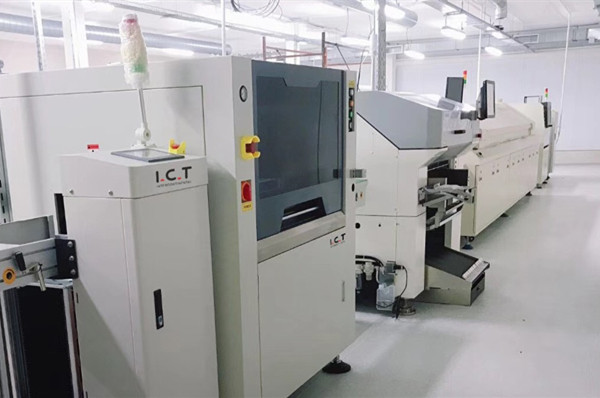
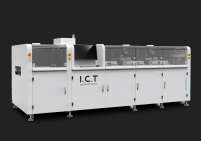
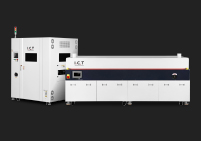
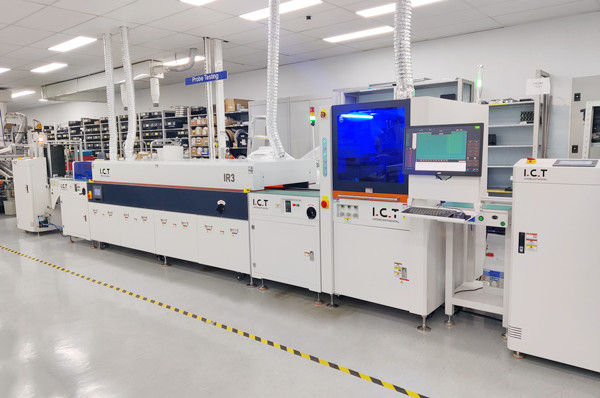
A dual-rail lead-free reflow oven runs two lanes inside one sealed chamber. Both boards share the same protected atmosphere. That means you get twice the throughput for roughly the same nitrogen flow as a single-lane chamber of similar size. I.C.T's Lyra series uses this approach, with full-zone nitrogen available and an inlet-outlet recirculation design that keeps oxygen use low. For high-mix lines, the efficiency is a direct saving on every joint.
The lesson is general. When atmosphere is a shared resource, design for sharing. Two lanes, one chamber, one nitrogen budget beats two separate machines each with their own leaks. The math rewards integration.
The cheapest nitrogen is the nitrogen you do not use. Closed-loop control measures oxygen and modulates flow to hold the target, rather than flooding a fixed amount and hoping. When the oven is tight and the board traffic is steady, flow drops to what is actually needed. When a door is opened or a leak appears, flow rises to compensate.
This single feature can cut consumption meaningfully versus a fixed-flow setup. It also protects joints: the atmosphere holds its target instead of drifting. If you are specifying a new oven, treat closed-loop oxygen control as close to mandatory rather than optional.
Nitrogen comes in grades, and higher purity costs more to make. For reflow, you rarely need the ultra-high-purity gas used in semiconductors. Industrial-grade nitrogen, well above what your target demands, is usually sufficient and far cheaper. Specifying a purity level you cannot use is another quiet tax on the budget.
The supply method also trades against consumption indirectly. Liquid nitrogen gives you high flow on demand, good for startups and surges, but it evaporates whether you use it or not. A PSA generator makes gas as you need it, which pairs naturally with closed-loop control. Membrane systems sit between. The right pick depends on your flow pattern, not just your average.
Think of these as one decision, not three. The oven's leak sets the flow. The flow sets the supply size. The supply size and pattern set the method. When you choose them in that order, the cost lands where it should: as low as your joints allow, no lower.
An estimate is a starting point. Reality on the line is where consumption either behaves or surprises you. This section connects the calculation to the two follow-up questions every engineer eventually asks.
If your installed supply cannot hold target during normal production, your leak estimate was low. The usual culprits are an aging seal, a curtain that has lost tension, or an exhaust setting nobody revisited. Our nitrogen reflow troubleshooting guide walks through how to trace a rising oxygen reading to its source, which is exactly the symptom of an underestimated leak.
The flip side is also common. If your analyzer sits far below target while your generator runs near its limit, you may have oversized the target. Lowering it slightly can free capacity or let you trim flow. Either way, the gap between estimate and reality is information, not failure.
When you take your calculated flow to vendors, quotes will differ. Some size generously, some tightly. Your worksheet lets you judge each against the same yardstick. Ask each vendor what oxygen target their rated output assumes, and what margin they built in. A quote that arrives without those assumptions is a quote you cannot compare.
Do not let the cheapest capital price decide alone. A smaller generator that runs near its ceiling all day wears faster and leaves no headroom for a new product that needs lower ppm. Total cost of ownership, including gas and reliability, beats sticker price for this equipment.
Your calculated flow sets the supply size today. But consumption is not fixed forever. New products, faster lines, and worn seals all move it. The companion article on how to reduce nitrogen consumption in reflow soldering covers the adjustments that bring the number back down: tightening openings, tuning exhaust, and right-sizing the target. Plan for both the install and the ongoing tune-up.
Treat nitrogen consumption as a living number. Measure it when you install. Re-measure when you change products. Note it when seals are serviced. The teams that do this never get surprised by a gas bill or a starved oven, because the number has a history instead of a guess.
Engineers naturally track the monthly gas bill. That is the right number for accounting. But the number that drives decisions is cost per board. Divide the monthly nitrogen cost by the boards you ran under nitrogen, and you get a figure you can compare with rework savings, scrap reduction, and yield improvement.
This reframing changes arguments. A manager sees a gas bill and sees expense. Show the same spend as a few cents per board that also cut rework by a percentage, and the conversation flips. The calculation in this article exists to support that view, by making the spend knowable instead of feared.
It also exposes waste clearly. If cost per board climbs while yield stays flat, something in the atmosphere path changed. The leak grew, the target drifted low, or the exhaust opened up. Your analyzer and your log will tell you which, and section 8.1 pointed you to the troubleshooting steps for finding it. The math and the maintenance are two sides of the same habit: measure, record, act.
No honest single number exists. Consumption depends on the oven's openings, seals, exhaust setting, target oxygen level, and how often boards pass through. The right approach is to estimate it from your own machine using a mass-balance method, then verify with the oxygen analyzer during production.
Run a purge test. With the oven hot, turn nitrogen on at a known flow and record the steady oxygen level it reaches. At steady state you can back out the air leak, then divide that leak by your target oxygen fraction to get the required nitrogen flow. Add a margin for startup purge and board traffic.
Roughly inversely. Dropping the target from 1,000 ppm to 500 ppm about doubles the nitrogen flow needed, all else equal. That is why setting the target at the level your joints actually require, rather than the lowest possible number, protects your budget.
Not necessarily. Chamber volume matters less than leakage. A large oven with tight seals and tuned exhaust can use less than a smaller leaky one. The dominant factors are opening size, seal quality, and exhaust rate, not the chamber's physical size.
Size for both. Steady-state flow keeps the target during production, but the startup purge needs a higher flow to dilute a cold oven full of air before the first board runs. Your supply should handle the surge, or your early boards will run in a half-purged chamber.
Yes, usually. It modulates nitrogen flow to hold the target instead of flooding a fixed amount. When the oven is tight and traffic is steady, flow drops to what is needed. When a leak appears, flow rises to compensate. The result is lower average consumption and a more stable atmosphere.