English
Views: 0 Author: Vinci Zhang Publish Time: 2026-10-09 Origin: Site


Not every board needs nitrogen. Some products solder just fine in plain air. But for others, the margin between a good joint and a bad one is thin, and nitrogen is what gives you that margin. This article helps you decide, using your own product and process data, whether nitrogen reflow is worth it for you.

Nobody wants to pay for nitrogen unless the product actually needs it. So here is the decision in one page. Nitrogen reflow becomes necessary when oxidation during soldering threatens either the yield or the reliability of your assembly — specifically, when you run lead-free SAC alloys on fine-pitch or miniature components, when your boards use oxide-sensitive finishes like OSP, when you depend on low-residue no-clean flux, or when your customer's reliability requirements leave no room for marginal joints.
If none of those describe your product, air reflow is probably fine, and this article will tell you how to confirm that with your own data. If one or more do describe it, nitrogen is not a luxury. It is the difference between a process that fights itself and a process that works.
The honest framing is this: nitrogen is rarely about preventing dramatic failures. It is about margin. Boards that would mostly pass in air pass with room to spare in nitrogen. That margin is what you are buying, and for certain products, the margin is not optional.
This article gives you a structured way to decide. We will walk through the product factors, the component factors, the alloy factors, and the customer factors — and then look honestly at the cases where nitrogen buys you nothing. By the end, you should be able to point at your own production data and say yes or no with evidence.
If you want the full technical background while you read, our complete guide to nitrogen reflow soldering explains how the process works from end to end. Here we stay on the decision itself.
Solder in nitrogen when oxide is the thing standing between your process and its target — and skip it when it is not. Everything else is detail. The rest of this article is the detail, organized so you can match each section against your own product.
One caution before we start. Necessity is not only technical. Your customer's requirements count too, and sometimes they count more than your own data. We will get to that.
Each of the next sections describes one group of signals. As you read, keep your current worst board in mind — the one that gives you the most trouble. The sections that describe that board are your answer. The sections that describe nothing you build can be skipped without guilt.
This is also a good article to share with your process team before any budget discussion. When everyone has walked through the same decision logic, the conversation about cost stops being opinion versus opinion and becomes data versus data.
Before deciding when you need nitrogen, be precise about what it delivers. You are not buying "better soldering" in some vague sense. You are buying one specific thing: the removal of oxygen from the soldering environment, and everything that follows from it.
Inside a nitrogen-purged oven, oxide growth on pads, powder, and leads nearly stops. Your flux stops wasting its activators on re-oxidation during heat-up. Molten solder meets cleaner metal, wets faster, and spreads further. The result is a wider process window: the same board, the same paste, the same profile, but more room between "works" and "fails."
That mechanism is explained in depth in our article on how nitrogen improves solder wetting and joint quality, including the visual and measurable signs to look for. For the decision in this article, you only need the summary: nitrogen converts oxidation from a live problem into a solved one.
It is worth being blunt about what nitrogen does not do. It does not fix bad prints. It does not repair profiles. It does not rescue contaminated pads. If your defects come from those sources, nitrogen will change nothing except the shine on your joints and the number on your gas bill.
Nitrogen buys margin specifically against oxidation-driven variability. So the question "when is nitrogen necessary" is really the question "when does oxidation-driven variability threaten my product." The next three sections answer that from three directions: the board's finish, the components on it, and the alloy in your paste.
It helps to name the failure modes precisely, because they are different in kind and they show up in different places.
The first is the visible defect: non-wet pads, graping, partial fillets, dull grainy surfaces. These appear at inspection or at AOI, they cost rework time, and they arrive in bursts that correlate with board finish, batch age, and humidity. This is the failure mode everyone sees, and the one nitrogen is famous for fixing.
The second is quieter: the marginal joint that passes every check today and ages badly. Oxide-contaminated bonds can look acceptable while carrying a higher share of weak interfaces. They show up months later, at your customer's end, which is the most expensive possible place. High-reliability lines worry about this mode more than the first one.
Nitrogen addresses both, which is why it appears on both yield discussions and reliability discussions. When you frame your decision, score your product against both failure modes. A product with neither exposure does not need nitrogen. A product with either one starts to.
A short detour that makes later sections easier: the oxygen inside your oven does not appear from nowhere. It arrives through three doors, and knowing them helps you predict whether your product will suffer.
The biggest door is the conveyor openings. Every entrance and exit is a wide-open window between your low-oxygen chamber and the factory floor. Curtain designs and tunnel geometry fight this, but physics keeps collecting its toll every time a board passes through.
The second door is the exhaust. Ovens deliberately pull gas out to manage flux volatiles, and every cubic meter exhausted must be replaced — either by your nitrogen or by air leaking in. Exhaust settings therefore sit in direct tension with atmosphere quality.
The third door is leakage: worn seals, poorly fitted panels, and gaps that grow as machines age. This is the door nobody opens on purpose.
Your product does not care which door let the oxygen in — it only experiences the total. But your decision should care, because the cost of holding a low ppm depends entirely on how well the machine closes those doors.

Start with the bare board, because the surface finish is the single strongest predictor of whether a product needs nitrogen. Finishes differ enormously in how they tolerate heat and air.
Organic Solderability Preservative is a wonderful finish with one weakness: it is a thin organic film, not a metal layer. It protects the copper underneath very well — until it breaks down. During reflow, OSP decomposes in the early zones, exposing bare copper for the rest of the profile.
In air, that exposed copper oxidizes through the hottest, most critical minutes of the process. Your flux has to rescue it at the exact moment when flux is running lowest. On simple boards the flux wins. On complex ones it loses, and you see non-wet pads in the zones that heated last.
Nitrogen covers this gap almost perfectly. From the moment the OSP degrades, the copper sits in a protective atmosphere instead of open air. It arrives at liquidus nearly as clean as it was when the film peeled away. Among all common finishes, OSP shows the clearest, most consistent benefit from nitrogen. If your product mix includes OSP boards with any complexity at all, you are already most of the way to a yes.
Immersion tin and other thin metallic finishes have their own vulnerability. Their protective layer is genuinely thin, and the intermetallic growth underneath consumes it over time. Boards that sit in storage for a few months arrive at the line with less protection than the datasheet implies.
Nitrogen does not restore aged finishes. But it does lower the bar for what the flux must accomplish during reflow, which is exactly what an aged finish needs. Lines running thin-finish boards with variable warehouse dwell times often find nitrogen smooths out a lot of the batch-to-batch surprises. The boards that would have been marginal become ordinary.
Mass matters as much as finish. A thick multilayer board with heavy copper planes heats unevenly. By the time the cool corners of the board reach liquidus, the flux on those zones has spent nearly everything it has.
This is a geometry problem with an atmosphere solution. You cannot shorten the heat path, but you can stop the oxygen from exploiting it. Under nitrogen, the late-heating zones wet almost as well as the early ones, and the board comes out uniform. Large backplanes, power boards, and anything with substantial thermal mass fit this pattern.
A practical marker: if your boards regularly show their worst joints in the same physical area — usually the trailing edge or the center of a heavy panel — you are looking at a heat-path problem, not a paste problem. That signature is easy to find in your inspection records, and it is one of the most reliable predictors that nitrogen will visibly help.
One more product signal deserves attention: rework and second-pass reflow. Boards that go through reflow more than once — double-sided assemblies, or panels that return after rework — see their finishes and flux residues degrade further each cycle. The second pass in air is where borderline pads quietly fail.
Nitrogen is kind to second passes. Cleaner environment, less additional oxidation, better odds for the joints that are forming for the second time. If your product is double-sided, count that as a point toward nitrogen in your scoring.
ENIG deserves its own paragraph, because it sits in an interesting middle position. Its nickel-gold structure resists oxidation better than OSP, and the gold wets beautifully when fresh. The classic ENIG problems — brittle intermetallics and black pad — are material and plating issues, not atmosphere issues, and nitrogen will not touch them.
So where does ENIG fall in the decision? Usually as a neutral. It neither demands nitrogen the way OSP does nor shrugs off the environment the way heavy HASL does. Lines running ENIG typically justify nitrogen by their components and alloys rather than by the finish itself.
The broader lesson is to judge each finish by how it behaves at the moment of wetting, not by its reputation. Finishes that degrade during the profile reward atmosphere protection. Finishes that stay intact do not need the help.

The bare board is half the story. The components and their geometry decide how much margin the process actually has.
This is the least controversial signal of all. Fine-pitch QFNs, micro BGAs, 01005 passives, and any package with sub-millimeter lands leave almost no room for wetting errors. The pads are small, the solder volumes are tiny, and the distances between joints are measured in fractions of a millimeter.
On these features, oxide is not a nuisance. It is a dominant variable. A film that would barely register on a large pad changes the outcome on a small one. Teams running 0201 and 01005 parts routinely find that nitrogen moves these categories from "constant attention" to "boring," which is exactly where you want them.
We give this topic its own article — nitrogen reflow for fine-pitch and miniaturized components — because the component-level detail deserves it. For the decision at hand, the rule is short: if your products carry genuinely fine-pitch or miniature parts, plan on nitrogen.
The opposite geometry has the opposite problem, and nitrogen helps here too. Big thermal pads under power components and large BGAs demand enormous wetting coverage from a limited amount of paste. Graping — that rough, beaded surface on thick paste deposits — shows up in air because the deposit's surface skins over during reflow.
In nitrogen the surface of the deposit stays mobile to the end. The beads coalesce, the coverage completes, and the X-ray picture looks dramatically cleaner. If your product runs large BGAs or big exposed-pad packages, the atmospheric advantage shows up in exactly the measurements your customer cares about: voids and coverage.
Many factories do not build one product; they build forty. High-density boards on Monday, simple panels on Friday. For a mixed line, the question shifts from "does this product need nitrogen" to "does my product mix contain enough nitrogen-needing work to justify running the oven under nitrogen."
Mixed production is where flexible atmosphere control earns its keep. An oven that switches cleanly between air and nitrogen modes, or holds a stable low-oxygen environment at reasonable gas cost, lets you serve both product families from the same machine. The decision becomes a scheduling question rather than a capital question.
Because the signal comes from many package types, it helps to keep a short mental list of which families push hardest toward nitrogen.
Passives are the simplest case: 0201 and 01005 parts have tiny lands and almost no wetting tolerance. They are the canaries of your atmosphere. QFNs and DFNs combine small exposed pads with thermal slugs, so they demand both complete coverage and clean release around the edges. BGAs add the hidden-joint problem — you cannot inspect what you cannot see, so the process has to be trusted, and trusted processes are built on margin.
Connectors and large through-hole-replacement parts bring their own geometry: long, thin terminations that need uniform wetting along their length. And any shielding can or stacked module creates local gas shadows that a better atmosphere helps ride through.
None of these packages is impossible in air. Together, they are the reason mixed-technology lines drift toward nitrogen: someone eventually builds a product that combines three of them at once.

If you still ran tin-lead solder, this article would be much shorter. Modern assembly does not, and that fact reshapes the decision.
Lead-free SAC alloys wet more slowly than tin-lead ever did. Their surface tension is higher. Their spreading is lazier. They tolerate oxide less gracefully. Every one of those traits narrows the process window in air, and every one of them relaxes in nitrogen.
For a lot of lines, the move to lead-free was the moment nitrogen stopped being optional. The alloy demands more from the flux, the flux demands more from the surfaces, and oxygen sits at the bottom of the whole chain causing trouble. Remove the oxygen and the chain holds. Keep it and the margins get thin.
The full chemistry is covered in our article on nitrogen reflow soldering for lead-free solder paste. For the necessity decision, the summary is: if you run SAC paste, your case for nitrogen is meaningfully stronger than it would be otherwise, and it grows as your components get smaller.
The second alloy-adjacent signal is your paste choice. No-clean and low-residue fluxes get their name from what they leave behind — which is very little. That is good for the board and hard for the process, because low-residue chemistry carries fewer activators to spare.
In air, a low-residue flux spends a large part of its modest budget fighting oxide. The result is exactly the residue you were trying to avoid, plus marginal wetting. In nitrogen, the same flux spends its budget where it was designed to spend it, and the process behaves like the datasheet.
If your product depends on no-clean chemistry — for reasons of test access, cleanliness specs, or conformal coating compatibility — nitrogen is not an accessory to that choice. It is the condition that makes the choice work.
There is a quieter set of gains that shows up after the switch, and they deserve mention because they often pay part of the gas bill by themselves.
With wetting no longer the limiting factor, some lines find they can soften their profiles: slightly lower peaks, or less time above liquidus, while holding the same joint quality. Temperature-sensitive components — connectors with warped housings, sensitive ceramics, moisture-classified parts — get a friendlier ride. Others find their cooling requirements ease, because joints that form cleanly need less aggressive solidification to look right.
These are not guaranteed gains, and chasing them the same week you switch atmospheres is bad practice, as we said earlier. But over a quarter or two, they are real. The window widens in more directions than one, and a line that audits its profiles annually will eventually find some of that width and convert it into throughput or safety.

Some decisions are not made by your data. They are made by your customer's quality department, and that is legitimate.
Automotive, medical, industrial control, aerospace-adjacent products — these markets judge solder joints not by today's appearance but by ten-year behavior. In those sectors, margin is not a luxury; it is the requirement. A joint that passes inspection but sits at the weak end of its natural distribution is a future warranty claim.
For high-reliability products, nitrogen is usually written into the process expectations somewhere between explicitly and implicitly. Even when it is not required by name, the defect rates it supports are. If your customer demands defect levels that your air process cannot reliably hit, the atmosphere is one of the few remaining levers.
Contract manufacturers know another version of this: the customer audit. Walkthroughs increasingly look at process control in detail, and atmosphere control is a visible, easy-to-audit parameter. An oven with a logged oxygen setpoint, calibration records, and alarm history presents well. It tells the auditor that oxidation is a managed variable, not an accident.
There is nothing cynical about this. A written oxygen target with real monitoring is genuinely better process discipline. The audit trail and the technical benefit come from the same practice. If your customers audit you regularly, nitrogen capability is part of the answer they hope to see.
One more version of the customer factor deserves its own space: the requirement you impose on yourself for consistency across sites. Companies with several factories — or several lines in one factory — often standardize atmosphere policy so that any board can run on any line with the same outcome.
Standardization sometimes means nitrogen everywhere even when individual products could live in air. That looks wasteful on paper, and it is worth being honest about the trade. What it buys back is transferability: qualifications that hold across the floor, fewer exceptions in the quality system, and one process description instead of two.
If you are building that kind of standardized operation, factor the consistency benefit into the decision. It will not appear in the gas bill, but it shows up in the audit results and in how rarely your lines surprise you.
An honest decision guide has to include the no. Plenty of products do not need nitrogen, and soldering them under low-oxygen conditions just burns money.
Simple boards with generous pads, robust finishes like HASL or heavy tin, large components, and forgiving geometry wet well in air. Consumer products without fine-pitch parts, thick single-sided panels, and LED boards with big open lands often fit this description. If your defect Pareto shows no wetting-driven categories for a product, and inspection finds nothing marginal, that product does not need nitrogen.
Running such a product under nitrogen will improve its shine. It will not improve its yield, because there is nothing left to recover. Shine is nice in photographs. It does not pay for gas.
Nitrogen is not free, and pretending otherwise is how lines end up with a gas bill nobody remembers approving. Consumption depends on the oven, the target oxygen level, and the seal condition — and the cost shows up every month for the life of the line. Our article on how to calculate nitrogen consumption in a reflow oven walks through the arithmetic so you can price your own decision before making it.
The right mental model is a subscription. You pay continuously for a continuously wider window. The products that need it justify the subscription easily. The products that do not need it make the subscription a pure expense. That is why the smartest lines treat nitrogen as a product-level decision, not a line-level default.
Between "full nitrogen" and "plain air" lies an option teams often overlook: a modest oxygen target. Not 500 ppm, but perhaps 2,000 to 5,000 ppm — enough atmosphere control to capture most of the wetting benefit, at a fraction of the gas flow.
The reason this works is the shape of the chemistry. The biggest wetting gains arrive as oxygen falls from 21 percent toward a few thousand ppm. Pushing from 2,000 ppm down to 500 ppm buys real but smaller improvements, at sharply rising gas cost. For moderately demanding products, the first step captures most of the value.
A relaxed target also forgives machine limitations. An older oven with imperfect seals may never hold 500 ppm economically, but it might hold 3,000 ppm all day on modest flow. That can be exactly the right compromise for a mixed line with occasional demanding boards.
The way to find your spot on this curve is arithmetic, not intuition. Estimate consumption at two or three candidate setpoints, price the gas, and weigh it against your wetting defect cost. The best target for your line is wherever that trade stops making sense — and it is rarely at the extreme.
You now have the signal list. Here is how to turn it into a decision with evidence instead of vibes.
Take your current worst five boards and score each against the signals: OSP or thin finish, fine-pitch or miniature parts, SAC paste with no-clean flux, large thermal pads, high-reliability customer, double-sided reflow. Boards scoring high are your nitrogen candidates. Boards scoring low are your air candidates.
Then do the arithmetic that matters: what share of your production volume sits in the high-scoring group? A line that is 80 percent nitrogen-needing products has an easy decision. A line with 10 percent needs a machine that can do both economically — or needs to accept the exceptions.
While you score, look one product generation ahead. The board you will build next year is probably denser than today's, with smaller parts and tighter customer specs. Atmosphere decisions are infrastructure decisions; they outlive individual products. Choosing for the portfolio you have and the one you can see coming usually beats choosing for last year's Pareto.
If the scoring says yes but the budget hesitates, run a trial. One week, one product, one oxygen target. Photograph reference panels, pull the defect Pareto before and after, and let your own line tell you the answer. Most trials settle the question faster than any number of meetings, and the record you build doubles as the justification document.
Set the trial up honestly: change the atmosphere only, keep the paste and profile fixed, and give the data a full week. A well-run trial protects you from both the enthusiasts and the skeptics, because it ends with your line's own numbers.
To make the trial concrete, here is the shape of a well-run one.
Day one: switch the atmosphere on in the morning, before production, and let the oven purge fully. Photograph reference panels from last week's air run. Brief the line — everyone should know the experiment is running, because unexplained shine causes its own rumors.
Days two through five: normal production, no profile changes, no paste changes. The line lead notes the oxygen reading at each shift start. AOI data flows as usual — no special handling, no extra inspection, or you will bias the sample.
Day six: pull the numbers. Compare the wetting-related categories against the previous four weeks, not just the previous week, because single weeks carry noise. Photograph the same reference product fresh off the belt.
Day seven: write one page. What ran, what changed, what the counters say, what the photos show, and a recommendation. If the answer is yes, this page becomes the opening slide of the budget conversation. If it is no, you have just saved yourself a year of subscription fees for one week of discipline — which is also a win.
If your decision lands on yes — or on "yes sometimes" — the equipment matters as much as the choice. Atmosphere integrity is an engineering property of the oven: seal design, tunnel architecture, nitrogen delivery, and closed-loop oxygen control decide how much gas each ppm costs you.
When you evaluate a reflow oven for nitrogen work, ask specifically about oxygen performance at your target setpoint, not just "nitrogen optional" on the datasheet. Machines built for atmosphere control — sealed chambers, entrance curtains, recirculation, and stable measurement — hold their setpoints with far less gas than retrofitted designs.
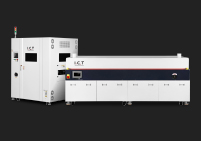
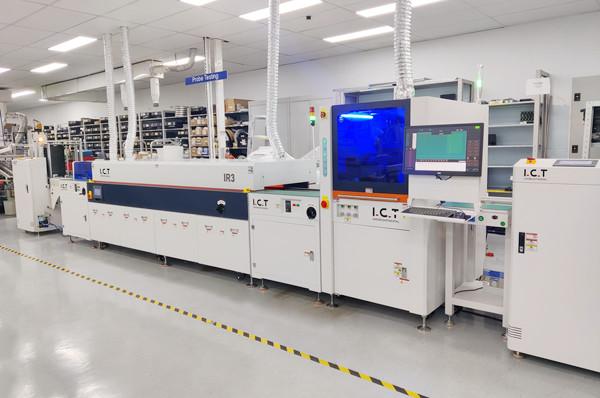
Layout flexibility belongs in the same conversation. A dual-rail lead-free reflow oven runs two lanes through one sealed, nitrogen-protected chamber, which means both boards share the atmosphere cost. I.C.T builds the Lyra series around exactly this principle — full-zone nitrogen availability, inlet-outlet recirculation, and a seal design meant to hold its oxygen level for years, not months. For a mixed-product line that has decided "yes, sometimes," that architecture is usually the economical answer.
Whatever you choose, buy the oxygen measurement and logging option. The data pays for itself the first time a question comes up in a customer meeting or an audit.
They benefit, but not equally, and not all of them need it. Boards with fine-pitch parts, OSP finishes, no-clean fluxes, or lead-free SAC alloys see the clearest gains. Simple boards with generous pads and robust finishes often run perfectly well in air. The benefit is real either way — the necessity is what varies.
Not by any regulation, but often by practicality. SAC alloys wet slowly and tolerate oxide poorly, so air reflow narrows your window exactly where lead-free is already least forgiving. Many lines run lead-free in air successfully on easy products. The combination of lead-free with fine-pitch components or OSP finish is where nitrogen moves from optional to near-essential.
The consistent list: fine-pitch and miniature assemblies (0201/01005, micro BGA, QFN), OSP-finished boards, thick multilayers with long heat paths, large BGA and exposed-pad packages, double-sided reflow products, and high-reliability assemblies in automotive, medical, and industrial sectors. If your product hits two or more of these, nitrogen is doing real work for you.
Bring your own data, not industry arguments. Score your product mix against the signals in this article, pull the wetting-related defect categories from your AOI history, and price the gas using your actual consumption estimate. Then propose a one-week trial on your worst product with before-and-after photographs and defect counts. Managers rarely argue with their own line's numbers.
Yes, and for mixed-product lines this is often the smartest answer. It requires an oven that can hold a stable atmosphere at reasonable cost and switch modes cleanly. The economics depend heavily on the machine's seal quality and oxygen control, so check real consumption numbers at your target ppm before assuming it will be cheap.
Not strictly in every case, but it is the strongest board-level signal. OSP protects copper well until it decomposes in early reflow zones — after that, the exposed copper relies entirely on flux for the rest of the profile. In air, complex OSP boards show the highest non-wet rates of any common finish. With nitrogen, they behave like much easier boards. Simple OSP designs can survive in air; complex ones rarely stay comfortable there.