English
Views: 0 Author: Vinci Zhang Publish Time: 2026-10-09 Origin: Site


Small parts are unforgiving. When pads shrink and pitches tighten, a tiny amount of oxide can ruin a joint that a big component would shrug off. That is exactly where nitrogen helps most. This article walks through the common small packages and shows how a clean atmosphere puts the process window back where it belongs.

Fine-pitch and miniature components are where nitrogen reflow earns its keep most clearly. When pads shrink and pitches tighten, the wetting margin that large features enjoy disappears. In a low-oxygen atmosphere, those tiny joints get back the room they need to form cleanly — fewer bridges on QFN leads, fewer opens on 01005 lands, better wetting on micro BGA balls. That is the short answer, and the rest of this article is the working detail.
The reason is physics, not marketing. Every solder joint forms by the same chemistry, but small joints run that chemistry with almost no slack. A large pad can survive a hesitant start; a 01005 land cannot. Oxide that a big component shrugs off becomes the dominant variable on a small one. Change the atmosphere and you change that variable directly.
If you run any of the modern small packages — 0201 or 01005 passives, fine-pitch QFNs, micro BGAs, dense connectors — you have probably already noticed that your process feels tighter than it used to. This article explains why, and how a controlled atmosphere puts the looseness back.
For the general mechanism, our complete guide to nitrogen reflow soldering covers the whole picture. Here we go component by component, because each family brings its own geometry and its own failure signature.
Here is a useful way to see the problem. A solder joint's ability to correct its own defects comes from the surface tension of the alloy. Molten solder pulls itself toward wettable metal and away from non-wettable surfaces. That self-alignment is what centers a BGA ball on its pad and pulls a chip component straight.
Self-alignment needs two things: enough wettable surface and enough solder volume. Shrink the package and you shrink both. A 0402 land still has enough area for the alloy to correct a sloppy placement. A 01005 land offers the alloy a fraction of that, and one oxide film eats the difference.
The lesson for fine pitch: everything that interferes with wetting matters more as features shrink. Oxide is the main interference, and it is the one you can remove without touching your design.
The term covers several families, and it is worth being precise because they fail differently.
Fine-pitch QFPs and connectors bring lead spacing measured in fractions of a millimeter, with thin leads that demand uniform wetting along their length. QFNs and DFNs flip the geometry: small exposed pads under the package body, surrounded by perimeter lands, with a thermal slug in the middle. Miniature passives — 0201 and 01005 — are the extreme of simplicity: two tiny lands, one body, no leads at all. And micro BGAs hide their joints underneath entirely.
Each family stresses the process in a different direction. What they share is the sensitivity to oxidation, which is why a single change — atmosphere control — helps all of them at once.
It is worth stating the economics plainly, because fine-pitch defects are expensive in a way that scales badly. A non-wet open on a 01005 part is rarely found at optical inspection. It survives to test, or worse, to your customer. Each escape carries the cost of diagnosis, rework or replacement, and the schedule disruption that follows.
Compare that with the marginal cost of the gas that prevents it. On a well-sealed oven running a sensible target, the atmosphere cost per board is modest — often less than the rework time saved on a single defect. You do not need many prevented escapes per month for the chemistry to pay for itself on a fine-pitch line. The full consumption arithmetic gets its own article later in this series, but the order of magnitude is worth knowing before the next section.
Walk through the main families one at a time. For each one: what makes it hard in air, and what changes under nitrogen.
Two-land components look simple, and that simplicity is exactly why they are unforgiving. There is no third land to average anything out. Each joint either forms or does not, and the solder volume is so small that surface chemistry dominates.
In air, the classic failures are non-wet opens — the paste melted, but never bonded to the pad — and mid-chip beads, where solder beads hide under the component body. Both trace back to hesitant wetting: the alloy started late, on a film of oxide, and ran out of energy before completing the joint.
Under nitrogen, wetting starts earlier and completes faster. The paste reaches the pad while there is still time and energy to spread. Teams that move these components to a low-oxygen process usually report the same thing first: the parts stop being special. They stop needing attention, stop generating escapes, and start behaving like ordinary 0603s.
QFN packages concentrate several difficulties into one small body. The perimeter lands are short and close together — a bridging risk. The center thermal slug is a large pad that demands complete coverage from a lot of paste — a graping risk. And the whole package sits low, so paste outgassing has nowhere to go — a voiding risk.
Oxide aggravates all three. Bridging worsens when the alloy wets slowly, because hesitant solder tends to cling between leads instead of pulling back to its own land. Graping worsens because the big deposit skins over in air. Voiding worsens because a stiff, oxidized surface traps gas that a mobile surface would release.
Nitrogen does not make QFNs easy, but it takes the atmosphere off the list of things working against you. Perimeter joints separate more cleanly. Center coverage completes more fully. The remaining risks — stencil design, paste volume — are then manageable with ordinary process tools instead of heroic ones.
BGAs hide their joints, which changes the whole quality conversation. You cannot inspect a BGA joint directly; you trust the process or you X-ray every board. That is why BGAs reward process margin more than any other family: the margin is the inspection.
The visible failure in air is usually indirect — the package sits slightly off-center, or the X-ray shows irregular joint shapes and bridges under the body. Both trace to wetting energy: a ball that wets its pad late and weakly never pulls itself into alignment.
In nitrogen, the self-alignment mechanism works as designed. Balls wet, center, and settle while the alloy is liquid. X-ray pictures come out round and uniform. For assemblies with fine-pitch BGAs, many process engineers consider a controlled atmosphere part of the baseline requirement, not an enhancement.
Long, thin leads have a geometric problem: they need uniform wetting along their entire length, and a single non-wet spot anywhere turns into an open circuit at test. In air, oxide films and flux exhaustion combine to make exactly those uneven results.
Nitrogen evens the field. The whole lead wets in the same window, and the fillet forms consistently from end to end. The improvement shows up at electrical test before it shows anywhere else — fewer intermittent contacts, fewer reflow-related opens on the trend chart.
One practical note: with pitch below 0.5 mm, stencil apertures get small enough that paste release becomes its own battle. Atmosphere helps wetting, not printing. Keep your stencil process honest alongside the gas.
Below fine-pitch BGAs sits the chip-scale world: packages whose ball grids approach the die size itself, with pitch measured in fractions of a millimeter and ball counts in the hundreds. From a soldering standpoint they behave like fine-pitch BGAs with the stakes raised — less self-alignment travel, less volume per joint, even less tolerance for hesitation.
The atmospheric story is the same, with one addition. Because the joints are so tightly packed, a single bridge or open can disable an entire functional block rather than one pin. The defect economics compound. That is why wafer-level packages almost always appear on the "requires nitrogen" side of any process decision, regardless of what else the board contains.

It is worth walking through the failure mechanisms one level deeper, because knowing why a defect forms tells you which fix will work.
A bridge between two fine-pitch leads starts as a wetting failure, not a volume problem — or at least not only a volume problem. Here is the sequence. Molten solder touches two adjacent lands. On clean metal it separates eagerly, pulled by surface tension toward each pad. On oxidized metal it hesitates. The hesitation gives the alloy time to form a connection between the two lands, and once the connection exists, solidification freezes it in place.
This is why bridges cluster on boards with marginal atmosphere even when your stencil calculations are sound. The volume is fine; the wetting energy is not. Restore the low-oxygen environment and the separation force does its job — most near-bridges pull back into clean gaps before solidification.
The remaining bridges, the ones from genuinely excessive paste volume, still need stencil work. But the population shrinks to the ones you can actually fix with design changes.
A non-wet open is the quietest defect in SMT. The joint looks present, sits at the right location, and simply carries no current. At inspection it passes. At test it fails. Sometimes it passes test and fails in the field.
The mechanism is pure wetting: by the time the alloy melted, the pad or the lead carried an oxide film the flux could not strip. The alloy cooled where it sat, bonded to nothing, and left a mechanical contact pretending to be a solder joint.
Nitrogen attacks this at the source. Pads and leads arrive at liquidus clean, so the alloy bonds on first contact. The defect does not get better — it stops occurring. Lines running 01005 parts under nitrogen see this category collapse first, and it is usually the number that ends the internal debate about gas cost.
Small two-land components produce two distinctive defects with atmospheric connections.
Mid-chip beads are tiny solder balls trapped under the component body, pushed there by outgassing from the paste as the joint forms. They are invisible until they cause trouble at test or in the field. The atmospheric link: a stiff, oxidized paste surface traps the gas, while a mobile surface lets it escape before the body settles.
Tombstoning — the component standing on one end — is mostly a thermal imbalance and pad design issue, and we will be honest: nitrogen alone will not fix it. But the wetting side matters too. When one land wets before the other, the imbalance torque grows. Anything that makes both lands wet faster and closer together in time reduces the driver. Teams often see tombstoning ease under nitrogen, especially on marginal pad designs they cannot change.
A pattern worth knowing: on any given board, the same handful of locations produce most of the fine-pitch defects. The corner where heating arrives last. The row of lands nearest a large thermal mass. The QFN whose paste volume sits at the top of tolerance.
These clusters are the fingerprint of a margin problem. The design is fine for most of the board and hostile at a few specific spots. Air reflow makes those spots a daily conversation. Nitrogen makes them ordinary — the margin widens exactly where the board needs it, without touching the design or the stencil.
There is a subtle interaction between oxide and paste volume that explains a lot of fine-pitch mystery defects. On a small aperture, paste volume is marginal by design — the stencil delivers almost exactly what the joint needs, with little surplus.
Now add oxide. In air, some of the paste's flux is consumed fighting oxidation, and the alloy that finally wets the pad is slightly "shrunk" by oxide skins on the powder itself. The joint that was designed with just enough volume now has effectively less, because part of the deposit oxidized or failed to coalesce. The result looks like a volume problem: insufficient solder, skimpy fillets, opens.
The trap is that teams respond by enlarging apertures — which fixes the symptom and creates bridging pressure on the neighboring joints. The atmosphere breaks the trap. With less oxide loss, the designed volume actually arrives at the joint, and the stencil stays balanced between starving and bridging.

Now the fix, in three parts: the chemistry, the flux, and what it means for your stencil.
The core mechanism never changes: less oxygen means less oxide on lands, leads, and powder, and cleaner surfaces wet faster. At fine pitch, the timing shift matters more than anywhere else. A joint that begins bonding at the first moment of liquidus has the full liquidus time to form. A joint that hesitates for even ten seconds has materially less.
Under nitrogen, the hesitation disappears. Paste spheres coalesce on contact with the land. The alloy spreads while the board is still climbing, and every joint — even the ones on the slowest-heating corner — completes inside the window. Our article on how nitrogen improves solder wetting and joint quality walks through the visual and measurable evidence if you want the deeper story.
Most fine-pitch production runs low-residue, no-clean paste. That chemistry carries a small activator budget by design — enough for clean surfaces, not enough to fight a losing battle against air.
In a low-oxygen process, the budget arrives at liquidus mostly unspent. The paste performs as specified, the residue stays low, and the fine-pitch joints form without drama. In air, the same paste is quietly overmatched on exactly the boards that matter most. If your fine-pitch yield problems come and go with paste lot numbers and humidity, this mismatch is a likely suspect — and atmosphere is its fix.
There is a purchasing angle hiding in this section, and it is worth naming. Once the atmosphere is protecting your surfaces, you gain freedom to choose paste on qualities other than raw activity — printability, stencil life, storage tolerance, price. Some lines use that freedom; others bank the wider window as insurance. Either way, the decision moves back into your hands instead of being forced by oxidation.
Here is the practical payoff that stencil engineers care about. With nitrogen, you design apertures for the joint you want, not for the defects you fear. Area ratios can lean toward the conservative side without tipping into insufficient solder, because the alloy uses what it is given more completely.
This is not a license for underspecifying paste. It is margin. The same aperture set that bridges occasionally in air often runs clean in nitrogen, and the same design that starves joints in air sometimes becomes merely adequate. Atmosphere does not replace good stencil engineering — it stops the environment from punishing it.

Fine-pitch work under nitrogen still needs process discipline. Three settings deserve your attention first.
Fine-pitch assemblies justify the tighter end of the oxygen range. While general work often runs comfortably at 1,000 to 2,000 ppm, fine-pitch production typically targets 500 ppm or below. The chemistry rewards it: at these levels, oxide formation during the profile is negligible, and the wetting advantage is at its maximum.
Two rules keep this sane. First, validate with your own boards — the right target is the one where your defect rates flatten, not the lowest number the machine can display. Second, prioritize stability. A steady 800 ppm beats a wandering 300–1,500 ppm, because your process is tuned to what happens every day, not to what happens on average.
Nitrogen removes oxidation from the fine-pitch equation. It leaves the other equations alone. Paste volume, aperture design, release, and placement accuracy remain exactly as important as before — in fact they become more visible, because atmosphere problems were masking or amplifying them.
Treat the switch as a chance to see your process clearly. Defects that remain under nitrogen are real process defects with real causes. Fix them with the standard tools: stencil revision, paste inspection, placement calibration. The atmosphere just stopped adding noise to the signal.
With faster wetting, some fine-pitch profiles can afford small optimizations: a slightly shorter time above liquidus, or a gentler peak, while holding joint quality. Miniature components and moisture-sensitive packages benefit most from that softening.
Do it in that order: atmosphere first, let it settle, then revisit the profile with fresh first-article data. And keep the changes small. Fine-pitch joints have little tolerance for moving two variables at once, even when both moves are improvements.
Fine-pitch production punishes a rushed startup more than any other work. The purge that brings the chamber from morning air down to your target takes time, and boards that enter early run in a half-clean atmosphere — precisely the conditions your fine-pitch joints tolerate worst.
Make the sequence non-negotiable: nitrogen on when the oven powers up, oxygen reading verified at target before the first board, first article inspected with extra attention on the known trouble spots. The whole routine costs minutes. Skipping it costs a board or two at the mediocre end of the distribution every morning, which over a year is a quiet but real yield leak.
The same discipline applies after any interruption. Extended stop, door opened for maintenance, profile change — treat the restart as a fresh purge. Your oxygen analyzer exists for exactly this moment; trust it over the clock.

Small joints demand sharp verification habits. Three practices cover most of what you need.
Your AOI is the first line of defense, and fine pitch tests its limits. 01005 components generate genuine false-call pressure: joints are a few pixels across, and the system needs help distinguishing real defects from reflections.
The atmospheric change does not alter this, but it does change what the AOI sees over time. Under nitrogen, wetting-related calls drop, which makes the remaining calls more trustworthy. Clean up your libraries after the switch — the thresholds that were fighting oxide noise can often be relaxed toward genuine geometry defects.
BGA and QFN joints need X-ray, and fine pitch raises the stakes. The good news: nitrogen's effect is highly visible in X-ray. Joint shapes become rounder and better centered. Bridges under packages — invisible from above — decline sharply. Voids shrink at the margins.
Run a before-and-after X-ray comparison when you qualify the change. It is the single most persuasive artifact in the whole evaluation, and it takes an hour of machine time.
Keep the comparison honest by using the same product and the same package positions in both images. X-ray interpretation has a subjective edge, and side-by-side images of identical locations remove it. File the images with your qualification record; they answer the "prove it" question for years afterward, for customers and auditors alike.
Fine pitch is where first-article discipline pays for itself. Check the first board of each shift and each changeover under magnification, with attention on your known trouble spots — the corner that heats last, the QFN with the big slug. Under nitrogen those checks get faster, because there is less to find. Keep doing them anyway. The day the atmosphere slips is the day the routine pays for itself.
Fine-pitch work deserves its own running record, separate from the line's general quality log. One page per product family: the oxygen target in force, the paste and stencil revision, the known trouble spots, and the defect counts for the wetting-related categories, week by week.
Three things this record does for you. It shows drift early — the week the readings or the defects start creeping, you see it in the trend instead of feeling it in the escapes. It documents process capability for customers who ask, and fine-pitch customers ask. And it keeps institutional knowledge alive when people change: the reasons behind a 500 ppm target or a particular stencil revision survive the engineer who set them.
None of this needs software. A spreadsheet and a disciplined weekly update cover it. The value is in the continuity, not the format.
The atmosphere is only as good as the machine delivering it. Three equipment topics matter at fine pitch.
Fine-pitch boards are unforgiving of atmosphere gradients. An oven whose oxygen level drifts along the tunnel — loose entrance, leaky mid-section, tight exit — produces boards whose quality depends on where their trouble spots sit. A 500 ppm average with local spikes is worse than a steady 800 ppm, because the spikes land exactly on your weakest joints.
When you evaluate a reflow oven for fine-pitch work, ask how the machine measures oxygen — one point or several — and how the delivery system responds to what it measures. Uniformity and closed-loop control matter more here than the datasheet's best-case number.
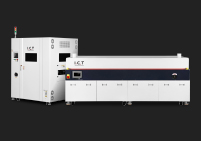
High-volume fine-pitch lines usually run dual-lane, and the atmospheric design of dual-lane ovens matters. The right architecture keeps both lanes inside one sealed chamber, so both boards share identical atmosphere and identical gas cost. The wrong one behaves like two ovens bolted together, with two budgets and two personalities.
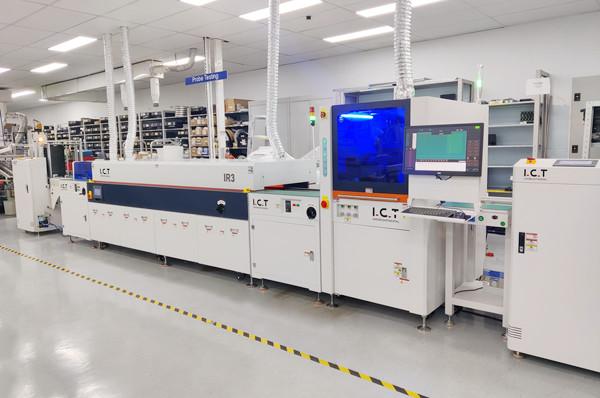
I.C.T's Lyra series is built on the shared-chamber principle — a dual-rail lead-free reflow oven with full-zone nitrogen availability and an inlet-outlet recirculation design that keeps oxygen low without wasting gas. For fine-pitch production at volume, that combination — uniformity for the joints, economy for the bill — is the point of the whole exercise.
Fine pitch does not usually demand exotic gas purity. Standard industrial nitrogen with modest residual oxygen meets most targets when the oven does its job. What matters is supply stability: pressure that does not sag when other equipment draws gas, and flow control that responds to the oven's actual demand.
Watch the simple things. Regulators sized correctly, lines without long narrow restrictions, and a purge routine that brings the chamber to target before the first board of the shift. Most fine-pitch atmosphere surprises trace to supply plumbing, not chemistry. And when a supplier change or a tank swap coincides with a bad quality day, the plumbing is the first place your investigation should look.
Nitrogen changes one more thing at fine pitch that rarely makes the datasheet: what happens to flux volatiles inside the oven. In air, the oxygen helps oxidize and break down some of the volatiles your paste releases. In a low-oxygen tunnel, more of that material travels farther before it condenses.
Practically, this means condensate management becomes part of fine-pitch process control. Ovens designed for nitrogen work handle it with well-placed condensation management and straightforward cleaning access. Neglected, the buildup slowly degrades everything — atmosphere tightness included. Put the oven's cleaning interval into your maintenance schedule from day one, and the problem never becomes visible in your defect data at all.
The questions below come up on nearly every line that moves to fine pitch. Short answers here; the links go deeper.
Almost everything downstream of your solder paste. Components shrank, finishes got thinner, pastes got cleaner and less aggressive, and the alloys got lazier. Each change consumed margin that air reflow used to return for free. Your process did not get worse; the product got closer to the edge of what air can support.
That is also why the question "do we need nitrogen" has a different answer every few years. The honest approach is to re-score your product mix annually, the way you would any other capability decision. If last year's answer was no and this year's boards carry 01005 parts and QFNs, the answer changed because the products did.
One more driver sits in plain sight: package availability. As suppliers retire larger, friendlier packages, you inherit finer pitch whether you asked for it or not. The decision to adopt nitrogen is often less about upgrading capability and more about staying compatible with where the component market is heading. Lines that recognize this early switch on their own schedule; lines that wait switch under pressure, mid-crisis, with a new product launch as the deadline.
A mixed product portfolio does not need an all-or-nothing atmosphere. It needs an oven that holds a target economically and a policy that says which products run under which mode. Our article on when nitrogen reflow is necessary gives a scoring framework for exactly that decision, including the middle-ground targets that let one machine serve both populations.
The practical mistake to avoid is running everything at the strictest target. Fine-pitch boards get the atmosphere they need; simple boards get a gas bill they did not. A written mode policy costs nothing and saves the difference every month.
If defects survive the switch to low oxygen, the atmosphere was not the root cause — and that is useful information, not a failure. Bridge patterns that persist point to stencil design or paste volume. Opens that persist point to print quality, placement, or pad oxidation that happened before the board reached you. Tombstoning points to thermal balance and pad geometry.
Work them with the standard tools, one variable at a time. And if the atmosphere itself starts misbehaving — readings drifting, alarms, quality changing mid-shift — that is a maintenance topic, and our nitrogen reflow troubleshooting guide walks through the usual suspects in order.
For stable production, effectively yes. The lands are so small that oxide films become a dominant variable, and no-clean pastes carry too little activator to compensate in air. Lines running 01005 under nitrogen report the sharpest defect reductions of any component family, especially on non-wet opens. Simple boards with only a few 01005 parts may survive in air with tight process control, but the margin is thin and the escapes are expensive.
Start at 500 ppm or below for fine-pitch production, and validate against your own defect data. General assemblies often run well at 1,000–2,000 ppm, but miniature parts reward the tighter range. Stability matters as much as the number — a steady level slightly above target beats a level that swings through your setpoint all day.
It eliminates the bridges caused by hesitant wetting, which are a large share of them. Molten solder in low-oxygen conditions separates between lands more decisively, pulling back to its own pad before solidifying. Bridges caused by genuinely excessive paste volume remain, and those need stencil or print changes. Most teams see the bridge population shrink to the ones that were design problems all along.
Only partially. Tombstoning is driven mainly by thermal imbalance between the two lands and by pad design, and nitrogen does not change either. But wetting speed is part of the mechanism — when both lands wet quickly and nearly simultaneously, the imbalance torque shrinks. Expect improvement on marginal designs, and fix the real thermal or geometric causes for the rest.
Usually not. Standard industrial nitrogen meets typical fine-pitch targets as long as the oven's atmosphere control is sound. What matters more is supply stability — consistent pressure and flow so the chamber holds its setpoint through the whole shift. Spend your attention on the oven's seals, curtains, and closed-loop control rather than chasing higher gas purity.
Three artifacts settle it. First, your AOI defect Pareto for wetting-related categories, compared across four weeks before and after the change. Second, X-ray images of BGA and QFN joints — rounder, better-centered joints are the visual proof. Third, first-article photographs under magnification from the same reference panel, before and after. Together they turn a feeling of improvement into a documented process change.