English
Views: 0 Author: Vinci Zhang Publish Time: 2026-10-09 Origin: Site


The cheapest nitrogen is the nitrogen you never lose. Before you shop for a bigger generator, look at the leaks and settings on the oven you already have. Most of the savings hide in plain sight: worn seals, open exhaust, an oxygen target set lower than your joints need. This article shows where to look and what to change.

The cheapest nitrogen is the nitrogen you never lose. If your reflow oven wastes gas through loose seals, open exhaust, or an oxygen target set far lower than your joints need, no supply upgrade will fix that. The fastest savings come from plugging leaks and tuning settings, not from buying a different generator.
This article walks through the adjustments that actually move the number. Most of them cost little or nothing. A few need equipment features you may already have. None of them require a new production philosophy. You keep running nitrogen where it helps. You just stop paying for gas that escapes or over-serves.
Before you act, it helps to know what your oven should use in the first place. Our guide on how to calculate nitrogen consumption in a reflow oven gives you the method to find your own baseline. This article assumes you have a baseline, or at least a meter reading, and now want to bring it down.
If you are still weighing whether nitrogen is worth running at all, our complete guide to nitrogen reflow soldering covers the full cost-and-benefit picture. Here we assume the decision is made and the job is trimming waste.
Reducing consumption is not the same as cutting the atmosphere. You are not trying to run poorer joints. You are trying to deliver the same oxygen target with less gas. Done right, the boards cannot tell the difference. The only thing that changes is the monthly bill and the size of supply you need.
This distinction matters, because it keeps quality engineers on your side. When you frame the project as "tighten the system," everyone agrees. When you frame it as "use less nitrogen," the quality team correctly worries about starved atmospheres. Lead with the system, and the savings follow without a fight.
Most ovens hide their biggest savings in three places: the board openings, the exhaust setting, and the oxygen target. These three account for the large majority of avoidable waste. Supply-source tweaks and equipment upgrades help too, but they come after the free wins, not before.
A useful habit is to walk the oven with the nitrogen on and feel for drafts. Air sneaking in is nitrogen leaking out, in effect. The places you can feel a draft are the places your gas bill is bleeding. This low-tech check often finds more than a week of spreadsheet analysis.
Safety comes before savings. Nitrogen is inert and displaces oxygen, so a confined leak can create an oxygen-deficient space without anyone noticing a smell. Any work around nitrogen lines, especially in enclosed areas, should follow your site's confined-space and gas-monitoring rules. The savings in this article are real, but none of them are worth a safety shortcut.
This is also why exhaust tuning must be done carefully. Cutting exhaust too far does not just waste gas; it can let flux vapors accumulate. Keep the chamber clean and the workspace monitored. The goal is a tighter system, not a riskier one. If a saving ever conflicts with a safety rule, the safety rule wins and the saving waits.
Most of the adjustments here are mechanical and harmless: seals, curtains, scheduling, settings. Treat the few that touch exhaust or purge as engineering changes, documented and reviewed, rather than something an operator tweaks between boards. That discipline keeps both the savings and the line safe.
The single most effective move is to shrink the air leak. Every cubic meter of air that enters must be diluted by hundreds of cubic meters of nitrogen. Cut the leak and you cut the bill by the same proportion, at any target.
Too many teams start by shopping for a more efficient generator. That is putting a smaller bucket under a bigger hole. Fix the hole first.
Nitrogen leaves through the same paths air enters. The board entrance and exit are the largest. Even with curtains, boards carry atmosphere in and out, and a gap remains for air to follow. Inspection hatches, maintenance doors, cable pass-throughs, and worn seals all leak. On an aging oven, the small leaks add up to a surprising share of consumption.
The escape is rarely dramatic. It is a steady seep that no single person notices. That is exactly why it persists for years and why fixing it feels like free money once you do.
Start with the cheapest, highest-leverage items. Replace worn door seals. Re-tension curtains that have gone slack. Close hatches that were left ajar during a forgotten maintenance job. These are minutes of work and often produce the first measurable drop in flow at a steady oxygen reading.
Make seal checks a scheduled task, not a reactive one. Seals age quietly. A curtain that was fine last year is not fine today, and the gas bill creeps up while nobody connects the two. A quarterly look at every opening costs little and protects every saving you make elsewhere.
Exhaust is the silent budget-killer. Its job is to remove flux vapors and keep the chamber safe. But excess exhaust pulls nitrogen out along with the fumes. Many ovens run exhaust at or near maximum "just in case," and that caution costs real money every shift.
The fix is to tune exhaust to the actual flux load rather than a fixed maximum. More flux, more exhaust. Less flux, less. This single adjustment, done carefully with safety in mind, is often the largest no-cost saving available. We return to it in section 4.
Before buying anything, do the draft check. With the oven running nitrogen, walk its perimeter and feel for moving air at every opening, seal, and pass-through. Air coming in is nitrogen you are paying to push out, in effect. Mark each draft you find. The list you make in ten minutes is often worth more than a consultant's report.
This check catches the obvious and the forgotten. A maintenance hatch left cracked after a weekend job. A curtain bracket that let a corner lift. A cable gland that was never tightened. None of these show up on a meter as a single event; they show up as a permanently higher flow that everyone accepts as normal.
The habit compounds. Do the walk quarterly, and you catch seals as they age instead of after they have leaked for a year. Pair it with the oxygen reading: a steady rise at constant flow is your cue that the walk is overdue. Between the two, most leaks never get the chance to become a budget line.

The second big lever is the target itself. Consumption rises roughly in proportion to how low you set the oxygen level. Halve the target and you roughly double the gas. So the question is simple: what target do your joints actually require?
General mixed-technology work often runs well around 1,000 to 2,000 ppm oxygen. Fine-pitch, OSP, and high-reliability assemblies often justify 500 ppm or lower. If your line is set to 200 ppm but your products would be fine at 1,000 ppm, you are paying several times over for a margin nobody asked for.
The right target is the one your defect data supports, not the one the manual's default suggests. Many ovens ship with a conservative default that operators never revisit. Checking that default against your own boards is a free review with a possibly large payoff.
Do not guess the target down and hope. Lower it deliberately, hold it for a production window, and watch your wetting-related defects. If they stay flat, you have found free savings. If they rise, you found the real floor, and you step back up one notch. Either way, the answer is now based on your boards, not a forum post.
This is also where the lead-free question lives. SAC alloys wet more slowly and tolerate oxide less, so they sometimes need a tighter target than tin-lead work. Our article on nitrogen reflow soldering for lead-free solder paste explains the alloy behavior that should inform your target choice.
There is no joint benefit to 50 ppm if 1,000 ppm already gives you clean fillets. The analyzer can read lower, but your boards cannot feel the difference, and your gas bill absolutely can. Resist the engineer's instinct to "just set it as low as it goes." That instinct is expensive and invisible until the invoice arrives.
A healthy target is the highest level that still delivers your required joint quality. Anything below that is atmosphere you paid for and threw away. Finding that level is a one-time experiment that pays back for the life of the product.
The right target is not carved in stone. When your product mix shifts toward finer pitch or more OSP finishes, your required oxygen level may drop, and you should tighten accordingly. When the mix shifts toward robust, generous-pad boards, you may be able to relax and save. The target should track the hardest product you are actually running this week, not the hardest product you ever ran.
This is a common missed saving. A line sets a tight target for one difficult customer years ago, that customer leaves, and the target never moves. The gas bill keeps paying for a requirement that no longer exists. A quarterly review of the active product list against the oxygen target closes that gap.
Make the review part of new-product introduction. When a product is qualified, record the oxygen level its joints needed. When it is retired, note that the floor may have risen. Small discipline, repeated, is what keeps a reduction project from silently reversing itself.

Once leaks are tight and the target is right, the next savings sit in how you move gas through the machine. Exhaust and purge are both tunable, and both are commonly set wastefully.
Flux load varies with the boards you run. Dense, paste-heavy panels outgas more than simple ones. Exhaust should track that load, not sit at a fixed maximum. Modern ovens often allow exhaust to be profiled per product or at least adjusted per shift.
The safe way to do this is gradual. Lower exhaust in small steps, watch the chamber for flux buildup or odor, and stop before either appears. You are looking for the lowest exhaust that still keeps the chamber clean and safe, not the lowest possible number. The flux load, not the meter, sets the floor.
The startup purge is a hidden cost. A cold oven full of air must be diluted before the first board runs, and that early surge can exceed steady-state flow. Two habits cut this. First, start the nitrogen as the oven heats, so purging overlaps warm-up instead of adding a separate delay. Second, size the surge so it ends right as production begins, not an hour early.
Some lines also purge with a lower-purity or recovered stream during warm-up, then switch to process nitrogen once boards approach. That is a more advanced move, but the principle is the same: do not pay top-grade gas rates to dilute an empty, cold chamber.
Boards disturb the atmosphere as they pass through. Running nitrogen for one nitrogen-only board an hour wastes far more than clustering those boards together. If your line mixes air and nitrogen products, schedule the nitrogen-required ones in blocks. The atmosphere stabilizes, the flow settles, and you avoid paying for gas during idle gaps.
This is a planning win, not an equipment win, and planners often overlook it. A simple production calendar that groups nitrogen products can shave meaningful hours of gas per week without touching a single machine setting.
Beyond exhaust and purge, two settings quietly waste gas when left at defaults. The first is recirculation mode, where the protective atmosphere is captured and reused at the inlet and outlet rather than vented. If your oven has it and it is off, turning it on often drops flow with no change to joint quality. Verify the oxygen still holds, then enjoy the saving.
The second is the idle setting. Many ovens keep flowing nitrogen at full pace even when no boards are running, during breaks or between batches. An idle-mode that trims flow to a hold level, just enough to keep the chamber purged, avoids paying full rate for an empty oven. The chamber stays ready, and the gas bill reflects the reality that nothing is being soldered.
Both are software or configuration changes, not capital. They sit in the oven's settings menu, overlooked because nobody assigned them to anyone. Pointing a process engineer at these two menus is sometimes the cheapest saving in the whole plan.

Some savings come from equipment features you may already own. The two that matter most are closed-loop oxygen control and efficient chamber design. If your oven lacks them, they are worth specifying on the next purchase.
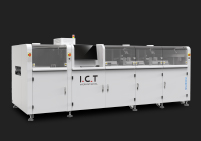
When you evaluate a convection reflow oven, closed-loop oxygen control should sit near the top of your list. It measures oxygen and modulates nitrogen flow to hold the target, instead of flooding a fixed amount and hoping. When the oven is tight and traffic is steady, flow drops to what is actually needed. When a leak appears, flow rises to compensate.
The saving is real and ongoing. A fixed-flow setup runs at its set rate whether the atmosphere needs it or not. A closed-loop setup trims flow continuously to the minimum the target requires. Over a year of running, that difference is a meaningful share of the gas bill, and it also protects joint quality by holding the target steady.
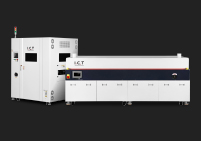
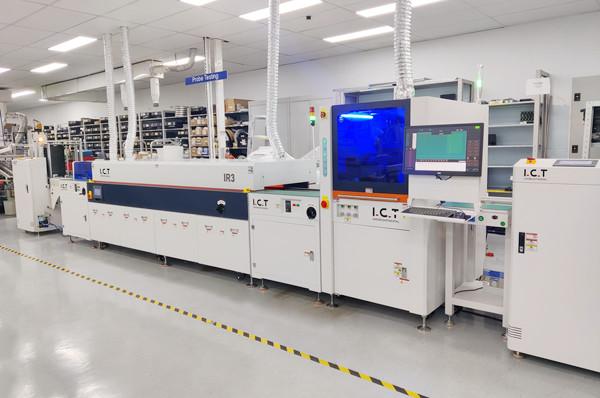
A dual-rail lead-free reflow oven runs two lanes inside one sealed chamber. Both boards share the same protected atmosphere and the same nitrogen budget. You get roughly twice the throughput for the same gas as a comparable single-lane chamber. I.C.T's Lyra series takes this approach, with full-zone nitrogen available and an inlet-outlet recirculation design that keeps oxygen use low.
The lesson applies beyond this one model. Where atmosphere is a shared resource, design for sharing. Two lanes, one chamber, one nitrogen budget beats two separate machines, each with its own leaks. If you are weighing a capacity expansion, the dual-rail route often costs less to run than adding a second single-lane oven.
Some ovens recirculate the protective atmosphere at the inlet and outlet rather than letting it escape. Others are built with fewer seals and fewer leak paths by design, which sounds counterintuitive but works when the remaining paths are well controlled. The point is that consumption is partly designed in. An oven engineered for low oxygen use will beat a generic one even at identical settings.
When you audit your current machine, check whether these features are enabled. A recirculation mode that is turned off is a saving you are leaving on the table. Turn it on, verify the oxygen holds, and note the lower flow.
Convection ovens move heated gas with blowers, and those blowers draw power and shape the atmosphere turnover. Some ovens allow fan speed to be profiled, or use variable-frequency drives that match blower output to the zone's need. Right-sizing blower speed reduces how often the atmosphere turns over, which in turn reduces how much nitrogen is needed to hold the target.
This is a subtler lever than sealing or targeting, and it is easy to overdo. Too slow a fan hurts heat transfer and profile control, which hurts joints faster than gas saves money. Treat fan tuning as a joint-quality-sensitive change: adjust in small steps, verify the profile, and stop at the point where thermal performance still meets spec.
The broader point stands. Anything that reduces unnecessary atmosphere turnover reduces nitrogen use, because the gas you do not churn through the chamber is the gas you do not have to replace. Fans, exhaust, and openings are three faces of the same turnover problem, and all three reward the same careful hand.

After the system is tight, the supply method itself offers savings. The right source, the right purity, and good housekeeping all reduce cost without touching the oven's atmosphere.
Liquid nitrogen delivers high flow on demand, ideal for startups and surges, but it evaporates whether you use it or not. A PSA generator makes gas as you need it, which pairs naturally with closed-loop control and avoids paying for idle capacity. Membrane systems sit between. The cheapest choice depends on your actual flow pattern, not on a generic recommendation.
If your line runs nitrogen in blocks rather than continuously, a generator that makes gas on demand may beat a tank that evaporates around the clock. If you have violent startup surges, liquid nitrogen's on-demand headroom may win. Match the pattern and the bill drops.
Reflow rarely needs semiconductor-grade ultra-high-purity nitrogen. Industrial-grade nitrogen, well above what your target demands, is usually sufficient and far cheaper to produce. Specifying a purity level your process cannot use is a quiet, permanent tax on every cubic meter.
Confirm the minimum purity your joints and your oven require, then buy to that, not above it. Vendors may suggest headroom; ask what joint benefit the extra grade delivers, and expect silence. The answer is usually none.
Small supply-side leaks waste gas too. Loose fittings on nitrogen lines, uninsulated liquid lines that warm and boil off, and regulators left open during idle periods all add up. A walk of the gas train, the same low-tech draft check you did at the oven, finds losses the invoice hides.
Treat the whole nitrogen path as one system, from the tank or generator to the oven inlet. Savings made at the oven are partly lost if the delivery line bleeds them back out. The audit that covers the full path is the audit that actually pays.
Supply savings are easiest to defend when expressed the way the business thinks. Take the monthly nitrogen cost after your changes and divide by the boards run under nitrogen. Compare that cost per board with the pre-project figure. A reduction that looks modest as a monthly percentage often looks compelling as pennies saved across every unit shipped.
This framing also exposes whether the saving is real or temporary. If cost per board drops but yield stays flat, you found genuine efficiency. If cost per board drops because you quietly raised the target on a product that needed it, the saving is borrowed against quality and will be repaid in rework. The per-board view makes that distinction visible.
Keep the calculation simple and repeatable. A one-line formula in the process doc, fed by the gas meter and the production count, lets any shift leader reproduce it. When the number drifts back up, the same formula shows it early, which is the whole point of measuring in the first place.
Knowing the levers is not the same as using them. This section gives a sequence you can run on a real line without stopping production for long.
Start by recording your current flow at a steady production pace and your current oxygen target. Note the exhaust setting, the seal condition, and the supply type. This baseline is what every later gain is measured against, so make it honest. A number you soften to look good will only confuse the next step.
Spend a shift just watching. Feel for drafts at the openings. Read the exhaust setting. Check whether closed-loop control is on. Most lines reveal their biggest leak within an hour of looking, before anyone turns a wrench.
First, tighten seals and curtains and close forgotten hatches. Second, right-size the oxygen target using a short experiment. Third, trim exhaust to the flux load in small steps. Fourth, enable closed-loop control and any recirculation mode. Fifth, schedule nitrogen products in blocks.
Each step is verifiable: the oxygen reading at a given flow should tell you whether the change helped. Do them one at a time so you can attribute the savings, rather than making five changes and never learning which ones worked.
After each change, record the new steady flow at the same target and the same production pace. Compare with the baseline. Over a few weeks, the cumulative drop becomes your savings story, expressed in cost per board if you want management's attention.
Keep the record with the oven paperwork. Six months later, when someone asks whether the tightened seals were worth the labor, the before-and-after numbers answer without opinion. That record is also what protects the gains, because the next leak will show up as a rise against a known good baseline.
The first mistake is changing everything at once. Five adjustments in a day leave you unable to say which one saved gas and which one did nothing. Worse, if a joint problem appears, you cannot tell which change caused it. Change one lever, measure, then move to the next.
The second is cutting the target without data. Engineers lower the oxygen setpoint because it "feels safer," then wonder why the bill rose. The target should move only after a deliberate test shows the joints tolerate the higher level. Faith is not a process.
The third is ignoring the supply side after fixing the oven. A tight oven fed by an oversized, idle-evaporating tank still wastes money. The audit must cover the full path, from source to inlet, or the savings leak out the far end. The fourth mistake is forgetting to document. A reduction project with no record is a saving waiting to be undone by the next seal that ages unnoticed.
Savings have a limit. Past that limit, you trade gas for joints, and joints always win. This section covers how to recognize the line and when to stop.
If you trim flow too far, the oxygen reading climbs above target during production. That is the clear signal you went too far. Joints begin to show the wetting defects nitrogen was supposed to prevent, and you have simply recreated the air-reflow problem at a lower bill. Step the flow back up until the target holds through the whole shift.
This is also where the "is nitrogen even necessary" question lives. If your joints are fine at a much higher target, you may not need as much nitrogen as you thought, or you may not need it at all for that product. Our guide on when nitrogen reflow soldering is necessary helps you tell the difference between "need less gas" and "need no gas."
Lead-free SAC assemblies are the first to complain when the atmosphere weakens, because they wet slowly and tolerate oxide poorly. If your reduction plan pushes oxygen up on SAC products, expect dull joints, graping, or bridging to return before they would on easier alloys. Our article on lead-free reflow under nitrogen covers the signs to watch so you catch the regression early.
High-reliability and fine-pitch products have even less tolerance. These are exactly the assemblies that justified nitrogen in the first place, so they are the wrong place to chase savings. Keep their target where the data put it, and find your savings on the products that can spare them.
The right stopping point is where further flow reduction would require raising the oxygen target below what your hardest product needs. Below that line, you are no longer saving; you are gambling. A good reduction project ends with the atmosphere holding its target comfortably, the openings tight, and the exhaust tuned — not with the meter reading as low as it will go.
Treat the finished state as a known good configuration. Document it. The next engineer should inherit a tight, tuned system, not a mystery of why the flow is what it is. That documentation is the difference between a saving that lasts and a saving that leaks back out within a year.
A reduction project is only as durable as the people who run the line after the engineer leaves. The settings, the seal schedule, and the target review all depend on someone owning them. Hand the team a short written procedure, walk them through the draft check, and show them how to read the oxygen-versus-flow trend.
Make the checks part of the normal shift routine rather than a special project. Glance at the oxygen reading during the walk. Note the flow in the log. Feel for drafts during preventive maintenance. None of these take time; they take attention, and attention is free.
The teams that keep their savings are the ones who treat atmosphere as a living system, not a set-and-forget feature. When a new operator joins, the procedure teaches them. When a seal wears, the routine catches it. The gas bill stays low not because of one clever change, but because everyone understands why it is low and what would raise it again.
Tighten the leaks first. Worn seals, slack curtains, and open hatches let air in, and every bit of air must be diluted by hundreds of times its volume in nitrogen. Sealing these paths is minutes of work and often produces the first measurable drop in flow at a steady oxygen reading, with no equipment cost.
Usually, yes, because consumption rises roughly in proportion to how low you set the target. But only lower it to the level your joints actually require. Halving the target roughly doubles the gas, so setting 200 ppm when 1,000 ppm would do is paying several times over for margin nobody asked for. Validate the new target with your own defect data.
It can be one of the largest no-cost savings. Excess exhaust pulls nitrogen out along with flux vapors. Tuning exhaust to the actual flux load, in small careful steps, often cuts significant gas without harming the chamber. Just watch for flux buildup or odor, and stop before either appears.
For most lines, yes. It modulates nitrogen flow to hold the target instead of flooding a fixed amount. When the oven is tight and traffic is steady, flow drops to what is needed. The result is lower average consumption and a more stable atmosphere, which also protects joint quality.
Often, yes. Boards disturb the atmosphere as they pass through, so running nitrogen for one nitrogen-only board an hour wastes more than clustering those boards. Grouping nitrogen-required products into blocks lets the atmosphere stabilize and avoids paying for gas during idle gaps, with no machine changes.
The oxygen reading climbing above target during production is the clear signal. Joints will also start showing wetting defects again, especially on lead-free SAC assemblies. When that happens, step the flow back up until the target holds through the whole shift. Savings end where joint quality begins to suffer.