English
Views: 0 Author: Vinci Zhang Publish Time: 2026-11-11 Origin: Site


A Buyer's Guide for Automotive Electronics PCB Assembly
Seven printers we would put on an automotive-electronics evaluation shortlist, organized by the kind of project each fits best. This is not a global power ranking measured in a lab — it is a recommendation set built around what automotive PCB assembly actually demands (fine pitch, traceability, closed-loop process control, uptime) and around how each machine is bought, run, and supported.

We evaluated each candidate against a five-part framework weighted for automotive needs, and we kept the evidence honest: vendor-stated accuracy is labeled as such, sigma bases (3σ vs 6σ) are not mixed, and a core cycle is not presented as a full production cycle. Where a brand has no named automotive reference or no published Cpk, we say so. Supporting sources include the equipment makers' own product pages and our solder paste stencil printer overview, the IPC interoperability standards, and independent benchmarks such as the EPP Europe four-printer print test and operator threads on SMTnet.
On this page
2. EKRA SERIO 6000 — process control for lines that can't stop
3. I.C.T-4034 — a practical option for cost-conscious line projects
4. Panasonic NPM-GP/L — for factories already on Panasonic lines
6. MPM Momentum II — print verification and process management
7. GKG G-Titan — solder paste management with optional SPI/MES
This is an editorial framework, not a scored league table. We did not assign each brand a 92 or 95, because complete, comparable data does not exist across all seven. Instead we looked at five dimensions and recorded, per machine, what is confirmed and what must be verified before purchase.
Dimension | Weight | What a buyer should actually see |
|---|---|---|
Print capability & process stability | 30% | Real printing accuracy, the test conditions it was measured under, repeatability, and any third-party verification (e.g., CeTaQ). Distinguish positioning repeatability from printing accuracy. |
Quality control & traceability | 25% | SPI feedback path, recipe management, data logging, and the interfaces (IPC-HERMES-9852, IPC-CFX, SECS/GEM, MES) that make a board audit-ready. |
PCB adaptation & support | 15% | Panel size range, clamping method, bottom support, and warpage handling for the boards you actually run. |
Automation & production efficiency | 15% | Cleaning, paste replenishment, changeover, and the real production takt — not just a headline cycle number. |
Total cost of ownership & service | 15% | Configured quotation, maintenance, consumables, training, and local support wherever the line will run. |
Three comparison traps we avoided: (1) positioning accuracy is not printing accuracy; (2) a 3σ figure and a 6σ figure are not directly comparable; (3) a "core cycle" that excludes printing and cleaning is not your line takt. Where a maker states accuracy without a sigma basis or a named test, we flag it.
Machine | Standout capability | Best for | Watch out for |
|---|---|---|---|
#1 ASMPT DEK TQ | OEM-owned 5D SPI closed-loop and deep MES integration | Lines that treat printing as a controlled, connected node | Premium cost; large-board jobs need the TQ XL |
#2 EKRA SERIO 6000 | Full autonomy (auto stencil/squeegee/cartridge/pins) with RFID tracking | Process-control projects that must run long stretches unattended | ±20 µm print is looser than some; no published Cpk |
#3 I.C.T-4034 | Strong catalog accuracy at a competitive total cost, inside a full turnkey line | Cost-conscious automotive SMT line projects needing one accountable supplier | 400×340 mm board ceiling; 2D only native, 3D SPI is separate |
#4 Panasonic NPM-GP/L | ±3.8 µm repeatability and proven Panasonic line synergy | Factories already running Panasonic placement and PanaCIM | Spec sheets disagree on accuracy; small-format SPV variants exist |
#5 Yamaha YRP10 | ±16 µm printing accuracy (CeTaQ, optimum) and fast automatic changeover | Yamaha-line shops with frequent product changeovers | Accuracy is a lab-optimum figure; open MES standards not documented |
#6 MPM Momentum II | CeTaQ-verified ±17 µm wet print and SPI Print Optimizer closed-loop | Projects that prioritize print verification and process management | One source lists 20 µm; 3D SPI is external; no named Tier-1 case |
#7 GKG G-Titan | Auto solder-paste management with optional SPI/MES links | Buyers wanting Chinese precision value with integration options | SPI/MES are options, not standard; verify automotive references |
Automotive control modules, sensors, and EV power electronics push QFN, 01005, and sub-0.4 mm pitches where a small print offset becomes a field failure. The printer sets the paste volume and position before any other process can correct it, so its stability drives the whole line's escape rate.
IATF 16949 and OEM audits expect every board to be traceable to its materials, parameters, and inspection history. A printer that exports stencil ID, paste batch, squeegee pressure, and offset data to MES is materially easier to defend in an audit than one that keeps that data in a local log. See our guide on choosing an SMT line for automotive electronics.
A slightly lower spec with a real SPI closed-loop and recipe management usually outperforms a higher spec running open-loop, because automotive volume exposes drift, paste-batch variation, and environmental change. The printers below are ranked as much on their control loops as on their headline numbers.
DEK TQ is the reference most automotive programs benchmark against when "printing" means a controlled, connected process node rather than a standalone machine. ASMPT kept the SMT segment (DEK + SIPLACE) after the strategic review it launched in 2025 and concluded in 2026, so the roadmap is intact.

Its differentiator is the owned stack: a 5D SPI (Process Lens) feeding correction back through WORKS software, so the loop is vendor-guaranteed rather than cobbled from third parties. Wet-print accuracy is stated at ±17.0 µm @ 2 Cpk (TQ), with a 5 s core cycle and >8 h of operation without operator assist. Interfaces include IPC-HERMES-9852 and IPC-2591 CFX, which is what makes the "integrated node" claim real.
Independent coverage positions DEK as the market leader for automotive and ADAS quality. The caveat operators raise is practical, not fatal: the built-in 2D paste inspection has been reported to throw false fails that some shops disable — a reminder that the headliner feature needs tuning, not blind trust.
Before choosing DEK TQ, check three things: the largest board you must run (the standard TQ tops out around 400×400 mm; extra-large automotive boards need the TQ XL), whether your quote includes the Process Lens + WORKS closed-loop, and the total cost against a premium-tier budget. It is the safe anchor of this list, not the cheapest.
EKRA (part of the German ASYS Group since 2005, distinct from the cleaning-chemicals company ZESTRON) built the SERIO 6000 around autonomy — the machine that can reload its own stencil, squeegee, and paste. For an automotive cell that must run long stretches with thin staffing, that is the point.

Note: EKRA does not publish a freely re-usable full-machine photo of the SERIO 6000, and the reseller images we found depict other SERIO models (4000 / 8000). This is an illustrative rendering of the SERIO 6000 platform, not an official product photograph.
The SPHERE print head transfers paste between stencils during changeover to cut waste; a cartridge magazine holds up to nine 12 oz cartridges (~12 kg, RFID-tracked) for up to 36 h of unmanned operation; automated stencil/squeegee loading and APS auto pin-set round out the lights-out story. Interfaces are explicit and open: IPC-HERMES-9852, IPC-CFX, and OPC UA, with SynapticaOS for MES.
Alignment repeatability is stated at ±12.5 µm @ 6σ and print repeatability at ±20 µm @ 6σ — note that EKRA publishes no Cpk and no named metrology method, so treat the number as vendor-stated. Older EKRA platforms (X3/X4-era) drew complaints about under-stencil cleaner faults and support responsiveness; those are legacy, not SERIO 6000-specific. We found no named automotive reference case for the SERIO 6000 itself.
Confirm the SPI closed-loop path (EKRA accepts external offset correction via TCP/IP, CFX, or OPC-UA, but there is no dedicated SERIO closed-loop bulletin — verify the exact SPI brand you will pair), and confirm the maximum panel size for your program (the SERIO platform figure is up to 610×510 mm, but the 6000-specific number is not published). Pay for the autonomy only if your volume and staffing actually use it.
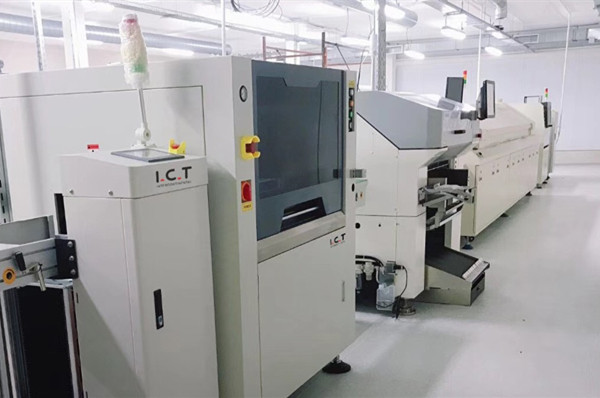
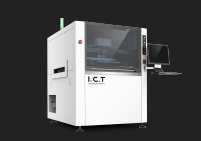
The I.C.T-4034 earns its place here on total cost of ownership and turnkey delivery, not on out-specifying the German or Japanese leaders. It is the shortlist pick for buyers who need a whole automotive-capable SMT line from one accountable supplier and want to control initial investment.

I.C.T's published figures are a positioning repeatability of ±0.01 mm (10 µm) and a printing accuracy of ±0.025 mm (25 µm) — these are catalog numbers, not a stated sigma basis or an independent Cpk, so read them as "confirmed capability class," not a guaranteed production distribution. The maximum PCB size is 400×340 mm, which comfortably covers most control modules and sensors but excludes larger body-control or power boards. Cycle is stated under 7 s. The key is to keep the two accuracies separate: positioning repeatability is how precisely the machine lines stencil to board; printing accuracy is what lands on the pad.
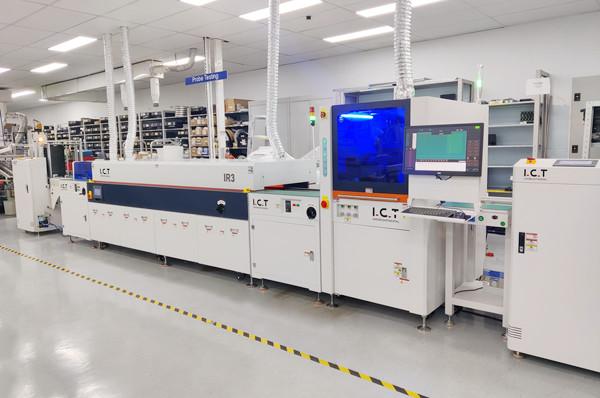
The value is the system around the printer: I.C.T supplies printer, SPI, placement, reflow, and AOI as one line, with installation, commissioning, and operator training included, plus global service (spare-part warehouses and on-site response). I.C.T has delivered real automotive-electronics lines — for example a 2026 Portugal project for car lighting and electronic controllers, and a full SMT line for automotive motors in Uzbekistan — so the automotive context is project evidence, not a generic claim. For a cost-conscious program, buying the printer inside that package is simpler than integrating seven vendors.
Before choosing the I.C.T-4034, do three things: run your actual PCB, stencil, and paste through a trial and measure print offset, paste-volume consistency, and continuous-run stability; confirm the exact SPI and MES configuration (native inspection is 2D, and 3D SPI is a separate machine — SPI closed-loop, MES link, and barcode traceability should be confirmed as standard, optional, or project-customized for your build); and confirm the 400×340 mm board ceiling against your largest automotive board. I.C.T is ISO 9001 / CE / RoHS certified; it is not itself an IATF 16949-certified supplier, so automotive compliance rests with your own certified production site, not the printer.
The Panasonic NPM-GP/L is the natural pick when the placement side is already Panasonic and you want the printer to disappear into PanaCIM rather than fight a heterogenous line. Its automotive pedigree is the strongest on this list on the evidence.

Repeatability is stated at ±3.8 µm (2 Cpk, 3σ) with printing accuracy of ±15.0 µm (2 Cpk, 6σ) and a 12 s board exchange. APC-5M closes the loop from SPI results back to print pressure, speed, and separation; up to ten masks can be stored with an autonomous changer, and auto solder supply and auto support-pin change reduce operator touches. Panasonic Industry holds IATF 16949, which matters for automotive supply-chain trust.
The clearest automotive reference on this list is Panasonic's: a ZF Automotive partnership running >160,000 uninterrupted hours on CM-series placement and citing PanaCIM cycle-time cuts. The honest counterpoints: published accuracy figures disagree across Panasonic documents (one brochure shows ±6.35 / ±12.5 µm, another shows ±3.8 / ±15 µm), so confirm the exact variant; and legacy control faults on older SP60-class machines surface in operator forums, not on the current NPM platform.
Match the exact model code and variant to the accuracy you will be held to, and confirm whether your program needs the large-format GW variant (boards to 760×687 mm) versus the GP/L. If you are not already on Panasonic placement, weigh the PanaCIM synergy benefit against the integration work of bolting it to another ecosystem.
The Yamaha YRP10 is the 2024-successor model we recommend over the older YSP20, chosen for its automatic stencil and push-up-pin changeover and its fit inside a Yamaha line. Yamaha positions it explicitly for automotive lighting, ECUs, power modules, and EV chargers/inverters.

Official specs separate the figures cleanly: positioning repeatability ±8 µm @ 6σ (Cp ≥ 2.0) and printing accuracy ±16 µm @ 6σ (Cpk ≥ 2.0), measured by CeTaQ under Yamaha's optimum conditions — so it is a verified-but-lab figure, not a warranted production distribution. The core cycle is 6 s excluding printing. Do not compare Yamaha's 6σ printing accuracy directly against a 3σ number from another brand, and note Yamaha's own materials also cite a "five seconds" figure elsewhere, an internal inconsistency worth pinning down.
Trade press ties YRP10 to automotive power-module and lighting production, and Yamaha's own automotive-lighting story emphasizes traceability and fast changeover. We found no independent end-user complaint specific to YRP10; the model is new enough that third-party field data is still thin, and Yamaha's open-standard MES interfaces (HERMES/CFX/OPC UA) are not published for YRP10 specifically — verify with Yamaha if your MES depends on them.
Confirm the optimum-condition accuracy against your production environment with a board trial; lock down the 5 s vs 6 s cycle definition in writing; and confirm the MES interface your plant uses. Choose it when changeover frequency and Yamaha-line synergy outweigh the need for the deepest published Cpk.
We replaced a jet printer with MPM Momentum II (ITW EAE) because MPM stays inside the stencil-printer scope and brings a verification story that fits automotive process management. It is placed at #6 by display order, not because its technology is weaker than the five above.

Accuracy is CeTaQ-verified at ±11 µm alignment / ±17 µm wet print @ 6σ, Cpk ≥ 2.0, measured with production-environment variables (print speed, table lift, camera movement) rather than ideal conditions — a transparency edge over vendors that quote optimum labs. The SPI Print Optimizer gives true closed-loop X/Y/θ correction with an external SPI, and EnclosedFlow supports 01005 / 0.3 mm CSP with >50% paste savings. Core cycle is 6.0 s (Elite, triple-track buffer) or 7.5 s (HiE, single rail).
Paste management is strong: a Paste Height Monitor with auto-add, a patent-pending Paste Temp Monitor, and a 2026 cartridge carousel for non-stop changeover. Traceability is open and current — IPC-CFX qualified (2021), IPC-HERMES-9852, SECS/GEM, PrinTrack. The honest flags: ITW's own Elite page lists 20 µm wet print against the CeTaQ 17 µm (verify the build); 3D SPI is external, not built in; and we found no named automotive Tier-1 reference for Elite/HiE.
Pin the accuracy to the CeTaQ 17 µm build and the exact variant (Elite vs HiE changes the buffer and rail), and confirm the SPI brand you will pair for the closed loop. If your program values verified accuracy and paste management over autonomy, Momentum II is a very defensible mid-list pick.
GKG G-Titan represents the Chinese precision-value tier done seriously: a listed company (Shenzhen ChiNext, 301338) whose flagship targets automotive, 5G, aerospace, and medical. It is the "best value with integration options" slot, not a generic "China cheap" label.

Machine alignment is stated at ±10 µm @ 6σ (Cpk ≥ 2.0) and process accuracy at ±17 µm @ 6σ, with an AGV-assisted automatic stencil change triggered by MES and paperless cleaning. Auto solder-paste dispensing and a stencil lock address the paste-consistency and stability issues that matter on long automotive runs. The G-Titan is the right GKG for automotive boards; the smaller G5/G9/GSE cap out around 400–450×340 mm and are not the large-board choice.
GKG lists solder-paste management and optional SPI closed-loop and MES connection on the G-Titan — the word "optional" matters: confirm which of SPI, MES, and barcode traceability are in your configuration rather than assuming them. IATF 16949 appears only in non-authoritative marketing aggregators and is not confirmed on an official GKG certificate page, and we found no named automotive-OEM deployment equivalent to Yamaha's Aisin reference. Treat GKG as a strong value pick whose automotive proof is thinner than its specification sheet.
Specify SPI closed-loop and MES in writing if you need them for IATF traceability; verify the maximum board size against your largest automotive panel; and request a local-service and spare-parts plan for your region. Pay the G-Titan price for the verified precision, not for assumed automotive certifications.
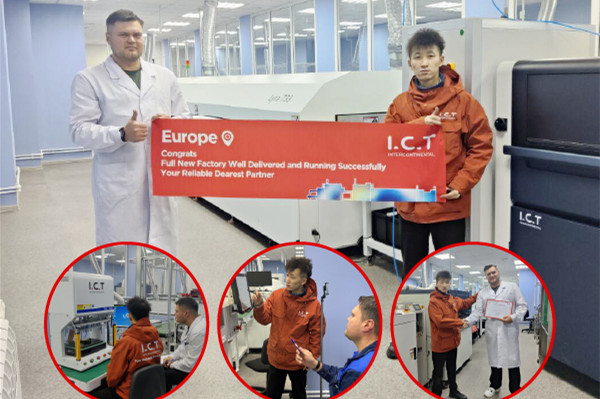
The notes above are specifications and references. The project below comes from I.C.T's own delivery record for an automotive-electronics manufacturer — published on the I.C.T stencil-inspection case page. The figures are from I.C.T's project team, not an independent audit, but they show what an actual automotive-line delivery and ramp-up looks like.
Project field | Detail |
|---|---|
Customer industry | Automotive electronics manufacturer in Portugal; products include car lighting and electronic controllers with strict process requirements |
Configuration | Full SMT line: stencil printing, SPI, placement, reflow soldering, AOI inspection, and test systems, integrated and balanced as one cell |
Product and pain points | Automotive lighting and control boards where print consistency and traceability were the binding constraints, not just throughput |
Production challenge | Achieve stable printing quality and auditable traceability across the workshop during ramp-up, with a local team that had to reach independent operation quickly |
Solution | I.C.T engineers provided on-site installation, production training, and process adjustment for the complete line; printer, SPI, and inspection were tuned together rather than as separate boxes |
Verified results (I.C.T project team, not independent audit) | Stable printing quality after startup; improved traceability management across the SMT workshop; positive customer feedback on both equipment performance and engineering support |

What this case adds beyond the spec sheet: the printer's value in an automotive program is how cleanly it joins the SPI and MES loop and how fast the local team reaches stable, independent production. That is exactly the "verify before you buy" logic this guide repeats — a board trial on your own product tells you more than any brochure. The Portugal line uses I.C.T's platform family, so the integration experience transfers to an I.C.T-4034-based configuration even where the exact printer model differs.
What is your hardest board and volume? Largest panel and finest pitch set the floor — confirm the printer clears both with margin, then shortlist DEK TQ, EKRA SERIO 6000, Panasonic NPM-GP/L, or MPM Momentum II and prove it with a board trial.
How often do you change products? High-mix and frequent changeover favor Yamaha YRP10 and EKRA SERIO 6000; single-product high volume favors DEK TQ and Panasonic NPM-GP/L.
What does your quality system require? Confirm the SPI closed-loop, recipe management, and data export to your MES; audit- and compliance-driven lines should weight EKRA, Panasonic, MPM, and DEK on documented interfaces.
What is the real total cost? Add consumables, service, training, and downtime to the configured quotation before comparing; weigh I.C.T-4034 and GKG G-Titan on total cost of ownership inside a turnkey line.
What is your service reality? Response time, spare-part stock, and non-business-hours support should be written into the contract — confirm local coverage for whatever brand you choose, especially outside the brand's home region.
Your situation | Shortlist first | Verify before ordering |
|---|---|---|
High-volume, stable single product, deep MES need | DEK TQ / Panasonic NPM-GP/L | Process Lens+WORKS (DEK) or PanaCIM (Panasonic); largest board vs TQ XL |
Frequent changeover, high mix | Yamaha YRP10 / EKRA SERIO 6000 | Auto stencil/pin change limits; open MES interfaces |
Long unattended runs, thin staffing | EKRA SERIO 6000 | Cartridge magazine size; SPI brand for closed loop |
Cost-conscious, needs whole line + support | I.C.T-4034 (+ GKG G-Titan as value alternative) | Board ceiling 400×340 mm; SPI/MES standard vs optional |
Audit/verification-driven process management | MPM Momentum II / DEK TQ | CeTaQ 17 µm build; external SPI pairing |
Budget tier (configured estimate) | Shortlist first | What you give up |
|---|---|---|
Entry / value | I.C.T-4034 / GKG G-Titan | Flagship brand backing and deepest published Cpk |
Mid | Yamaha YRP10 / MPM Momentum II / Panasonic NPM-GP/L | Some autonomy features and top-tier service density |
Flagship | DEK TQ / EKRA SERIO 6000 | Higher capital and maintenance cost across the board |
Everything above is stencil (screen) printing, which is what the title promises. One technology sits adjacent and is worth a paragraph: solder paste jet printing from Mycronic (MY600 / MY700). It is stencil-free — a jet head deposits paste pad by pad, eliminating stencil cost, lead time, and the aperture-design loop.
Jet printing earns a look when your pain is high mix, cavity or fine-pitch boards, or frequent design changes where stencil iteration eats weeks. Mycronic cites cases where scrap dropped near zero on difficult cavity boards and stencil procurement disappeared entirely. The trade-offs are real: single-dot repeatability is coarser (about ±35 µm 3σ), throughput is lower than a screen printer on volume, and jet heads are a consumable cost at production volume. It complements a stencil printer as a flex/high-mix tool far more often than it replaces one on an automotive volume line — which is why it belongs in this footnote, not the main ranking.
Is a stencil printer with 2D inspection enough for automotive PCB assembly?
2D inspection catches print position and some coverage issues, but automotive programs usually want 3D SPI to measure paste height and volume before placement, because volume variation drives the escape-rate failures that audits and field returns punish. If a printer only offers native 2D (as several on this list do), budget for a separate 3D SPI and a closed loop into the printer. Our article on the warning signs your SMT line needs SPI walks through the failure modes — squeegee-pressure drift, PCB warpage, and paste-batch variation — that 2D alone will miss. For automotive, treat 3D SPI as the control instrument, not an optional extra.
Does higher printing accuracy always mean a better automotive printer?
No, and this is the trap that misleads shortlists. A slightly lower accuracy with a real SPI closed-loop and recipe management typically beats a higher accuracy running open-loop, because automotive volume exposes drift, paste-batch change, and environmental shift that a static spec cannot capture. Also compare like with like: a 6σ figure is not directly comparable to a 3σ figure, and a lab-optimum measurement (for example Yamaha's CeTaQ optimum) is not a warranted production distribution. Weight the control loop and verification path at least as heavily as the headline micron number.
We are a cost-conscious automotive supplier. Is the I.C.T-4034 a safe choice?
It is a defensible choice for mainstream control modules, sensors, lighting, and EV-charging PCBA when bought as part of an I.C.T turnkey line with SPI, installation, training, and service included, and when your largest board fits the 400×340 mm limit. Confirm three things first: run your actual PCB, stencil, and paste through a trial and measure offset, volume consistency, and continuous-run stability; confirm whether SPI closed-loop, MES, and barcode traceability are standard, optional, or project-customized in your build; and remember I.C.T is ISO 9001 / CE / RoHS certified but is not itself an IATF 16949-certified supplier, so compliance sits with your own certified site. For sub-0.3 mm pitch or the largest body-control boards, a German or Japanese leader is the safer process limiter.
Which printer is best if we already run a Panasonic or Yamaha line?
Stay in the ecosystem. If your placement is Panasonic, the NPM-GP/L folds into PanaCIM with the strongest automotive reference on this list (a multi-decade ZF partnership). If your line is Yamaha, the YRP10 brings automatic stencil and push-up-pin changeover and a CeTaQ-verified accuracy, designed to sit inside Yamaha's intelligent-factory software. The synergy — shared programming, material management, and traceability — usually outweighs a few microns you would otherwise gain by mixing brands, provided you confirm the exact variant and MES interfaces for your plant.
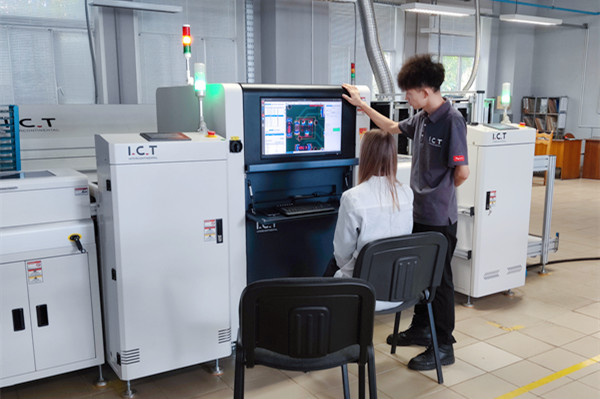
If your shortlist includes the I.C.T-4034 inside a full automotive SMT line, the fastest next step is a board trial on your actual product. I.C.T supplies printer, SPI, placement, reflow, and AOI as one line, with installation, commissioning, operator training, and global spare-part support — and the Portugal automotive project above is the kind of delivery it represents.

Share your board size, finest pitch, and volume, and I.C.T's engineering team will propose a printer-plus-SPI-plus-placement configuration with a board trial instead of a brochure promise.
Stencil printer setup & quality control guide → · SPI & AOI inspection equipment →
Method note: accuracy and cycle figures are vendor-stated unless a third-party verification (e.g., CeTaQ) or independent benchmark is cited; sigma bases (3σ/6σ) and test conditions are stated where known and flagged where not. This is an editorial buyer's guide, not a commissioned ranking, and no brand paid to be included.