English
 Views: 0 Author: Vinci Zhang Publish Time: 2026-09-05 Origin: Site


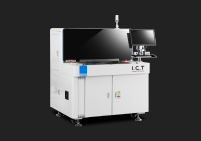
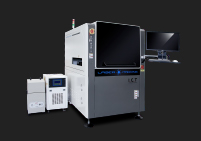
During the week of August 31 to September 4, I.C.T completed the delivery and technical handover of an I.C.T-5700L PCB router for an electronics manufacturer in the Philippines.

To help the manufacturer put the machine into production smoothly, I.C.T sent an experienced technical engineer to the factory. The on-site service covered machine inspection, CCD and router-bit calibration, PCB programming, cutting tests, parameter optimization, troubleshooting, maintenance guidance, and hands-on training.
Rather than stopping after a basic machine demonstration, the engineer used the manufacturer’s actual PCB products throughout the training. This allowed the local team to learn how to program the machine and adjust the cutting process under real production conditions.
The manufacturer produces uninterruptible power supply systems, commonly known as UPS products. These products contain electronic control boards and power-related PCB assemblies that must be separated accurately after panel assembly.
The factory already had engineers with experience in SMT and DIP production equipment. However, the team needed systematic training in PCB router programming, vision calibration, router-bit selection, cutting-depth control, spindle settings, and daily machine maintenance.
The customer also needed to confirm whether different PCB structures—including V-cut boards and flexible circuit boards—could be processed with suitable depaneling methods and parameters.
Based on these production requirements, I.C.T provided a PCB depaneling solution centered on the I.C.T-5700L.
Equipment or System | Application |
|---|---|
I.C.T-5700L PCB Router | Automatic routing and separation of PCB panels |
CCD Vision System | PCB positioning, mark recognition, and program calibration |
High-Speed Spindle System | Accurate routing with adjustable spindle speed |
Router-Bit Cutting System | Supports different router-bit sizes and cutting parameters |
Dust Collection System | Collects PCB dust generated during routing |
Safety Light Curtain | Protects operators during machine operation |
Programming Software | Creates cutting paths and manages production parameters |
Remote Support Software | Allows technical assistance when on-site troubleshooting is unavailable |
This configuration gave the manufacturer the tools required to create cutting programs, control routing parameters, test different products, and improve PCB edge quality.
After arriving at the factory, the I.C.T engineer followed a step-by-step service plan. The work started with a complete machine inspection before moving into calibration, programming, product testing, and operator training.

The engineer first checked the general condition of the I.C.T-5700L and communicated with the factory team about its current operation.
During the initial inspection, an X-axis alarm appeared when the machine returned to its home position. The engineer restarted the equipment, checked the axis operation, and cleared the alarm.
The safety light curtain also showed unstable detection. Its installation position was readjusted to restore normal sensing.
Several hardware items—including two safety door-lock switches, the safety light curtain, and the PC power switch—required further replacement or improvement. The necessary parts were recorded, and follow-up shipment arrangements were made.
The engineer also explained why these safety devices must be checked regularly and reminded the team that two operators should never control the machine at the same time.
Once the basic inspection was complete, the engineer calibrated the CCD vision system.
Correct CCD calibration helps the machine recognize PCB reference points and align the programmed cutting path with the actual board. The router-bit position was then calibrated to ensure that the cutting tool followed the intended route accurately.
The customer’s engineers were shown how to:
Set PCB reference points
Adjust camera exposure
Confirm the PCB image position
Calibrate the router-bit location
Set the cutting depth
Select the correct router-bit model
Modify spindle speed
Adjust cutting speed
These steps are especially important when a factory handles several PCB models rather than running only one product.
After the machine had been calibrated, the I.C.T engineer introduced the main software interfaces and explained how to create a new PCB routing program.

The training covered the complete programming process, including importing or capturing the PCB image, setting reference points, creating the cutting path, selecting the router bit, and defining the cutting parameters.
The engineer also demonstrated the skip-point production mode. This function can be used when certain boards or positions in a panel do not need to be processed.
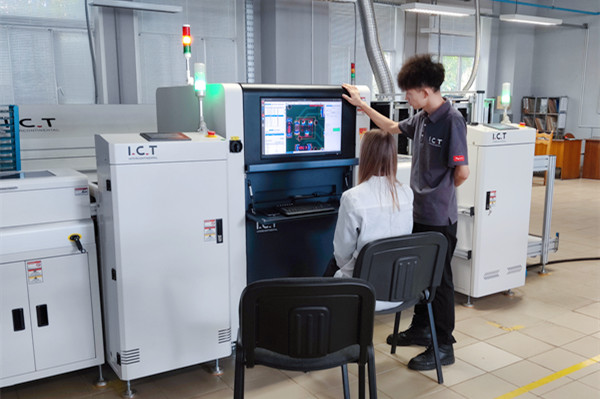
Instead of only watching the demonstration, the customer’s SMT and DIP engineers created programs using their own PCB samples. They adjusted the board calibration, cutting depth, spindle speed, camera exposure, router-bit model, and cutting-speed settings by themselves.
When questions came up during operation, the I.C.T engineer explained the cause and showed the team how to make the correct adjustment.
The local team was trained to replace router bits safely and correctly. The engineer explained how to confirm the tool position after replacement and why worn or incorrectly installed bits can affect PCB edge quality.
Training also covered the dust collection system, including:
Proper dust collector operation
Dust bag inspection
Dust bag cleaning
Dust bag replacement
Routine cleaning around the routing area
Good dust management helps maintain a clean working environment and reduces the buildup of PCB dust inside the machine.
Real PCB products were used to evaluate the machine and confirm the effectiveness of the training.
The manufacturer provided two V-cut PCB products for testing. Their original board structure made a blade-type V-cut depaneling machine another possible option, so the team initially evaluated whether routing would be suitable.
The I.C.T engineer tested the boards with different router bits and cutting settings. When a 0.9 mm router bit and a cutting-speed setting of 2 were used, the boards were completely separated.
The finished PCB edges were clean, with no visible burrs. This confirmed that the products could be processed on the I.C.T-5700L when the appropriate tool and cutting parameters were selected.
The test also gave the local engineers a practical example of how router-bit diameter and cutting speed can change the final result.
The engineer also helped the customer test a flexible circuit board product.
A small trial batch was programmed and cut on the machine. The finished result met the expected cutting requirements. At the same time, the engineer observed how well the customer’s team could create and modify the program independently.
This test expanded the customer’s understanding of how the router could be used for different products and materials.
Besides machine operation, the I.C.T engineer provided the customer with practical maintenance and troubleshooting guidance.
The training included:
Daily machine inspection
Common alarm identification
Basic troubleshooting procedures
Router-bit condition checks
CCD and cutting-position verification
Dust collector maintenance
Safety device inspection
Remote support procedures
The customer also received a list of consumable and wearing parts, daily maintenance instructions, and a guide covering common machine problems and their solutions.
Remote support software was explained and prepared so that the customer could contact I.C.T if an issue could not be resolved locally.
By the end of the on-site service, the participating engineers could independently create PCB programs, calibrate the board position, select router bits, modify cutting parameters, and complete the routing process.
They also understood how to use different parameters to improve the cutting result based on PCB material and structure.
The technical support achieved several practical results:
The I.C.T-5700L was inspected and calibrated.
CCD and router-bit positions were confirmed.
Actual UPS-related PCB products were tested.
Two V-cut PCB products were successfully routed.
Clean board edges without visible burrs were achieved.
A flexible circuit board sample was successfully tested.
Customer engineers completed independent programming exercises.
Maintenance and troubleshooting documents were provided.
Follow-up replacement parts were arranged.
Training certificates were prepared for the participating engineers.
The completed training gave the factory a local engineering team capable of operating the PCB router without depending on daily external assistance.
The customer’s engineers had previous experience with SMT and DIP production equipment, which helped them quickly understand the I.C.T-5700L.
During the training, they showed strong learning and hands-on abilities. After completing the programming exercises, they were able to create routing programs, modify machine parameters, and perform PCB cutting independently.
They also learned how to use different router bits and process settings to improve cutting quality. The successful tests on V-cut boards and flexible circuit boards gave the team greater confidence in applying the machine to future products.
The customer recognized the value of combining equipment delivery with on-site technical training, real-product testing, maintenance guidance, and continued remote support.
A PCB router cannot deliver consistent results through hardware alone. Cutting quality also depends on correct calibration, suitable router-bit selection, stable fixturing, optimized cutting parameters, and well-trained operators.
Through this project in the Philippines, I.C.T helped the manufacturer move from initial equipment setup to independent programming and actual product validation.
I.C.T continues to provide overseas installation, training, process testing, and technical support for electronics manufacturers worldwide. Whether a project involves one PCB depaneling machine or a complete electronics manufacturing line, our engineers focus on one practical goal: helping the customer turn new equipment into reliable production capacity.