English
Views: 0 Author: Site Editor Publish Time: 2026-04-15 Origin: Site
If your SMT production line is experiencing inconsistent yield, unexpected rework, or difficulty maintaining stable soldering quality, the root cause may not be where you think.
In many cases, these issues are not caused by operators, materials, or even upstream processes — but by the reflow oven itself.
As the final and most critical stage of the SMT process, reflow soldering determines whether all previous steps — printing, placement, and inspection — translate into reliable, high-quality assemblies. A mismatch between your product requirements and your reflow oven capabilities can quietly introduce variation, reduce first-pass yield, and increase long-term production costs.
Yet, many manufacturers still select reflow ovens based on price, basic specifications, or general recommendations, without fully understanding how these choices impact real production performance.
This guide is designed to change that.
Instead of focusing only on technical features, this article will help you evaluate reflow ovens from a practical, production-oriented perspective — so you can make a decision that improves quality, stability, and profitability over time.
So, why does reflow oven selection matter so much in the first place?
If your SMT line occasionally suffers from unstable yield, unexpected rework, or inconsistent solder quality between batches, the issue may not come from where you expect.
Many manufacturers initially look at solder paste, placement accuracy, or operator performance when problems arise. However, in a significant number of cases, the real source of variation lies in the reflow stage — where all upstream processes are either validated or compromised.
A mismatched reflow oven can introduce subtle but critical inconsistencies: uneven thermal distribution, unstable profiling, or insufficient process control. These issues rarely appear as immediate failures. Instead, they build up over time, showing up as higher rework rates, hidden defects, and long-term reliability risks.
By contrast, a properly configured reflow oven brings stability to the entire production line. It ensures consistent heat transfer, repeatable soldering results, and predictable process performance across different products and production cycles.
This is why reflow oven selection is not just a technical choice — it is a decision that directly affects your production stability, product quality, and overall profitability.
Choosing a reflow oven is not about comparing specifications — it’s about making sure the machine truly fits your production.
Many selection mistakes happen because decisions are made too quickly, without fully understanding how different factors affect real manufacturing performance. A structured approach can help you avoid costly mismatches.
Here is a practical step-by-step method used by experienced SMT engineers:
Start with your actual products — not the equipment.
Are you producing LED panels, automotive control boards, or high-power PCBs? Each category has very different requirements in terms of thermal behavior, component sensitivity, and process stability.
Choosing a reflow oven without clearly defining your product often leads to either over-specification or insufficient capability.
Your production volume determines the type of system you need.
High-volume manufacturing requires inline reflow ovens with stable throughput and repeatable performance. In contrast, low-volume production or R&D environments may prioritize flexibility over speed.
More importantly, consider not just current capacity, but future growth. A system that works today may become a bottleneck tomorrow.
Not all SMT processes are the same.
Lead-free soldering, high-reliability applications, or complex assemblies require tighter temperature control, better thermal uniformity, and more consistent profiling.
If these requirements are underestimated, the result is often unstable yield and ongoing process adjustments.
This is where many decisions go wrong.
Instead of selecting based on general specifications, focus on how the configuration supports your actual production:
Heating zones must match your thermal profile needs
Conveyor systems must handle your PCB size and weight
Nitrogen options should be considered for oxidation-sensitive products
A mismatch here directly translates into process instability.
Even the best equipment cannot perform well without proper support.
A reliable supplier should provide not only the machine, but also:
Process guidance during setup
Training for your engineering team
Fast response in case of issues
In real production environments, long-term stability depends as much on support as on hardware.
Not all reflow ovens are designed for the same type of production.
In practice, one of the most common mistakes is selecting equipment based on general specifications, without considering how different product types place very different demands on the reflow process.
To avoid this, the first step is to match your reflow strategy to your actual application.
LED boards, especially large panels, require highly uniform heat distribution.
Even small temperature variations between different areas of the board can result in uneven solder joints, which may lead to visible brightness inconsistency in the final product.
In this case, reflow ovens with stable convection systems and consistent thermal profiles are essential.
Automotive applications demand long-term reliability under harsh conditions.
Nitrogen reflow is often recommended to reduce oxidation and improve solder wetting, especially for fine-pitch components and critical connections.
Without proper atmosphere control and precise temperature profiling, hidden defects may pass inspection but fail in the field — leading to costly warranty risks.
Industrial control boards and power electronics typically involve larger PCBs, thicker copper layers, and heavier components.
These characteristics require:
Strong and stable conveyor systems
Higher thermal capacity for consistent heating
Robust mechanical design to prevent deformation
If the reflow oven cannot handle these conditions, it may lead to board warping, insufficient soldering, or process instability.
Selecting a reflow oven without considering your product application often results in two costly outcomes:
Over-specification → unnecessary investment with no real benefit
Under-performance → ongoing production issues and hidden losses
The right approach is not to choose the “most advanced” oven, but the one that best matches your actual production needs.
Understanding reflow oven specifications is not just about knowing what each parameter means — it is about understanding how each one affects your production results.
In many cases, production instability is not caused by obvious machine failures, but by subtle mismatches in configuration. These mismatches often go unnoticed during selection, yet they directly lead to defects, rework, and inconsistent quality.
The following technical factors should therefore be evaluated not as features, but as critical controls for process stability.
The number of heating zones determines how precisely you can control the temperature profile.
More zones allow smoother transitions between preheating, soaking, and reflow stages, reducing thermal shock and improving solder joint formation.
However, insufficient zones can lead to unstable profiles, especially for complex or high-density boards. This often results in defects such as incomplete soldering or component stress.
The goal is not to choose the highest number of zones, but to ensure your oven can maintain a stable and repeatable profile for your specific products.
Modern reflow ovens rely on convection heating for efficient and uniform heat transfer.
For applications requiring higher reliability — such as automotive or fine-pitch assemblies — nitrogen atmosphere is often used to reduce oxidation and improve solder wetting.
Without proper atmosphere control, oxidation can lead to weak solder joints or inconsistent quality, especially in lead-free processes.
The decision here is not simply “with or without nitrogen,” but whether your product and reliability requirements justify the added control.
The conveyor system must match your PCB size, weight, and mechanical stability requirements.
Chain systems provide strong support for heavy or large boards
Mesh belts are suitable for lighter products
Hybrid systems offer flexibility for mixed production
If the conveyor is not properly matched, issues such as board sagging, misalignment, or vibration can occur — directly affecting placement accuracy and soldering quality.
Cooling is not just the final step — it plays a key role in determining solder joint structure and reliability.
Controlled cooling helps form stable intermetallic compounds and reduces the risk of defects such as micro-cracking or weak joints.
Poor cooling control can compromise product reliability, even if the heating process appears stable.
A common mistake is evaluating these parameters individually.
In reality, reflow performance is the result of how all these factors work together — thermal control, atmosphere, mechanical stability, and cooling behavior.
Optimizing only one aspect while ignoring others often leads to unstable production.
The right approach is to ensure that the entire system is matched to your product, process, and long-term production goals.
Once these technical requirements are clearly defined, the next step is to choose the right type of reflow oven configuration — whether an inline system for continuous production or a batch solution for flexibility — based on your production model and throughput needs.
Once you have defined your technical requirements, the next critical decision is choosing the right type of reflow oven configuration.
Inline and batch reflow ovens are designed for very different production environments. Selecting the wrong type can create long-term limitations in efficiency, scalability, and process stability.
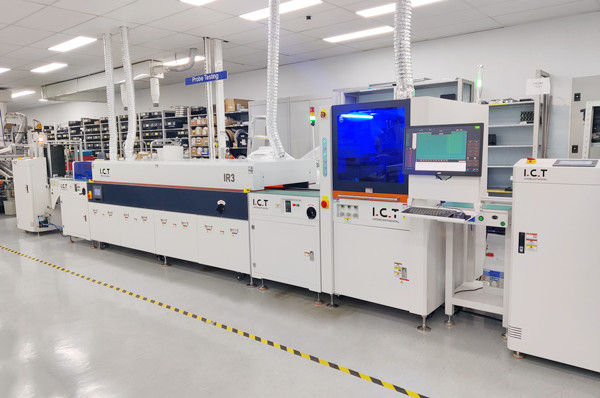
Inline reflow ovens are designed to operate as part of a fully integrated SMT production line.
They offer:
Continuous processing with stable throughput
Consistent thermal profiles across large production volumes
Seamless integration with upstream and downstream equipment
For manufacturers running medium to high-volume production, inline systems provide the stability and efficiency required to maintain consistent output.
However, they require a well-structured production flow and are less flexible for frequent product changes.
Batch reflow ovens process one batch at a time, making them suitable for:
Prototyping and product development
Small-batch or high-mix production
R&D environments where frequent adjustments are needed
They offer flexibility and lower initial investment, but cannot match the throughput and consistency of inline systems.
In production environments where output stability is critical, relying on batch systems may lead to inefficiencies and variation.
Choosing between inline and batch is not about which is better — it is about which fits your production model.
If your priority is high volume, stability, and repeatability → Inline is the right choice
If your priority is flexibility, testing, or low-volume production → Batch may be sufficient
One common mistake is starting with a batch system and later struggling to scale production. Transitioning to inline systems at that stage often requires additional investment and process adjustments.
The type of reflow oven you choose will directly affect your ability to scale production, maintain consistency, and control costs over time.
Making the right choice early helps avoid bottlenecks and ensures that your SMT line can grow with your business.
Once the appropriate configuration is selected, the next step is to understand how evolving process requirements — such as lead-free soldering — further influence reflow oven performance and selection.
To explore the pros and cons of inline and batch systems in more detail, check out our in-depth comparison of inline vs batch reflow ovens.
Lead-free soldering introduces higher temperatures and narrower process windows.
This requires more precise thermal control and stable profiling to avoid defects such as poor wetting or component damage. For manufacturers evaluating these requirements in more detail, our lead-free reflow oven selection guide can help explain what to look for in actual SMT production.
Manufacturers transitioning from leaded processes often underestimate these requirements, leading to instability during production ramp-up. As more industries move toward lead-free production, reflow soldering has become significantly more demanding — not just in terms of temperature, but in overall process control.
Lead-free soldering operates at higher temperatures and within narrower process windows. This means there is less tolerance for variation. Even small inconsistencies in thermal profiling can result in defects such as poor wetting, voids, or component stress.
Compared to traditional leaded soldering, lead-free materials require:
Higher peak temperatures
More precise control during soaking and reflow stages
Better thermal uniformity across the entire PCB
Without sufficient control, the process becomes unstable. What might have been acceptable variation in leaded processes can quickly turn into defects in lead-free production.
Manufacturers upgrading from leaded to lead-free processes often face unexpected issues during ramp-up:
Increased defect rates due to unstable profiles
Component damage caused by excessive thermal stress
Inconsistent solder joint quality between batches
These problems are not always caused by operator error — they are often the result of equipment that cannot maintain the required level of precision.
Lead-free production places much higher demands on reflow ovens.
To maintain stable results, the oven must provide:
Accurate and repeatable temperature profiling
Efficient and uniform heat transfer
Reliable cooling control to protect solder joint integrity
If the reflow oven cannot meet these requirements, process adjustments alone will not solve the problem.
Lead-free production is not just a short-term upgrade — it is a long-term standard.
Selecting a reflow oven that is fully capable of handling lead-free processes ensures that your production line remains stable, scalable, and ready for future product requirements.
With these process challenges in mind, it becomes clear that equipment selection is not just about meeting current needs — but also about preventing defects and ensuring consistent quality, which directly connects to the cost, efficiency, and return on investment of your SMT line.
Even when printing and placement are under control, defects can still appear during reflow.
In many cases, recurring issues are not simply process mistakes. They are often a sign that the reflow oven cannot maintain stable and repeatable thermal conditions.
Common defects include:
Tombstoning caused by uneven heating across the PCB
Solder bridging caused by excessive or poorly controlled temperatures
Voids caused by improper thermal profiling
When these problems appear repeatedly, the focus should not be only on process adjustment. It is also necessary to evaluate whether the reflow oven can provide uniform heat distribution, accurate profiling, and controlled cooling.
A well-matched reflow oven helps reduce these defects at the source, improving both product quality and production stability. or more detailed insights into how equipment selection plays a role in preventing common reflow soldering defects, refer to our guide on common reflow soldering defects and how equipment selection helps.
To explore how reflow soldering challenges in power electronics affect your production and how to address them, refer to our comprehensive guide on reflow soldering challenges in power electronics PCBA.
And once defect reduction becomes measurable, the next question is clear: how much value does that stability create in terms of cost savings and return on investment?
The cost of a reflow oven is not just the purchase price — it is the total impact it has on your production over time.
Lower-cost equipment often comes with hidden costs that are not immediately visible, such as higher defect rates, increased rework and scrap, and greater reliance on manual adjustments — but long‑term operational expenses like energy consumption and ongoing cost efficiency also play a crucial role, which you can explore in more detail in Reflow Oven Cost & Energy Consumption Considerations to better understand how energy usage and lifecycle costs affect your ROI.
Higher defect rates
Increased rework and scrap
More unplanned downtime
Greater reliance on manual adjustments
These issues may seem manageable at first, but they accumulate quickly in daily production.
Even a small drop in first-pass yield — for example, 0.5% — can translate into significant annual losses, especially in medium to high-volume manufacturing.
By contrast, a stable and well-matched reflow oven improves consistency, reduces process variation, and minimizes hidden costs.
Over time, this leads to:
Higher effective output
Lower operating costs
Faster and more predictable return on investment
In other words, the real question is not “How much does the machine cost?”
—but “How much does instability cost your production every year?”
After understanding the impact of reflow performance on cost and stability, the next question is why so many production issues still occur in practice.
In most cases, the problem is not the equipment itself — but how it was selected.
Common mistakes include:
Choosing based only on price
→ often leads to higher long-term costs due to instability and defects
Ignoring actual process requirements
→ results in mismatched performance and ongoing adjustments
Overlooking future production expansion
→ creates bottlenecks as demand increases
Underestimating supplier support
→ leads to slow problem-solving and extended downtime
These decisions may seem reasonable at the time, but they often become the root cause of recurring production issues.
In reality, many factories do not suffer from a lack of equipment — they suffer from equipment that does not match their production needs.
By this stage, it should be clear that selecting a reflow oven is not just about the machine itself — it is about ensuring long-term production stability.
This is why choosing the right supplier is just as important as choosing the right equipment.
A reliable supplier should provide:
Proven experience across multiple industries
→ ensuring they understand different application requirements
Global technical support capability
→ reducing downtime and ensuring fast problem resolution
Full SMT line integration expertise
→ avoiding mismatches between equipment and process
Strong process knowledge, not just hardware
→ helping you achieve stable and repeatable results
Working with the right partner means fewer risks during setup, smoother production ramp-up, and more predictable long-term performance.
Before making a final decision, take a moment to evaluate your actual requirements:
What is your PCB size and complexity?
What is your current and future production volume?
Do you require nitrogen reflow for your products?
What level of reliability is required?
Will your production scale increase in the near future?
If any of these questions are unclear, it usually indicates that the solution has not yet been fully defined.
Choosing a reflow oven is not just a technical decision — it is a long-term investment that directly affects your product quality, production stability, and overall profitability.
At this point, the key question is no longer:
“What specifications should I choose?”
—but:
“What solution best fits my production?”
At I.C.T, as a reflow oven manufacturer, we evaluate real production conditions and recommend solutions that match both current needs and future growth.
✔ Customized recommendations based on your PCB and production requirements
✔ Clear comparison of configurations with practical ROI insights
✔ Support from experienced SMT engineers with global project experience
Get Your Reflow Oven Recommendation Now!!!
How many heating zones do I really need for my SMT production?
Is nitrogen reflow worth the extra cost for my application?
How much can poor reflow oven selection reduce first-pass yield?
Should I buy a new reflow oven or upgrade my existing one?
What after-sales support should I expect from a reflow oven supplier?