English
Views: 0 Author: Site Editor Publish Time: 2025-12-24 Origin: Site
Most BGA void problems are not found where they are created.
They are found much later — after products have been shipped, stressed, and returned with no obvious explanation.
Factories often say they are “inspecting” voids. What they really mean is that they are recording the evidence after the fact. The void is already there. The process that created it has already moved on.
To understand why voids keep coming back, engineers must look past the inspection result and examine the mechanism behind it. This requires understanding not only what the X-ray image shows, but how X-ray Inspection works in electronics and how its data can be used as feedback rather than judgment.
When X-ray inspection is treated as a feedback tool instead of a pass/fail gate, it becomes possible to trace void formation back to its source and stop the same defect from appearing again.

BGA voids are dangerous precisely because they behave politely at first.
They do not short circuits, they do not break signals, and they do not announce themselves during functional testing.
The board powers on. The numbers look normal. Everyone moves on.
What the void does instead is wait.
It sits inside the solder joint, reducing contact area and concentrating stress, while the product enters real life—heat, load, vibration, and time.
By the time the joint begins to fail, the process that created it is long gone, and the evidence is buried.
This delay is not an accident of physics.
It is the reason voids escape factories and return as reliability problems.
A void does not weaken a solder joint evenly.
It creates an imbalance—thermal, mechanical, and eventually structural.
Heat struggles to escape through a joint with internal cavities.
Stress accumulates at the edges of the void instead of spreading naturally through the solder.
Under thermal cycling, those stress points become crack origins.
The failure is rarely dramatic.
It appears as intermittent behavior, temperature-sensitive faults, or early-life fatigue that defies simple explanation.
This is why void-related failures are often misdiagnosed as component quality issues rather than process problems.
A void does not weaken a solder joint evenly.
It creates an imbalance—thermal, mechanical, and eventually structural.
Heat struggles to escape through a joint with internal cavities.
Stress accumulates at the edges of the void instead of spreading naturally through the solder.
Under thermal cycling, those stress points become crack origins.
The failure is rarely dramatic.
It appears as intermittent behavior, temperature-sensitive faults, or early-life fatigue that defies simple explanation.
This is why void-related failures are often misdiagnosed as component quality issues rather than process problems.
Electrical testing can only confirm that a circuit is connected, not whether the solder joint will survive long-term stress.
AOI faces a more fundamental limitation: it simply cannot see inside bottom-terminated packages.
This is why many critical BGA-related defects remain invisible to optical inspection alone, as clearly explained in X-ray vs AOI: which defects are invisible to optical inspection.
As a result, void-related failures are often misdiagnosed as component quality issues rather than process-related problems.

Most discussions about voids begin and end with a percentage.
This is convenient, measurable, and often misleading.
Two solder joints can share the same void percentage and behave completely differently in the field.
A void centered beneath the ball interferes with heat flow far more than several smaller voids near the edges.
Distribution tells a story that numbers alone cannot.
X-ray does not just measure quantity.
It reveals structure—and structure determines behavior.
A single large void acts like a flaw in glass.
Stress does not spread around it; it gathers.
Multiple small voids, evenly distributed, may reduce solder volume but still allow load sharing.
The difference is not theoretical—it shows up in fatigue life and thermal resistance.
Without X-ray, these two conditions look identical to downstream tests.
With X-ray, the difference is obvious—and actionable.
A single X-ray image is a photograph.
A series of images is a timeline.
When void behavior repeats across panels, it points to a stable—but flawed—process condition.
When it drifts gradually over time, it signals wear, contamination, or parameter creep.
Trend consistency is where X-ray stops being inspection and starts being surveillance.
It tells engineers not just what happened, but whether it is getting worse.

Standards define the minimum line between acceptable and unacceptable.
They do not define excellence, stability, or margin.
A process that lives just below the limit is not healthy—it is fragile.
Yet many factories treat passing IPC criteria as proof that nothing needs attention.
X-ray reveals how close a process is to that edge.
Ignoring that information is a choice, not a limitation.
Pass or fail is simple.
Reality is not.
Processes drift quietly.
Paste ages. Stencils wear. Profiles shift.
None of these cause instant failure, but all of them leave fingerprints inside the solder joint.
Binary judgments erase those fingerprints.
Trend analysis preserves them.
Used properly, X-ray answers a single, powerful question:
What did the process actually produce?
When parameters change, X-ray confirms whether the change mattered.
When materials change, it shows the consequence, not the intention.
This feedback loop replaces argument with evidence.
It turns process control from belief into observation.

Void formation often begins before the component ever touches the board.
Inconsistent paste volume means inconsistent flux availability.
Poor release traps residues where gases should escape.
X-ray does not diagnose printing directly, but it exposes its outcome.
When void patterns repeat, printing is often speaking through the solder joint.
Placement determines how solder is allowed to move.
Too much force restricts flow. Too little allows imbalance.
Component coplanarity decides whether collapse is uniform or chaotic.
These effects are subtle, invisible during placement, and undeniable under X-ray.
The joint remembers what placement forgot.
Reflow does not create voids so much as it reveals whether earlier stages prepared the joint correctly.
Insufficient preheat leaves flux inactive.
Aggressive ramps trap gases before escape is possible.
X-ray feedback separates necessary adjustments from superstition.
If the void does not change, the cause lies elsewhere.
Before a process can be improved, it must first be understood.
Many factories skip this step and move directly to adjustment, hoping the next change will be the right one.
A void baseline is not a target. It is a description of reality.
It records what the process produces when it is running normally, with its strengths and its flaws intact.
This baseline must include variation—good boards, average boards, and marginal ones—because reliability problems do not originate from averages.
Without a baseline, engineers have no reference point.
Every fluctuation feels urgent, every deviation feels suspicious.
With a baseline, change becomes measurable, and improvement becomes deliberate instead of emotional.
One X-ray image answers only one question: what happened to this board?
Production, however, is not made of single boards.
Voids become meaningful when they repeat, drift, or cluster over time.
A slow upward trend often signals stencil wear, paste aging, or thermal imbalance long before failures appear.
These early warnings are invisible if engineers look only at isolated results.
Trend monitoring shifts attention from blame to behavior.
It tells engineers whether the process is stable, deteriorating, or responding to intervention.
This is the moment when X-ray stops being inspection and starts becoming foresight.
Every process change is a claim: this will make things better.
X-ray is how that claim is tested.
Without verification, adjustments accumulate and interact in unpredictable ways.
Engineers lose confidence because they cannot tell which change mattered and which did nothing.
X-ray feedback restores clarity by tying cause to consequence.
When void behavior does not change after an adjustment, the message is simple: the root cause lies elsewhere.
This honesty saves time, prevents overcorrection, and protects process stability.
Evidence replaces argument, and progress becomes repeatable.

Averages are comfortable because they simplify complexity.
They are also dangerous for the same reason.
An acceptable average can hide extreme cases where reliability begins to fail.
A few joints with critical void structures can exist quietly beneath a reassuring number.
This is how processes pass audits and still fail customers.
X-ray images reveal distribution, not just magnitude.
Ignoring that information is not a technical limitation—it is a choice.
And it is rarely a wise one.
When X-ray is used only after a problem appears, it becomes a historical record.
It explains what went wrong, but too late to prevent it.
By the time a failure triggers inspection, materials may have changed, equipment may have drifted, and conditions may no longer match.
Root cause analysis turns speculative instead of precise.
Preventive inspection, even at low frequency, changes this dynamic.
It allows engineers to recognize patterns before they become incidents.
The difference is not in the machine, but in when it is used.
Data should clarify processes, not assign guilt.
When X-ray results are used to point fingers, learning stops.
Operators adjust behavior to avoid scrutiny rather than improve outcomes.
Engineers become cautious instead of curious.
The process becomes rigid, not better.
Void reduction requires openness.
X-ray must be seen as neutral evidence—what the process produced, not who failed.
Only then can improvement be sustained.

In high-power assemblies, solder joints are part of the thermal system.
Voids interrupt heat flow just as surely as poor heatsinks do.
Without X-ray feedback, these interruptions remain invisible until performance degrades.
At that point, corrective action is no longer preventative—it is damage control.
For thermal-critical designs, guessing is not acceptable.
X-ray feedback provides the visibility required to control what cannot be seen from the surface.
In these cases, inspection is not optional—it is foundational.
Time is unforgiving in long-life products.
Small imperfections grow under repetition, heat, and vibration.
Industries that demand reliability understand this.
They require evidence not just of compliance, but of control.
X-ray feedback supplies that evidence by showing internal joint behavior over time.
This is why these sectors do not ask whether X-ray is needed.
They ask how it is used.
The distinction matters.
As boards become thicker and more complex, thermal behavior becomes less intuitive.
Heat no longer flows evenly. Gas escape becomes unpredictable.
What engineers intend during reflow is often not what actually happens beneath the package.
X-ray reveals this gap between intention and outcome.
In complex boards, visibility is not a luxury.
It is the only way to replace assumption with understanding.

When X-ray data enters SPC, voids stop being surprises.
They become trends, limits, and signals.
Control charts turn inspection into monitoring.
Engineers no longer wait for defects to appear—they watch behavior develop.
This is the difference between reacting to failure and managing a process.
SPC does not make decisions.
It makes decisions unavoidable.
X-ray alone shows outcomes, not causes.
Connection creates meaning.
When void trends are compared with printing data, patterns emerge.
When they are linked to reflow profiles, explanations become clearer.
Correlation narrows the search space and accelerates correction.
Isolated data confuses.
Connected data teaches.
The pursuit of zero voids often destabilizes production.
Each small adjustment introduces new uncertainty.
A stable process with predictable void behavior is far more valuable than an unstable one chasing perfection.
X-ray feedback helps define that stability window and keep the process inside it.
Reliability is not achieved by eliminating every imperfection.
It is achieved by controlling the ones that matter, consistently, over time.
X-ray reveals voids but does not fix them—only systematic feedback closes the formation paths.
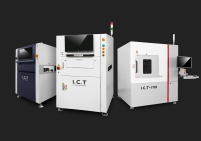
Shift from pass/fail to trend-based control; correlate voids to printing, placement, and reflow; use capable tools like the I.C.T-7900 for fast, accurate data.
Target consistent low voiding as proof of process mastery, especially in high-reliability applications.
IPC standards treat >25% voiding in any single ball as a defect for Class 3 products, but this is a minimum baseline. Background: The limit derives from reliability studies showing increased risk above that level for thermal and mechanical stress. In practice, capable processes achieve <15% average with no ball exceeding 20%. Application example: In automotive power modules, engineers often tighten to <10% on thermal balls to ensure heat spreading, verified through accelerated life testing that correlates lower voids with longer cycles to failure.
No—some voiding is inherent due to flux outgassing and material physics. Background: Even optimized low-void pastes and vacuum reflow leave trace levels. Principle: Voids form when volatiles escape molten solder; perfect elimination would require flux-free soldering, which is impractical. Example: Leading lines using nitrogen, extended soak, and low-void paste routinely reach <5% average but never zero; the goal is predictable, low-impact voiding rather than absence.
Daily or per-shift sampling during stable production; 100% on new lots or after changes. Background: Statistical process control requires enough samples to detect shifts early. Principle: Trend monitoring catches drifts faster than end-of-line checks. Example: High-volume lines inspect first-piece and every 50-100 boards, plus full lots after profile or material changes, feeding data back within hours to prevent scrap.
No—printing and material choices often yield bigger gains. Background: Void sources span the entire process chain. Principle: Extended soak helps outgassing, but insufficient paste volume or poor release traps more gas initially. Example: One facility cut voids from 22% to 8% by optimizing stencil apertures and paste selection alone; further reduction to <5% needed only minor soak extension, proving upstream fixes are frequently more effective.
Inline handles high-volume pass/fail and basic measurements; offline provides deeper diagnostics. Background: Speed versus resolution trade-offs exist. Principle: Inline systems integrate into lines for real-time data but lack the tilt/oblique views and higher magnification of offline units needed for root-cause pattern recognition. Example: Production uses inline for trend monitoring and alerts; engineering pulls samples to offline stations like the I.C.T-7900 for detailed void mapping and correlation studies.